
This advertising content was produced in collaboration with our sponsor, Piccini.
“Our story begins in 1861, the year of Italy’s unification, in the shadow of the Collegiate Church of Poggibonsi [a small village in the heart of Tuscany],” says Mario Piccini, the fourth-generation CEO of Piccini, who now runs the family winery with the support of his sisters, Martina and Elisa. “That same year, Angiolo Piccini was born—the man who would ignite an adventure spanning five generations.”
Angiolo Piccini, like Italy, was throwing off the past, and looking ahead to a more dynamic and rewarding future. The heir of a family of merchants, Angiolo could have had a steady and lucrative career in fabrics, but he realized his passion was in wine, and at age 21, he made the bold choice to change the path of the Piccini family.
In 1882, he purchased 17 acres of vines in Poggibonsi and embarked on a new adventure in the heart of Tuscany. That initial parcel of land was relatively small, but his vision was enormous. Angiolo’s first plantings in the shadow of Tuscany’s rolling hills has grown considerably, with each successive generation honoring his legacy, and building on the solid foundation he laid for them.

Don’t miss the latest drinks industry news and insights. Sign up for our award-winning newsletters and get insider intel, resources, and trends delivered to your inbox every week.
Today, the Piccini family operates a powerful, international brand that helped put Chianti on the map through its distribution in more than 90 countries around the world.
Sparking a Legacy of Astute Passion
By combining his family’s talent for business, and his personal passion for wine, Angiolo landed on a recipe for success that every single family member who followed in his footsteps not only inherited, but has successfully deployed.
“When Angiolo passed the reins to his son Mario in 1925, he left them not only with a company, but a guiding principle,” says Mario Piccini, explaining what Angiolo told them, “‘It’s not how much you do that matters, but how much passion you put into what you do.’”
The decades that followed weren’t always easy, and the family often returned to the founder’s advice amid economic and political turmoil, says Mario Piccini.
“Mario, bold and determined, led Piccini through the storms of the Great Depression and the Second World War, even when bombs reduced the winery to rubble in 1943,” says Mario Piccini of his grandfather’s era.
Instead of “just” rebuilding, the second-generation Mario helped found a consortium dedicated to reviving the wine trade in the traumatized and economically devastated country. Dubbed Chianti Preferito, the consortium not only helped bring Chianti to distant shores, it became a symbol of rebirth and hope.
A Classic Is Born
Every generation has contributed mightily to the Piccini story.
In 1963, Mario’s son Pierangiolo took the helm and initiated a grand era of expansion that echoed Italy’s own transition, and indeed much of the developed world’s, from a time of deprivation and war to a time of relative peace and prosperity.
Pierangiolo moved the winery to Castellina in Chianti, and expanded its vineyards in the heart of the Gallo Nero. Without Pierangiolo, Piccini wouldn’t have the rich array of vineyard sources, or the global presence, that it does today.
But it was Pierangiolo’s son Mario Piccini, the winery’s current leader, who brought the family business into the 21st century.
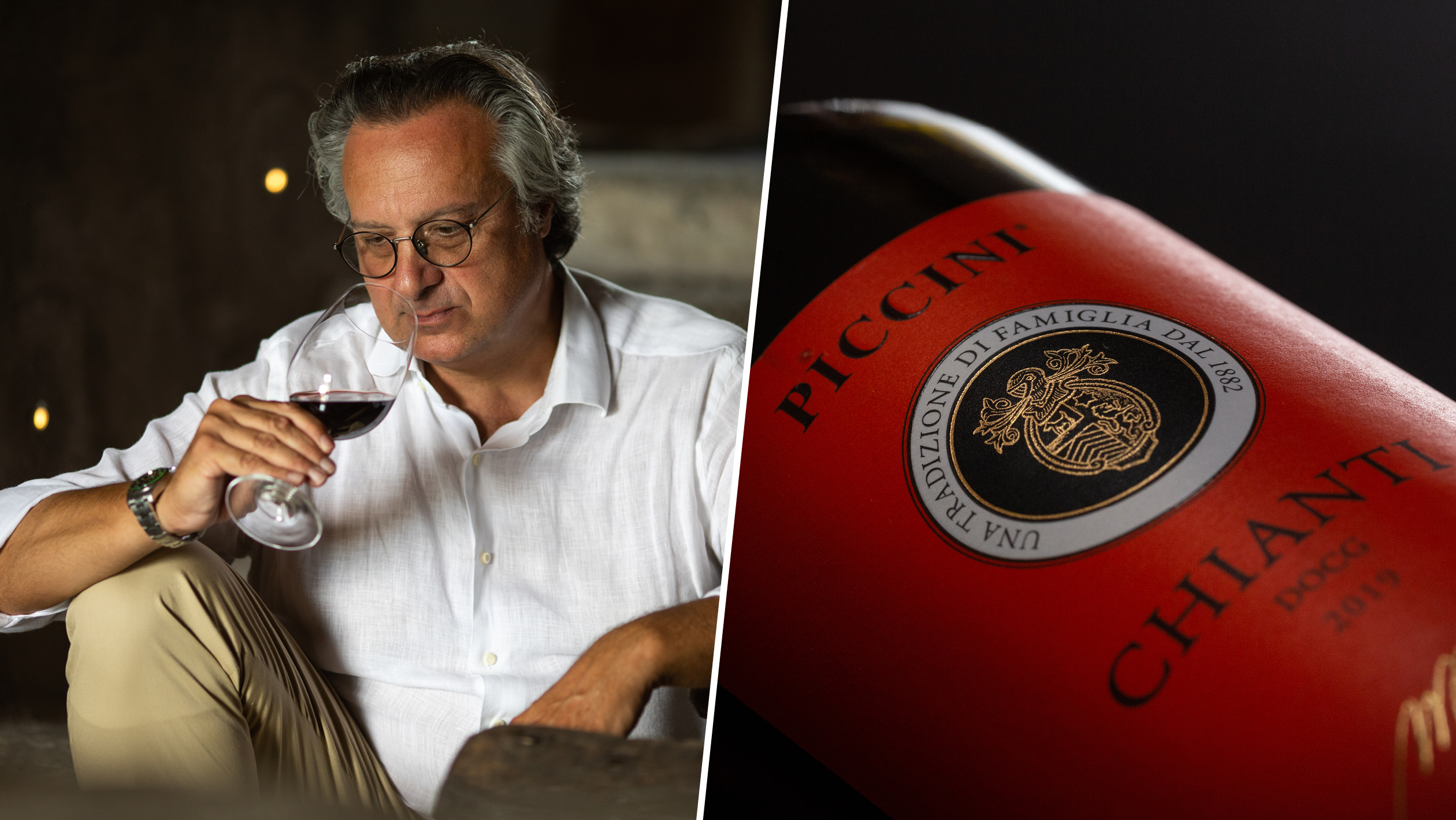
In 2000, Mario Piccini created one of the most instantly recognizable and unforgettable labels in the business with Chianti Arancio. “The choice of its bright orange label was born from a family debate, and a compromise between tradition and innovation,” says Mario Piccini. “It soon became a symbol of the company’s vibrant, contemporary spirit. Over time, orange became the very color of Piccini itself: bold, dynamic, and forward-looking.”
Chianti Arancio, or Chianti Orange in English, has become the flagship wine of the family, and it has come to symbolize not only the family’s spirit, boldness, and courage, but Italy’s turn toward modernity. The streamlined, bright-orange, simple, and ultra-contemporary label was one of the first modern labels to emerge from Chianti.
Acquisitions Beyond Chianti
Although Mario Piccini created the now-iconic orange label, he didn’t officially assume leadership of the winery until 2004. Taking cues from his predecessors, he also expanded Piccini’s holdings and in the process, he has opted to explore terroirs well outside of Chianti.
In his searches for the next great vineyards for the family to share on the global stage, Mario Piccini discovered auspicious sites in Basilicata’s Regio Cantina and Sicily’s Torre Mora on Mount Etna.
In 2018, looking both to the past and the future as only the Piccinis can, the family purchased the historic Agricoltori del Chianti Geografico. Founded as a cooperative winery in Gaiole-in-Chianti in 1961, it still produces wines grown by 80 grape growers. “We wanted to preserve its legacy, while infusing it with innovation,” explains Mario Piccini.
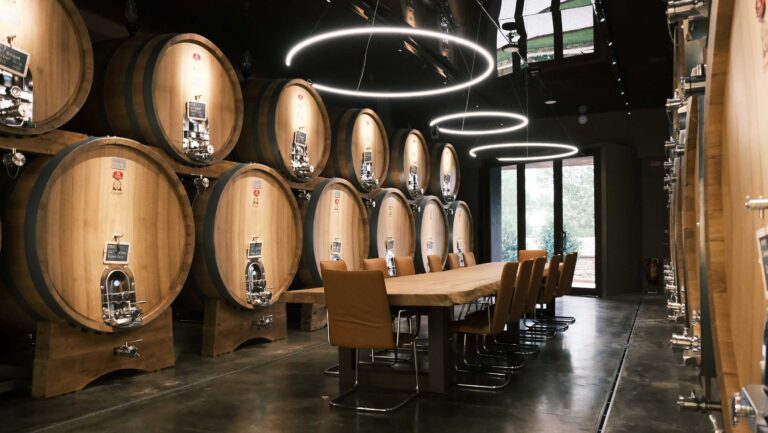
That same strategic instinct guided the opening of a 17,000 square-meter production facility in Casole d’Elsa, which couldn’t have come at a better time for everyone: 2020.
Mario Piccini says that it helped the company “overcome the challenges of the pandemic without sacrificing jobs,” while still maintaining their increasingly stringent values of social and environmental responsibility.
The Next Generation’s Vision
The next stage of the Piccini evolution will be defined by the fifth generation, who joined the family business in 2017. Ginevra, Benedetta, and Michelangelo have joined their father Mario Piccini, and plan to reinforce the legacy of entrepreneurism and innovation, coupled with a love of tradition.
For them, and indeed many younger generations, this involves a turn towards more sustainable environmental practices, from the vine to the bottle. Several of their production facilities and estates are certified organic, including Castellina, Casole d’Elsa, Gaiole, Casa all Terra, Castelnuovo Berardenga, Regio Cantina, and Torre Mora. Tenute Piccini also introduced a PET bottle, and a lower-alcohol DOCG wine dubbed Chianti Slim.
But because this is the Piccinis, the dawning of the next era also involves growth: in 2022, in honor of the family’s 140th anniversary, the Piccini family acquired Cantina Porta Rossa in Piedmont’s Langhe region, and land in the Veneto, where they launched a Prosecco.
“Today, Piccini offers a journey through Italy in every glass,” says Mario Piccini. “From Veneto’s sparkling bubbles, to Sicily’s volcanic reds, and Tuscany’s timeless treasures, what unites all Piccini wines is their vibrant, contemporary style.”
And of course, the spirit of a family that has dedicated itself to sharing the joy, complexity, and panache of Italian wine with the rest of the world.


Dispatch
Sign up for our award-winning newsletter
Don’t miss the latest drinks industry news and insights—delivered to your inbox every week.