This article was originally published in March 2025 and has been updated.
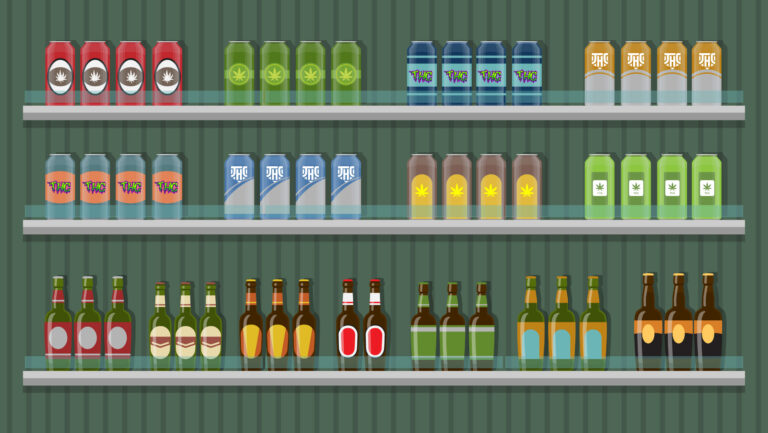
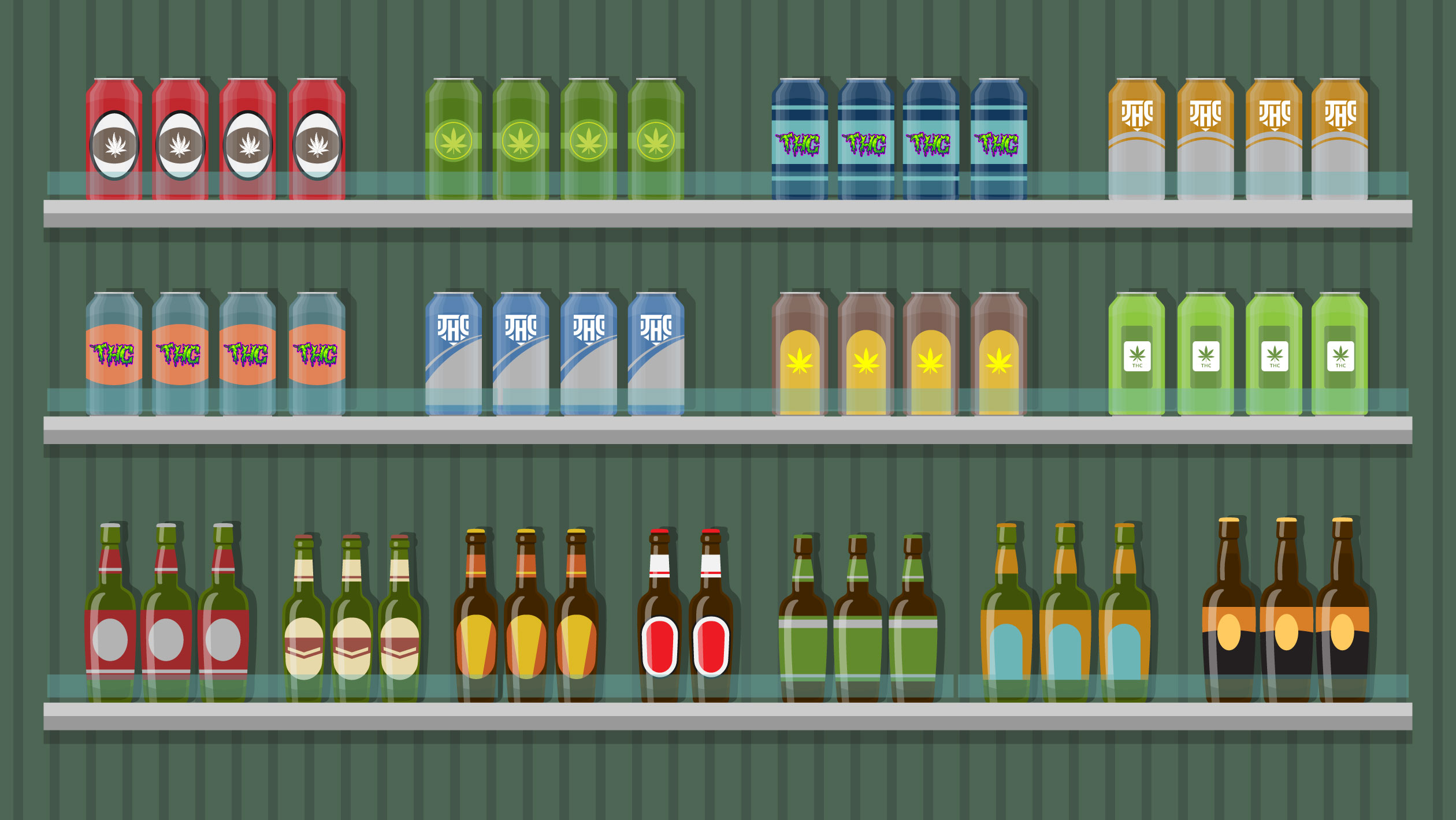
Art Nergaryan’s specialty wine and cheese shops in Massachusetts had thrived for years. But when he introduced hemp-derived THC-infused beverages, something unexpected happened: his business boomed.
“I turned half of the store into THC products,” says Nergaryan, whose Art’s Specialties has four locations across the state. “My business jumped by 25 to 35 percent.” His customers, delighted by the convenience, started buying THC-infused drinks alongside their usual purchases. “Those customers started coming in more frequently, not just for the beverages, but for everything else, too.”
Nergaryan’s success seemed like a harbinger. “Once liquor stores opened for business, everything exploded,” says Adam Terry, the cofounder and CEO of Cantrip, a Massachusetts-based manufacturer of THC drinks. Indeed, the THC-infused beverage market saw retail sales rise 135 percent in the 52 weeks prior to April 20, 2026, according to NIQ, reaching $239 million. Cannabis data research firm Whitney Economics conservatively values the total potential market for THC beverages to sit between $9.9 billion and $14.9 billion. Emboldened by states like Minnesota, which in 2022 enacted legislation that created a “quasi-legal” market for hemp beverages and in 2023 brought more regulatory certainty to the category, retailers increasingly sold THC-infused drinks and other edible products to consumers.
Don’t miss the latest drinks industry news and insights. Sign up for our award-winning newsletters and get insider intel, resources, and trends delivered to your inbox every week.
But, for Massachusetts retailers like Nergaryan, the success vanished almost overnight. In a regulatory whiplash, state regulators issued new guidance in May 2024 that banned the sale of any cannabis-infused beverages in wine and liquor stores. “If you see my numbers, they dropped when the bulletin was published,” says Nergaryan. “The distributors came and picked up the products. They said, ‘We’re not allowed to sell anymore.’”
His store’s once-thriving business was suddenly struggling, all because of a regulatory shift, over which he had no control. He isn’t alone—last year, legislation passed by Congress to end a federal government shutdown included a provision that would limit THC to 0.4 milligrams per container, which effectively amounts to a ban on hemp-derived, THC-infused drinks. That limit is set to take effect on November 12, 2026, with an enforcement deadline of December 11, 2026.
Now, many U.S. beverage industry members—retailers, distributors, and manufacturers alike—are trying to navigate this fast-changing and tangled web of regulations that dictate whether and how they can sell hemp-derived THC-infused beverages, and which of these beverages are even legal to sell. But with growing demand for the category in an otherwise down market, industry members are anxious for answers.
A New Legal Definition for Hemp Begins the Confusion
The 2018 Farm Bill removed “hemp” from the definition of marijuana under the Controlled Substances Act, effectively legalizing hemp at the federal level and establishing it as an agricultural crop.
Under federal law, hemp is defined as a variety or cultivar of Cannabis sativa containing less than 0.3 percent delta-9 THC by dry weight. One of more than 100 identified cannabinoids (a group of chemical compounds found primarily in cannabis plants) THC is known for its psychoactive effect—the high.
Though it federally legalized hemp as an agricultural product, the 2018 Farm Bill did not directly legalize food and beverage products made with hemp-derived cannabinoids. But the expansive legislative language in the U.S. Code—the definition also includes “all derivatives, extracts, cannabinoids” and other compounds of hemp—was generously interpreted by many, and a new industry erupted. As experts observed at the time, however, a backdrop of existing federal and state laws heavily restricted how newly legalized hemp could be commodified.
The U.S. Food & Drug Administration (FDA) was quick to step in. Concerned about the burgeoning market for consumer products made with hemp-derived THC and CBD (or cannabidiol, another cannabinoid), the FDA announced in December 2018 that foods in interstate commerce containing hemp-derived cannabinoids were still unlawful under the Federal Food, Drug, and Cosmetic Act.
Despite this, regulation at the state level soon took on a life of its own. With the industry swiftly and exponentially growing, states decided their own rules and enforcement priorities, leading to a wildly inconsistent market. Some states embraced hemp beverages, like Minnesota and, more recently, Georgia and Tennessee; others were more hands-off; and some restricted or outright banned them outside the cannabis-licensed system, like California, Washington, and Vermont. Yet, according to the FDA, the interstate market for THC-infused beverages is still illegal under federal laws—making nationwide distribution of any brand who wants to comply with federal law very challenging or nearly impossible. Many brands have assumed the risk of noncompliance, however, operating in what remains a legal gray area.
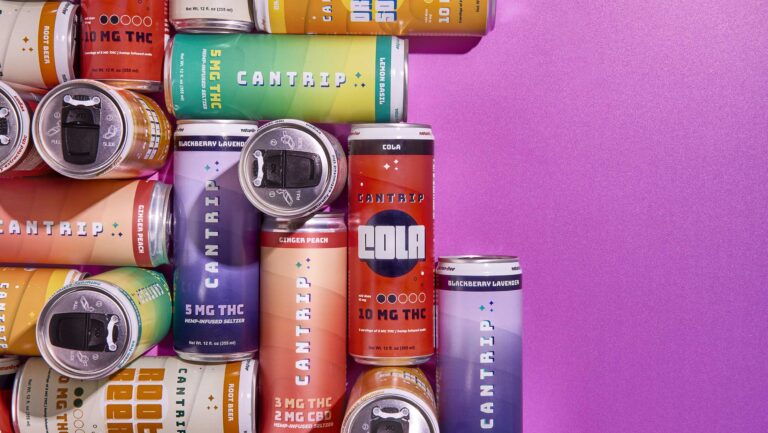
The uncertainty surrounding hemp beverages has been one of the biggest challenges to industry legitimacy and growth, according to Diana Eberlein, the chair of the Coalition for Adult Beverage Alternatives. Composed of members across the hemp beverage supply chain, the Coalition aims to educate and influence federal lawmakers and regulators to craft clear and consistent policies for the industry. “States are trying to regulate them, but without federal guidance, it’s a constant back and forth,” she says. “We need a clear and consistent path forward.”
A Dizzying Regulatory Landscape Emerges
State laws are actively being devised for the lawful sale of these drinks, but the regulatory landscape varies significantly. “Right now, it’s a patchwork,” says Eberlein.
Soon after the 2018 Farm Bill legalized hemp, products containing other forms of hemp-derived THC (known as isomers) emerged, particularly delta-8 THC and delta-10 THC. The definition of “hemp” under federal law limited the content of only delta-9 THC, therefore these other isomers arguably fell outside that restriction but could still be intoxicating to consumers. As these products proliferated, FDA issued warning letters to manufacturers and distributors of consumable products made with delta-8 and delta-10 THC that action would be taken against them.
To make matters murkier, the Drug Enforcement Administration in September 2021 issued a letter to a state pharmacy board clarifying that delta-8 THC, if derived from hemp and containing no more than 0.3 percent of delta-9 THC on a dry-weight basis, is not a controlled substance under the Controlled Substances Act. The November 2025 legislation passed by Congress closes the loophole created in the 2018 Farm Bill by laying out a stricter definition for hemp. P.L. 119-37 sets a total THC concentration limit of 0.3 percent on a dry weight basis, rather than focusing solely on delta-9 THC.
Against the backdrop originally laid out in 2018, some states have implemented cannabinoid-specific regulations, like Georgia. In 2022, a county district attorney’s office in the state issued a press release stating that consumable products containing hemp-derived delta-8 and delta-10 THC were unlawful and that the office would pursue prosecution of businesses that sold them. Two retailers subsequently sued the State of Georgia and sought, among other things, a declaratory judgment that hemp-derived cannabinoids are lawful hemp products under state law. In March 2023, Georgia’s Supreme Court held that the case had to be dismissed on procedural grounds. In a later, separate criminal case, the Court of Appeals of Georgia held that hemp-derived delta-8 and delta-10 THC were not controlled substances. The following year, Governor Brian Kemp signed the Georgia Hemp Farming Act, which, among other things, established the regulation of consumable hemp products specifically containing delta-9 THC. The status of hemp-derived delta-8 and delta-10 THC was not addressed in the act.
In response to this putative gray area, many states have simply regulated total THC, regardless of the isomer. These include Iowa, New Jersey, and Virginia, among others. In a similar vein, another response has been to legislate how THC may permissibly come into existence. One way to do this is to distinguish between naturally derived THC and synthetically created THC—that is, chemically similar to THC but not derived from a hemp plant. Louisiana and Wyoming, for example, explicitly exclude synthetic substances from the definition of hemp products.
“States are trying to regulate them, but without federal guidance, it’s a constant back and forth. We need a clear and consistent path forward.” — Diana Eberlein, Coalition for Adult Beverage Alternatives
As the regulatory landscape evolves, the path forward has become muddied. Take, for example, dosage. There is no standard of measurement, with the federal definition referring to dry weight only. States are now increasingly opting to limit the total milligram amount of hemp-derived cannabinoids per serving size and container, typically around five milligrams per serving and 10 milligrams per container. Kentucky, for instance, takes this approach, and at the same time, it distinguishes between intoxicating and non-intoxicating cannabinoids, granting licensed businesses more leeway to sell products made with non-intoxicating ingredients. As a backstop, all cannabinoids must be pre-approved before they may be permissibly sold.
Many markets are having trouble finding their regulatory footing in this climate, particularly in Texas. Its Department of Health and Human Services permits the retail sale of consumable hemp products, subject to various requirements and limitations. However, the state legislature is making efforts to stop “retailers [who] are exploiting a legal loophole and selling dangerous products,” including beverages, and Lieutenant Governor Dan Patrick aims to prohibit the sale of all forms of consumable THC. “Texas is at risk of a ban,” Eberlein says. On July 31, Texas banned the sale of products containing hemp-derived delta-8 or delta-10 and made possession of products containing those forms of THC a state felony.
The Ongoing Impact on Beverage Industry Members
With multiple approaches to state regulation, the impact on industry members has been profound. Retailers like Nergaryan have been forced to adjust quickly, either pulling products from shelves or scrambling to meet new compliance requirements. Take Connecticut’s Liquor Control Division action in 2023: the agency notified retailers that selling hemp-derived THC-infused beverages was “now illegal,” but then, just over a year later, retailers were informed that cannabis retail establishments and liquor stores with a waiver could sell these products. Businesses operating in such an unpredictable regulatory environment face uncertainty and challenges unlike their competitors operating under stabler policies.
For Ryan Moses, the CEO of Best Brands Inc. in Tennessee, the shifting legal landscape is frustrating for distributors, too. “While Tennessee continues to be a leader in hemp legislation and regulation, our ability to meet customer demand is hampered by a lack of clear rules on a federal level.” As Nergaryan points out, “I got into THC beverages early, but others were scared to carry them because of the uncertainty.”

While Nergaryan and others in Massachusetts suffered from shifting regulation, Jon Halper, the owner of Top Ten Liquors in Minnesota, had the opposite experience. Minnesota is amongst the states that have taken a permissive stance on hemp beverages, which transformed his business, with THC-infused drinks becoming a key part of his sales strategy. “Over 10 percent of our sales are hemp beverages, and we’re targeting 20 percent in 2025,” says Halper. “If you’re talking about a category that’s growing to be nearly a fifth of our business in just a few years, that’s hugely impactful.”
In the absence of a federal legal framework, state lawmakers in Minnesota established clear and structured regulations that promote controlled sales and product safety. Beverages are subject to clear hemp-derived THC thresholds, both per serving and per container. Sales are restricted to individuals aged 21 and over, and packaging is subject to labeling requirements. Minnesota’s Office of Cannabis Management publishes pamphlets and newsletters to inform industry members and consumers of these rules.
For Halper, hemp beverages are an essential category reinforced by a supportive policy regime. “Thank God in Minnesota many retailers have been able to transition to THC,” he says. “Having these beverages available in liquor stores makes all the difference and helps make up the gap in decline in beer and wine sales.”
The Future of Hemp Beverage Regulation
Producers, distributors, and retailers of hemp-derived THC beverages are, understandably, opposed to the move to outlaw products containing more than 0.3 milligrams of THC, which poses an existential threat. However, many industry members welcome a clear, consistent regulatory framework. Advocacy groups like the Coalition for Adult Beverage Alternatives, the Hemp Beverage Alliance, and the Cannabis Beverage Association argue that a balanced approach—one that ensures consumer safety while enabling fair competition—is the only way forward.
“The growing availability of hemp beverages in the U.S. highlights the urgent need for appropriate oversight regulation to ensure public safety and consumer confidence,” says Representative H. Morgan Griffith, Republican of Virginia. “Protecting the health and well-being of Americans while maintaining the integrity of our regulatory framework is something we cannot afford to overlook.”
Alcohol industry bodies, like the Wine & Spirits Wholesalers of America (WSWA), have also repeatedly called on the government to regulate cannabis to ensure a fair and safe marketplace. “Hemp-derived products must be regulated with the same rigor as other intoxicating substances,” says Dawson Hobbs, the EVP of government relations, adding, “There’s no room for loopholes that allow unsafe, unregulated products to undermine consumer confidence and public safety.”
Now that the federal government has changed the definition of hemp, there’s no going back to the old way of operations—nor would beverage industry members want to. “We don’t want to operate in a loophole. We want a clear path forward,” says Eberlein.
Instead, a proposed bipartisan bill would establish a three-tier distribution system for hemp-derived beverages (similar to that currently used for alcohol), as well as age limits, THC limits, and a federal excise tax. The Beverage Regulatory Parity Act, introduced on August 11 by Representative Greg Landsman, Democrat of Ohio, and Representative Beth Van Duyne, Republican of Texas, is supported by many alcohol industry bodies and businesses, including WSWA, Total Wine & More, Hemp Beverage Alliance, and American Beverage Licensees.
Until a final decision comes down, businesses will suffer from the unpredictable regulatory landscape. They will remain susceptible to the enforcement priorities of state and federal regulators and prosecutors and the financial and operational hardships that arise from sudden regulatory shifts.
As a producer on the frontline of this issue, Terry is optimistic about the long-term future of the industry, however, buoyed by booming consumer demand. “Despite the complications, off-premise retailers are forging ahead.”

Dispatch
Sign up for our award-winning newsletter
Don’t miss the latest drinks industry news and insights—delivered to your inbox every week.
Brian Fink is an attorney at Foster Garvey PC. He represents members of all tiers of the alcoholic beverage and cannabis industries, as well as people and companies who do business with them. The information provided in this article does not, and is not intended to, constitute legal advice.