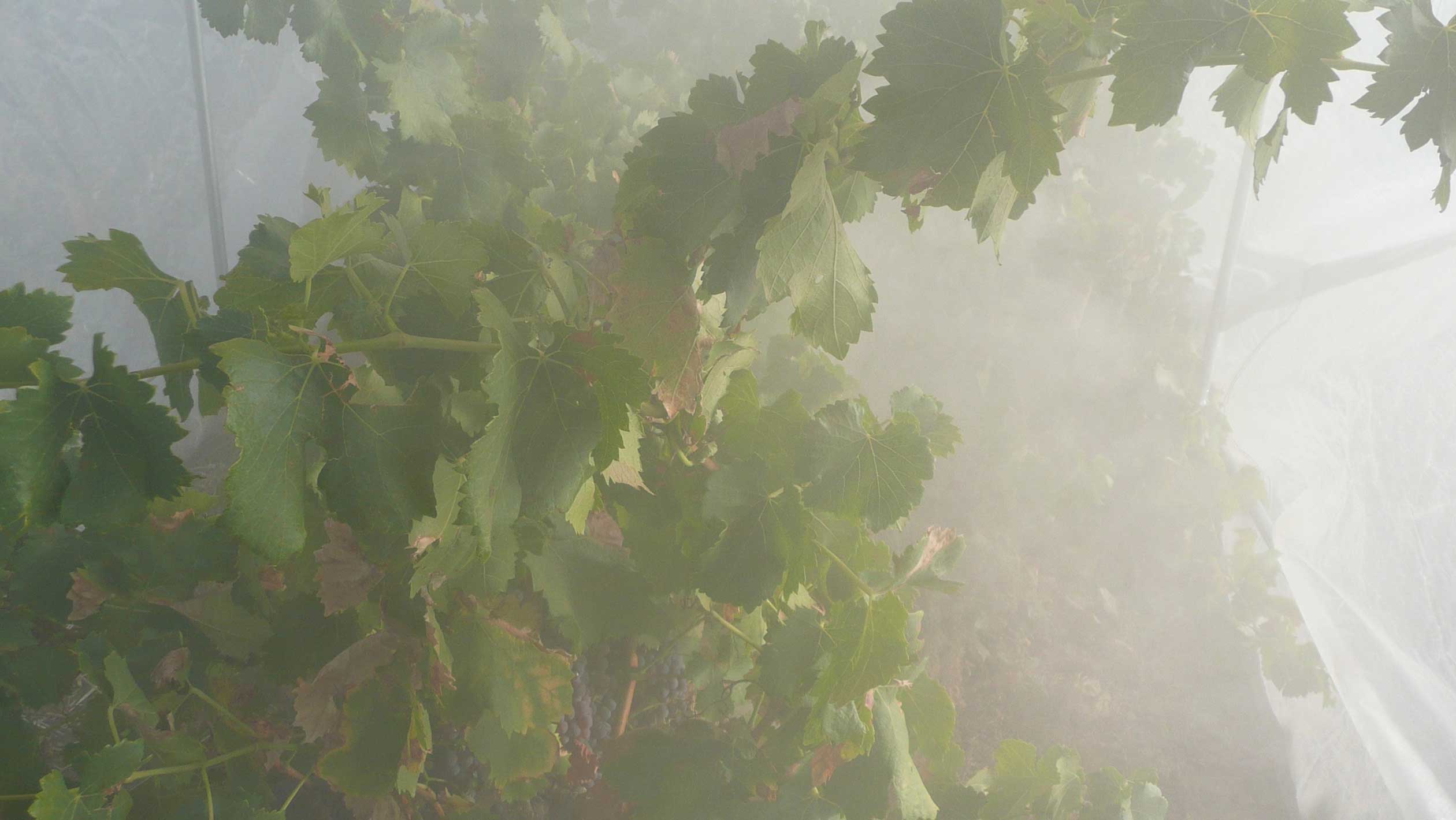
Good stress, bad stress—a familiar concept for quality wine production. A closer look at grapevine stress is helping researchers uncover what happens when a vine is exposed to smoke. Which defenses are launched? What reactions are triggered, and how does this differ according to variety?
These questions are helping move industry response to smoke events from the macro to the micro. Early research identified key chemical compounds associated with smoke taint, and subsequent treatment methods were developed to remove them from the final wine. The challenge, however, was that smoke taint continued to appear unpredictably at any point from fermentation to post-purchase.
With further research, scientists linked the reappearance of smoke taint to protective measures triggered when a vine is under smoke stress.

Don’t miss the latest drinks industry news and insights. Sign up for our award-winning newsletters and get insider intel, resources, and trends delivered to your inbox every week.
How Grapevines Respond to Smoke
When grapevines are exposed to even a small amount of smoke, a series of defense responses are generated. One such response is a biochemical change called glycosylation, which binds together different molecules. This happens when families of enzymes known as glycosyltransferases (GTs) bind sugar molecules to free volatile phenols. These phenols are the primary markers for smoke taint and include syringol, guaiacol, 4-methylguaiacol, and cresol. When the sugar and phenols are bound together, they become compound chemicals known as volatile phenol glycosides (VPGs). In the bound form, they have no sensory effect on wine.
However, certain enzymatic activity may occur that breaks the glycosidic bonds and releases the volatile phenols back into a free, sensorially active form. If this happens, the wine is at risk of developing smoke taint.
Scientists in Australia and the U.S. investigating these protective measures and how they impact the sensory characteristics in the final wine are uncovering a complex, multifaceted response to smoke.
Different Grapes, Different Responses
Studies using Merlot and Pinot Noir show several defensive mechanisms are activated during smoke exposure, including cell wall fortification, redeployment of energy reserves, and enhanced antioxidant capacity. Scientists were also able to expand on knowledge about a particular family of glycosyltransferases enzymes (GTs) known as GT1. They did this by identifying 12 genes from the GT1 family that are specifically responsible for triggering glycosylation, the process whereby sugar molecules are bound to volatile phenol molecules.
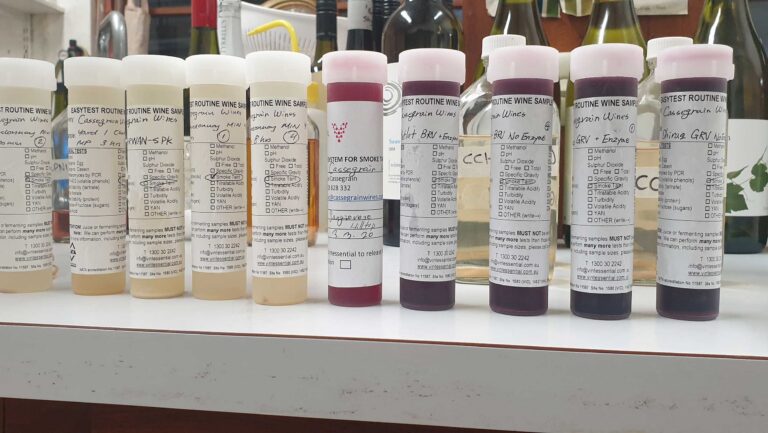
At Adelaide University in Australia, researchers examined genetic triggers and enzymatic activity in different grape varieties under smoke-induced stress. “We wanted to understand,” says Kerry Wilkinson, Ph.D., a professor of enology at Adelaide University, “more about the endogenous enzymes that add sugar molecules to volatile phenols.”
Comparing Chardonnay and Shiraz, the study recorded different gene activation across distinct GT families. Chardonnay showed activation of 15 genes from five GT families, while Shiraz showed activation of only five genes, primarily from two GT families. Jennifer Mortimer, Ph.D., a professor of plant synthetic biology at Adelaide University, suggests there is a wider response to smoke that involves glycosylation beyond the GT1 family of enzymes, pointing to the value of further research on responses across grape varieties.
While commercial decisions will be the primary driver for variety selection, a more comprehensive understanding about how different varieties respond to smoke stress will be useful in prioritizing vineyard activities during a fire event, and in selecting appropriate treatment methods in the winery.
Product development is another beneficiary of this research. In mapping these genetic pathways, there is potential to develop techniques that block the enzymatic activity initiating glycosylation. This would keep volatile phenols in a free, unbound state making them easier to remove from the final wine. Dr. Wilkinson does, however, caution that further research is needed to ensure that if certain enzymatic activity is blocked, there are no negative effects on other cellular activity.
The Importance of Regional Context
“You have to have contextual knowledge that helps you understand which type of environment you’re in,” says Bruce Pan, Ph.D., a chemistry research director at Gallo in California.
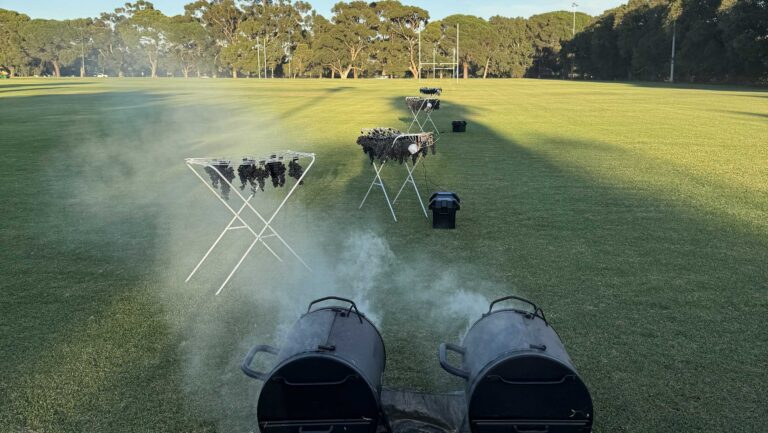
Contextualizing diagnostics reflects a maturation in smoke taint research. This is achieved by integrating local data—such as type of fire and exposure levels—with standardized diagnostics. “Those are only questions that researchers working in their respective local fields, local areas, can work together to generate this knowledge,” says Dr. Pan.
A study brought together scientists from Australia and the U.S. in a bid to understand how much Australia-based research is translatable to California. Outcomes included a novel technique and methodology to identify the bound form of volatile phenols (VPGs). Building on existing Australian research recognizing six key VPGs, the new technique detected an additional two VPGs sensitive to low sub-sensory threshold smoke exposure in the Lodi and Sacramento Delta regions. These can serve as molecular markers in diagnostic tests.
More research is required to refine the process, and it should consider, says Pan, “how well those metrics carry through the entire process to understand what you could do to leave as much of the problem behind as possible. And there are limits to that.”
Putting the Research to Work
Two techniques making use of chemical markers are in development: one to protect fruit from smoke exposure, the other to remediate it.
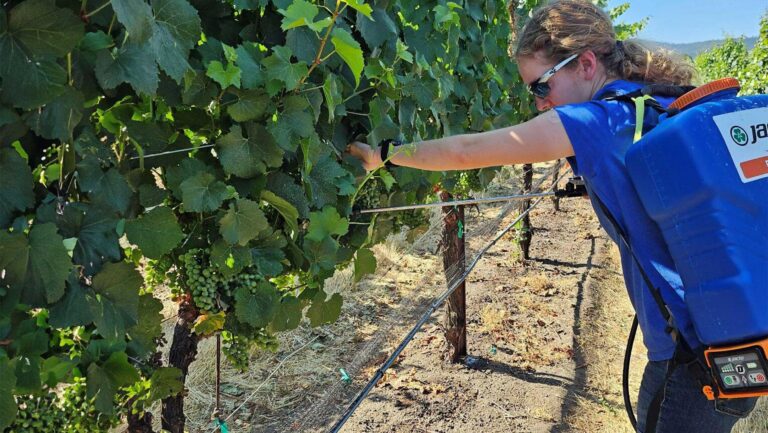
After Australian research showed chitosan successfully protected grapes from smoke taint compounds, scientists at Oregon State University (OSU) developed a chitosan-cellulose barrier spray, or coating, for pre-harvest application. Chitosan is a natural fiber made from the outer shells of crustaceans or the cell walls of fungi, and in this case, shrimp was the source of chitosan.
In designing the coating, scientists used established chemical markers for smoke taint to successfully test the coating’s smoke-blocking capacity. Interactions between chitosan and cellulose fibers help form a stable coating layer. “We tried to minimize other ingredients,” says Jooyeoun Jung, Ph.D., an assistant professor and senior researcher at OSU. “So we really emphasise the role of these two ingredients and maximize each of the functions.”
In transitioning from laboratory development to commercial application, researchers aimed to minimize disruption to existing vineyard practices. “The coating was therefore designed to be applied with commonly used vineyard spraying equipment and integrated into existing spray practices,” says Dr. Jung.
Field evaluations have been conducted in collaboration with Alexander Levin, Ph.D., a viticulturist and director of OSU’s Southern Oregon Research and Extension Center, and his research team. Now in the third year of field trials, feedback from vineyard researchers and managers has helped refine the formulation and application practices under realistic vineyard conditions.
Membrane filtration can be used to remove free volatile phenols from smoke-affected wine. The challenge has been persistence of smoky characteristics in wine post-treatment. Research into how glycosides impact sensory perception of these flavors, and their passage or retention through different membranes, is helping scientists develop a two-step membrane filtration process.
It works by refining the original practice to reduce the amount of wine being treated. The idea, says Wilkinson, is to first use a loose membrane that allows both free and glycosylated phenols to pass into the permeate, while the retentate preserves molecules including delicate color and flavor compounds. The permeate is then passed through a nanofilter, which isolates volatile phenols for removal using an adsorbent material. The glycosides are isolated in the second retentate, which decreases their concentration in treated wine.
In terms of scaling from laboratory to winery, Wilkinson says they are now moving from 20-liter, lab-scale trials to around 500-liter, semi-commercial-scale trials. This has greatly reduced the amount of smoke-affected wine needed for initial experiments, while demonstrating the commercial options available to the producer.
Opening a window into the internal world of the grapevine when under smoke stress is an important step in developing a robust response to wildfires. Collaborative research is expanding the catalog of genetic pathways, molecular markers, and chemical compounds, while detailing varietal differences.
These insights help improve diagnostics and product development, providing more options for the producer. Ultimately, the value is to those on the ground. As Alex Cassegrain of Cassegrain Wines in New South Wales, Australia, notes, “Having the industry aware that there is that information and access to resources does make a big difference.”

Dispatch
Sign up for our award-winning newsletter
Don’t miss the latest drinks industry news and insights—delivered to your inbox every week.
Simone Madden-Grey is a writer originally from Aotearoa, New Zealand, and now living in the United Kingdom. She holds the WSET Diploma and has written for The Drinks Business, Australian & New Zealand Grapegrower & Winemaker, and Wine Industry Advisor. Visit happywinewoman.com to read more of her work.