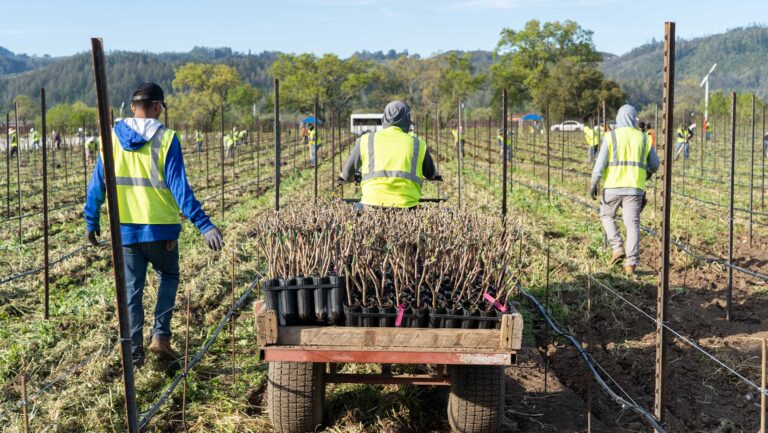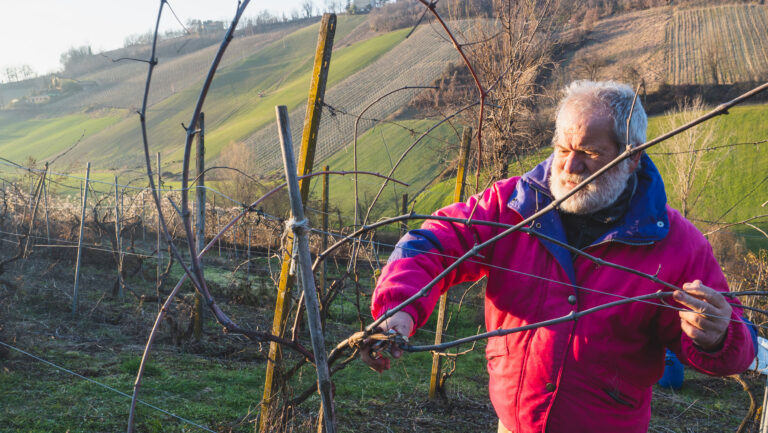
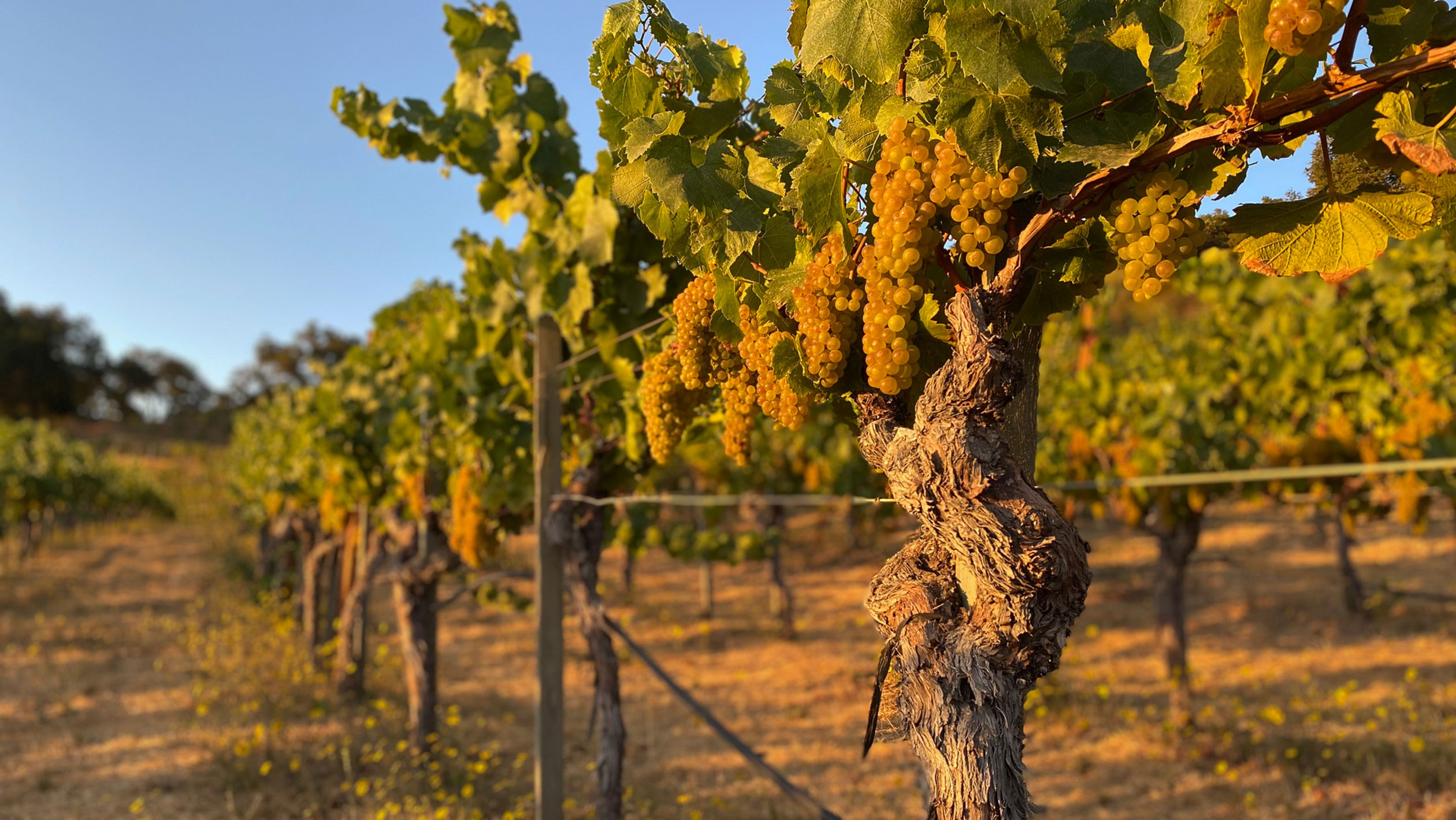
Vertical shoot positioning (VSP) is a trellis system (often interchangeably referred to as a vine training system) that can make for an attractive and efficient vineyard. Shoots—the greenery from which leaves, tendrils, and flower clusters, which eventually become grape clusters, grow—are pinned upward on movable catch wires as grape clusters develop.
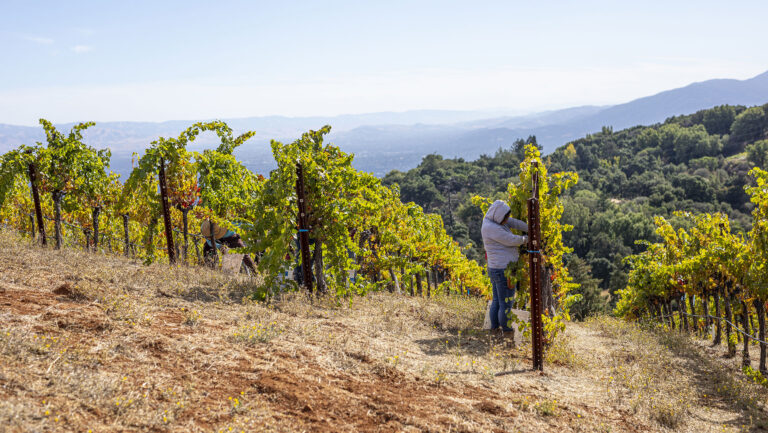
When a canopy is “hedged on top religiously,” says Braiden Albrecht, the winemaker at Mayacamas Vineyards in Napa Valley, “VSP can appear clean and ornate, the vineyard like a garden.” Mechanical equipment thus moves easily through rows, and more rows of vines can fit within a vineyard.
In the 1991 book Sunlight Into Wine: A Handbook for Wine Grape Canopy Management, authors Richard Smart and Mike Robinson classify VSP as one of the most popular trellis systems for commercial vineyards, noting, “because the shoots are uniformly trained, all the fruit is in one zone, and the shoot tips are in another. This makes mechanical operations easy, like leaf removal, bunch zone spraying, and trimming.”

Don’t miss the latest drinks industry news and insights. Sign up for our award-winning newsletters and get insider intel, resources, and trends delivered to your inbox every week.
“A grapevine wants to crawl and climb and ripen bunches of tiny clusters for birds to eat so they can spread their seeds and make more grapevines,” explains David Gates, the senior vice president of vineyard operations at Ridge Vineyards. “We contain it to fit a system we can farm and sustainably work. If you want more vines per hectare or acre, and to be able to farm with a tractor and vehicle, then you are almost forced to use VSP.”
However, despite its efficiency and subsequent broad application, there are caveats; VSP does not meet the needs of every grape variety or growing site.
VSP demands “more intensive and thoughtful management efforts than required for most other trellis systems,” writes Stan Grant, a California-based viticultural consultant; this can necessitate greater expense. Justine Vanden Heuvel, a professor in the department of horticulture at Cornell’s College of Agriculture and Life Sciences and her colleague Andrew Robinson concluded in this 2009 study that a variety of training systems beyond VSP are “capable of improving wine quality through a combination of enhanced canopy and fruit microclimate.”
“The short story is that VSP isn’t always the best choice,” explains Vanden Heuvel. Here, SevenFifty Daily investigates VSP’s predominance as a vine training system, discerning where it works well, where it does not, and why.
Understanding Vertical Shoot Positioning
“There really isn’t a true origin story for VSP,” explains Michelle Moyer, a professor of viticulture at Washington State University’s Prosser Research and Extension Center. “Grapevines like to grow on a structure, and we’ve developed different structures over millennia. The concept of training shoots vertically into a single plane or flat wall is common across multiple trellising systems.”
Its ubiquity means that VSP is often alternately referred to as a “vine training system” and a “trellis system,” the latter being “the permanent physical framework, like posts, wire, and fittings, that the vines grow on,” explains Justin Scheiner, Ph.D., an associate professor in the department of horticultural sciences at Texas A&M University.
“Vertical shoot positioning references how the canopy is trained,” says Moyer. “But to support that specific canopy training system, a trellising system was developed.”
Further, vine training systems vary in nomenclature based on how they are pruned in winter, which includes the practice of removing dormant wood to scale the plant to accommodate a select number of buds during the growing season. Therefore, systems that use a VSP structure may have different names because of the way they are trained and pruned; Scott Henry and Pendelbogen, for example, are variations of VSP.
VSP’s Adaptability Is Why It’s Widely Utilized
“There are many different ways to work a VSP system,” explains Gates. The system’s versatility increases its usability.
At Ridge’s Montebello estate in the Santa Cruz Mountains, Gates enacts a “relaxed VSP,” where tucking shoots underneath crosswires, as would be typical, isn’t a priority; shoots that aren’t caught between the wires offer canopy cover that provides shade, which is especially helpful for Cabernet Sauvignon. At Lytton Springs, in Sonoma, Syrah is trellised in what Gates calls “a shaggy VSP.” On the north or east side of rows, where there’s less direct sunlight, Syrah canes are trained laterally to grow straight. On the south or west side, which are more sun-exposed, canes are allowed to curve, as they do intuitively, so south-facing grape clusters will similarly benefit from canopy cover.
Wood or metal crossarms can also be used to divide the canopy, creating a modification of VSP. At Mayacamas, Albrecht says that splitting the canopy this way has proven especially effective with Bordeaux varieties like Cabernet Sauvignon, Merlot, and Cabernet Franc—grapes with variable ripening tendencies on site. By contrast, Mayacamas’ estate Chardonnay relies on a California sprawl system, where vines are single-staked to one wire. The canopy is left loose and robust, shading grape clusters and slowing ripening, which proves ideal for Chardonnay, as it ripens readily on site.
“VSP has a reputation for producing riper, richer-styled wines because the fruit is more exposed to sunlight, but you can have different outcomes within these systems, depending on your decisions and the styles you’re trying to achieve,” says Albrecht.
Similarly, Bordeaux varieties at Jonata in the Santa Ynez Valley “take to VSP very well,” says Matt Dees, the winemaker for Jonata and The Hilt Estate, also in Santa Barbara County. Dees and the viticultural team add extensions to crosswires to spread shoots further apart as they are trained upward—emulating a Lyre system, another variant of VSP—and opening the center of the canopy to receive “Richard Smart’s dappled sunshine,” says Dees.
Where Vertical Shoot Positioning Delivers Results
Beyond tidiness and improved mechanization, VSP has several benefits, depending on the vineyard site and layout. VSP is ideal on sites where vigor is low to moderate; in high-vigor grapevines, shoots grow rapidly and the canopy must be frequently hedged, which is labor intensive. At Jonata, vines are on sand, and in the cooler Radian and Bentrock vineyards farmed by The Hilt Estate, are on diatomaceous earth. Both are low-nutrient soil compositions, resulting in less vine vigor, making them ideal for VSP.
With high-density plantings, a VSP system is also beneficial because it can minimize crowding due to the raised and tucked position of shoots, while vine density modulates vine vigor, as vines share resources like sunlight, soil nutrients, and water.
“For newer plantings in the Santa Cruz Mountains, we can plant three times the vines per acre—it at least doubles the yield, and with the same intensity and quality,” says Gates. “The only way we can do that is using VSP, and getting the shoots to grow upright instead of sprawling.”
Frederick Frank, the president of Dr. Konstantin Frank Winery in the Finger Lakes of New York, learned about VSP while studying viticulture at the Geisenheim School of Viticulture in Germany in 1982. “It reduces fungal diseases and hastens ripening,” says Frank. His winery is collaborating with the Cornell Cooperative Extension to assess the impact of four different types of leaf removal around the fruiting zone, to perfect its application of VSP.
Dees says VSP “can bring the best out of vines,” especially when variety and vine density are taken into consideration. For example, “Nebbiolo requires a big solar panel to ripen—just a lot of photosynthetic activity is how it does best accumulating sugars. For that variety, we would consider taking every other row out and adding a wire to make the canopy taller,” says Dees, which would offer grapes consistent, expansive sunlight.
Where Vertical Shoot Positioning Falls Short
Canopy management is a persistent concern with VSP though, and the system can both “limit yield and increase production costs,” says Vanden Heuvel.
These issues are context-dependent, informed by the nuances of regional climates and growing sites. For example, if row orientation and vine density don’t support unmediated sun exposure, ripening can be compromised for some clusters, even with the advantages of their lifted position to maximize sun exposure—leading to lost yields.
On the other hand, in warm California regions, heat spikes and intervals of triple-digit temperatures for several consecutive days are both becoming more common; with grape clusters lifted for optimal sun exposure in a VSP system, these extremes can result in yields being lost to sunburn. Plus, “With unfavorable row direction, adding shade cloth entails another step,” says Gates, referring to the subsequent increase in labor and expense.
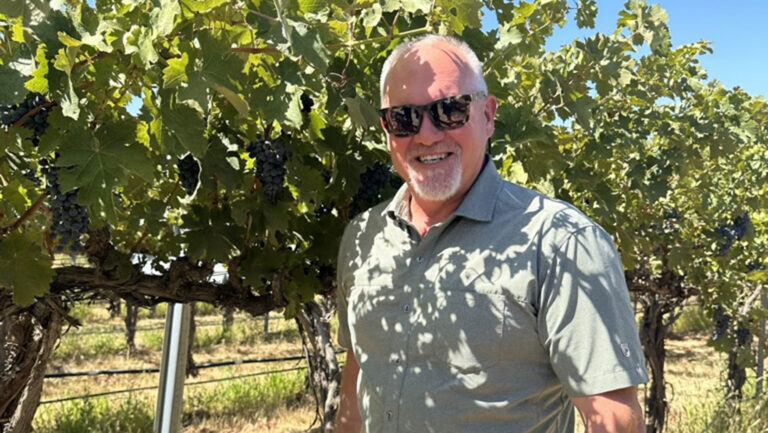
At Saviah Cellars’ estate vineyards in Washington’s warm The Rocks District of Milton-Freewater and Walla Walla Valley AVAs, founder and director of winemaking Richard Funk has ruled out VSP as the best choice. Instead, Cabernet Sauvignon and Syrah are trained on the Geneva Double Curtain system, where two parallel wires run between rows, dividing the canopy into two curtains.
“A VSP system stacks vigor vertically, which can lead to canopy density and shading unless we aggressively thin and hedge,” explains Funk. “That often means sacrificing yield to maintain quality.” The Geneva Double Curtain spreads out vigor and improves light distribution throughout the canopy, thus allowing for slightly higher crop loads without compromising quality. “While the initial investment was higher than a VSP system, increased quality and yield compensate for that,” Funk adds.
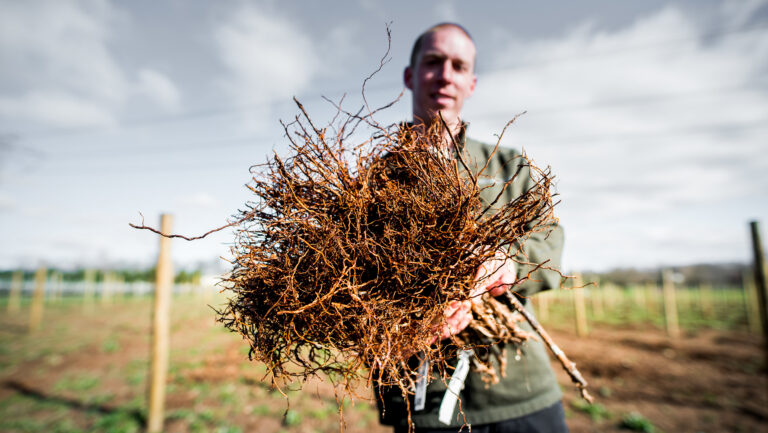
Dees also expresses concern about VSP as it’s most suited to drip irrigation, yet climate change necessitates that grape growers prioritize water conservation while producing high-quality fruit. “If vines focus on surface roots for water, they become very reactive, because that top soil starts to dry out faster than the subsoil areas,” says Dees. “It’s a vicious cycle.”
For this reason, Jonata is converting VSP-vines to head-trained, own-rooted vines on its Ballard Canyon estate to establish deeper, more resilient root systems. In a gobelet structure, permanent wood arms orient around the head of the vine axially. “At 660 vines per acre, we’re getting about a ton to a ton and a half, and it’s very cheap to farm,” says Dees. “There’s less sunburn. The berries are smaller. The fruit ripens earlier. They get a better dormancy.”
VSP also won’t suit all grape varieties. For example, varieties that grow “a more pendulous canopy,” says Moyer, necessitate battling the grapevine to get it into an upright position. These include PIWI and other cold-hardy, disease-resistant varieties like Cayuga White, Noiret, and Corot Noir.
“VSP is a great solution to today’s farming questions,” says Dees. “We have to automate many things—to spray evenly and to deal with hillsides while being efficient. But as the environment changes, there’s room for things that are more sustainable. VSP is an answer. I’m not sure it’s the only answer.”

Dispatch
Sign up for our award-winning newsletter
Don’t miss the latest drinks industry news and insights—delivered to your inbox every week.
Amy Beth Wright is a creative nonfiction writer and journalist covering wine, food, and travel. In addition to SevenFifty Daily, she contributes to Wine Enthusiast, Decanter, and Imbibe, and publishes Wine Flights on Substack. She holds a Level 3 certification from the Wine & Spirit Education Trust (WSET). Keep in touch on Instagram @amyb1021 and visit amybethwrites.com to read more of her work.