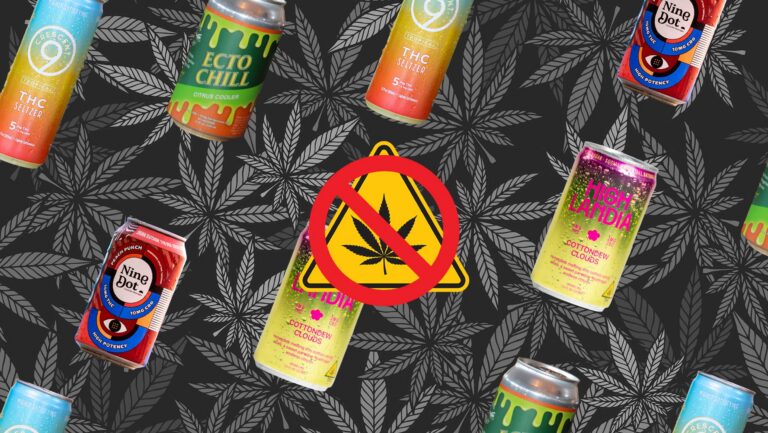
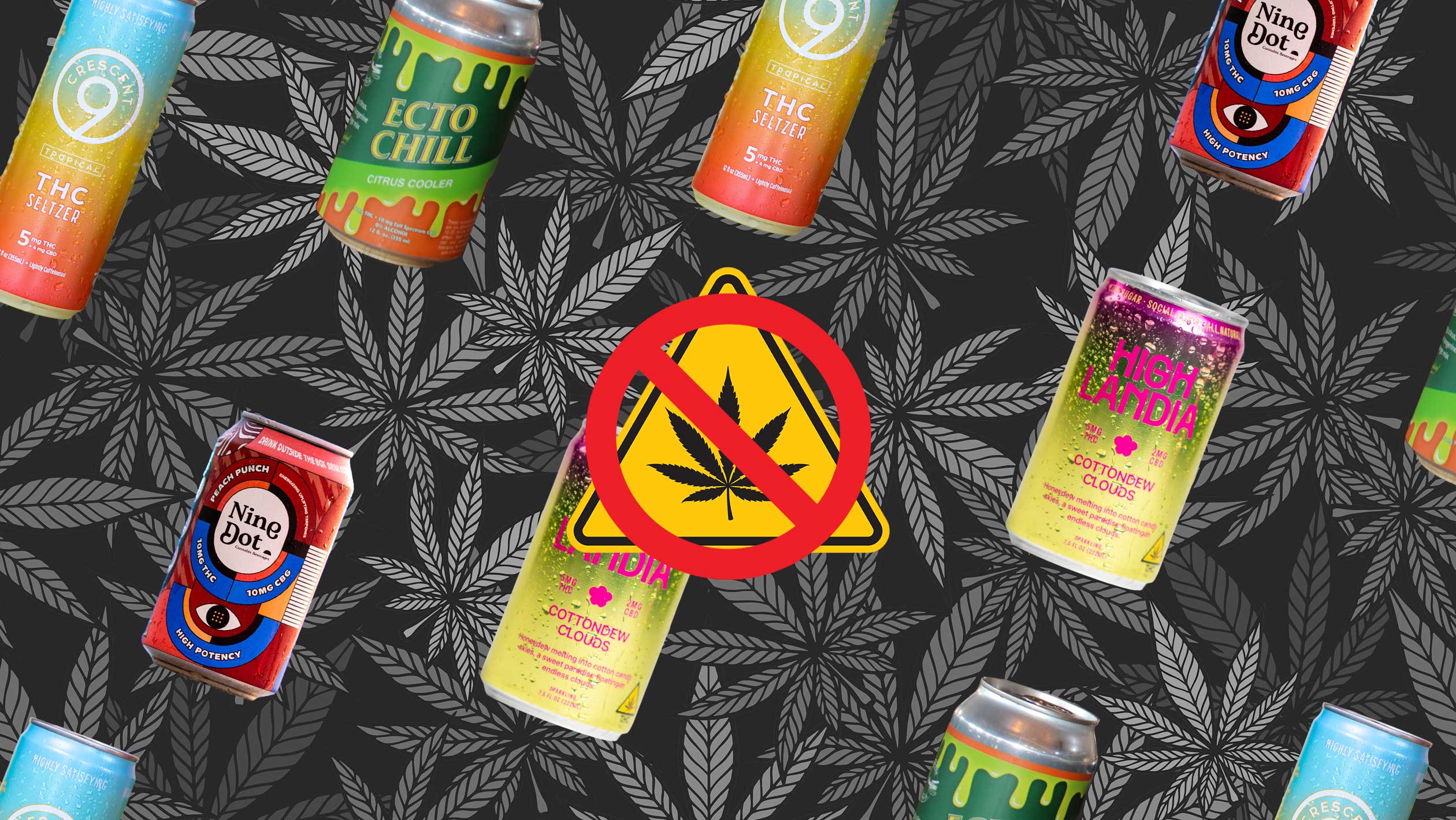
When drinks vanish from shelves, it’s typically due to lack of demand. On the contrary, sales of intoxicating hemp-derived delta-9 THC beverages now top $1.1 billion, according to Whitney Economics, but most hemp-THC drinks will disappear anyways if a looming nationwide federal ban is implemented this winter.
“Name another industry that was in prohibition for 100 years, got out of prohibition, and within 10 years is heading back into prohibition,” says Nick Warrender, the co-founder of Lifted Made, the maker of Highlandia hemp-derived THC beverages.
The federal government’s 2018 Farm Bill opened a loophole for edibles, vapes, and beverages derived from hemp, which is defined as a variety of Cannabis sativa containing 0.3 percent delta-9 THC measured by dry weight. A beverage could contain 5, 10, or 50 milligrams and still test less than 0.3 percent, given the liquid’s weight. Hemp-derived THC drinks proliferated at liquor stores, bars, breweries, and chain grocery stores and retailers including Target, Jewel-Osco, and Winn-Dixie. (Cannabis-derived THC drinks, which are derived from Cannabis sativa plants containing more than 0.3 percent delta-9 THC, are only sold at controlled dispensaries.)
Don’t miss the latest drinks industry news and insights. Sign up for our award-winning newsletters and get insider intel, resources, and trends delivered to your inbox every week.
Last November, the federal government looked to close the loophole by capping hemp-derived THC products at 0.4 milligrams total, essentially killing the hemp THC beverage industry. In early September, the government voted to delay the hemp ban, from November 12 to December 11.
“I hope desperately that where we land here has a clear set of regulations and not a ban,” says Jake Bullock, the CEO and cofounder of Cann tonics, which are infused with hemp-derived THC. “Give us rules and we’ll follow them.” In August, federal lawmakers introduced the bipartisan Beverage Regulatory Parity Act, which would limit hemp-derived THC drinks to 5 milligrams per serving and regulate them like alcohol, with three-tier distribution and a 21-and-up age limit. It has not yet moved forward, leaving hemp’s legal future on shaky ground.
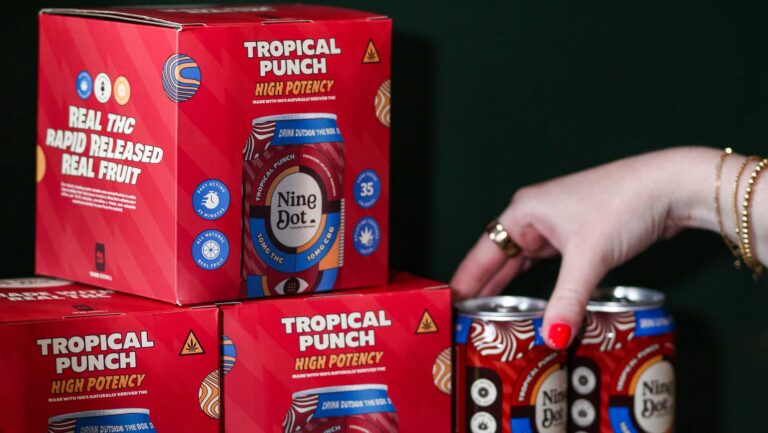
The beverage industry exists in the present and future, predicting sales and sourcing ingredients and packaging to produce drinks to meet the expected consumer needs. For David Spang, the cofounder of Nine Dot Cannabis Beverages, figuring out “our product forecast six months from now is next to impossible.” Raw-goods lead times can stretch 45 days.
“If you’re looking at a December deadline, I need to cut off all raw ingredients [in September],” he says. “I’m choosing to remain optimistic about a long-term fix, but it’s just such a big gamble.”
Some hemp-derived THC producers have already gotten a preview of what the total ban could bring. Like many other breweries facing declining beer demand, Seventh Son Brewing in Columbus, Ohio, created the Green Buddy line of hemp-derived THC beverages, which soon accounted for 20 percent of wholesale revenue.
That evaporated when Ohio’s early ban on intoxicating hemp products went into effect in late March, leaving Seventh Son with around 1,200 cases of hemp-THC drinks. A temporary restraining order let Seventh Son restart THC sales this summer, but the TRO’s uncertain length led to product shortages.
“It’s not a great way to run a business,” says Collin Castore, the cofounder. “It’s just a mess.”
Diversifying Product Lines Against Prohibition
During America’s alcohol Prohibition, breweries swapped beer for sodas and ice cream to remain solvent and survive. Hemp-derived THC companies are diversifying product lines to create an economic safe harbor, no matter which way the legislative winds blow.
After Ohio’s hemp-THC ban, Seventh Son leaned heavier into its fruit-rich canned cocktails, and they’ve made up around 70 percent of lost wholesale revenue. “Making the THC beverages and investing in pasteurization helped let us become good at making beverages with real fruit,” Castore says. An apple-inspired RTD cocktail is slated for fall.
Jim Higdon cofounded Cornbread Hemp in Louisville, Kentucky, in 2018 with full-spectrum CBD products made from organic hemp, later adding THC seltzers and gummies shipped to all 50 states. Now Cornbread offers gummies made with nonpsychoactive mushrooms, plus adaptogenic spritzes.
“We’ve got different levers to pull on on our product lines,” Higdon says. “Some will go full force, some will moderate, and some might get eliminated.”
Creating multiple lanes to drive revenue is crucial. Last year, hemp beverages accounted for around 40 percent of revenue for Earl Giles, a Minneapolis distillery and “drinks emporium” that produces its own hemp-derived THC drinks and formulates them for others. “We’ve helped launch more than 20 hemp beverages in the last few years,” says Nick Kosevich, the CEO.
The company has experienced a large drop in sales for its bulk liquids, which are shipped to brands countrywide for canning and THC infusion, and hemp now accounts for 10 to 15 percent of revenue. “In the last several weeks, our national brands let us know that they’re not going to be placing any more orders until everything gets figured out,” Kosevich says.
To make up for that loss, Earl Giles is pushing on other product lines that include sodas, spirits, RTD cocktails, and cocktail syrups, plus forthcoming functional beverages. “We’re doing our best to inch along and get through this tough time,” Kosevich says.
Will Consumers Buy THC Drinks That Don’t Deliver a Buzz?
To safeguard Cann’s future no matter which way legislative winds blow, the beverage company adjusted course this summer by releasing the nonintoxicating 0MG (pronounced “OMG”) line, including a golf-inspired Half & Half made with bergamot lemonade and yerba mate iced tea. The products are “shaped by regulatory uncertainty,” Bullock says.
Creating drinks containing no more than 0.4 milligrams of THC can also help assuage retailer uncertainty. Cann hopes that its new 0.4 milligram offering will provide retail flexibility with a transition product.
“Instead of them saying, ‘Hey, come pick up all your products, they’re illegal,’ they’ll say, ‘Hey, come swap out your products for the 0.4,’” Bullock says. “That’s been a dynamic that we’ve been working on with our big chain partners.”
Hemp-beverage company Nowadays is also releasing, in November, the federally compliant Extra Light, which contains 0.3 milligrams of THC and 5 milligrams of CBD. Retailers such as Lowe’s Food in North Carolina plan to stock the line extension. “This will allow us to stay on the shelf and give consumers access to THC past December,” says Marissa Kinsey, the senior vice president of marketing.
One challenge is testing variance. Even if a beverage is precisely dosed, lab results might come back outside the legal range. “The lab variance can be 20 to 30 percent,” Bullock says.
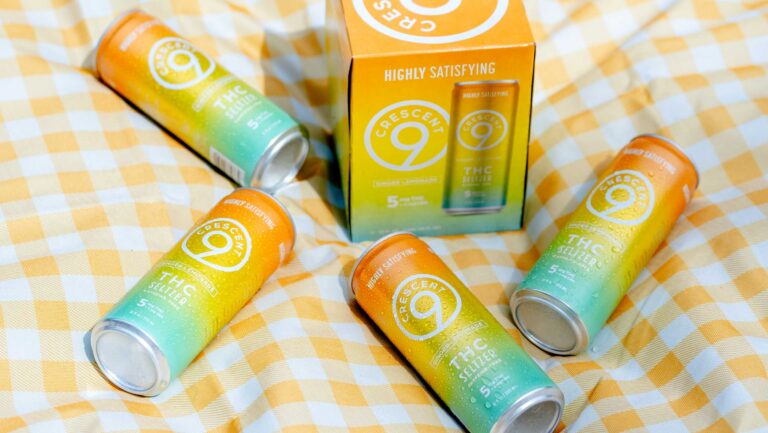
Even if a hemp-derived THC beverage stays within spec, selling consumers on a teensy bit of THC might be tough. “It’s such a negligible amount of THC that you’re basically selling a CBD product,” says Joe Gerrity, the CEO of Crescent Canna in New Orleans. “Nobody wants to pay for a product that’s not intoxicating.”
THC-beverage consumers typically buy on potency, favoring 10 milligrams or higher. Crescent is leaning into that potency, reformulating its 50-milligram seltzers with cannabis-derived THC purchased from state-licensed growers—a requirement in the cannabis industry—and will start selling the potent beverages in dispensaries this fall. Gerrity sees this move as getting ahead of one potential legislative outcome.
“Long term, you’re looking at low-potency beverages being available in grocery stores and higher-potency beverages being available in dispensaries,” says Gerrity, who remains committed to hemp. “I have a hard time believing that Congress is going to kill such a huge industry.”
Lifted Made’s Warrender would like to see legalization instill uniform regulatory language on packaging. “It’s extremely cumbersome when you’re trying to put together a SKU that can be sold” in multiple states, Warrender says. “You’re like, ‘Wow, I need to have 16 different warning labels for pregnant women because each one requires different verbiage.’”
Among producers, consensus seems to be building around an outcome that keeps hemp beverages legal at a lower dose, around 5 milligrams, with beverages age-restricted to 21 and up. Seeking something stronger? Head to a dispensary, a model not dissimilar from liquor stores.
“We think those rules should look like alcohol,” Spang says. “We have a system for regulating adult beverages that’s been in place for almost 100 years, and it seems to work pretty well.”

Dispatch
Sign up for our award-winning newsletter
Don’t miss the latest drinks industry news and insights—delivered to your inbox every week.
Contributing editor Joshua M. Bernstein is a beer, spirits, food, and travel journalist, as well as an occasional tour guide, event producer, and industry consultant. He writes for the New York Times, Men’s Journal, New York magazine, Wine Enthusiast, and Imbibe, where he’s a contributing editor in charge of beer coverage. Bernstein is also the author of five books: Brewed Awakening, The Complete Beer Course, Complete IPA, Homebrew World, and Drink Better Beer.