In January, hundreds of people gathered in New York City for a glittering, sold-out celebration of German wine. Rieslingfeier, an event modeled on La Paulée, filled an elegant hall with collectors, consumers, and trade. As they elbowed for pours from icons like Julia and Klaus Peter Keller and Katharina Prüm or selfies with Julian Haart and Lara Haag, everyone was in full agreement: these producers—and their peers—have ushered in a golden age for German wine. But amid the buzz of enthusiasm, no one talked about what was happening back in Germany, where the broader wine industry is in crisis.
“We are facing a transition of a magnitude not seen since the Second World War,” says Simone Loose, Ph.D., a professor of wine and beverage business administration at Geisenheim University and one of Germany’s leading researchers in the field. A combination of economic pressures and shifting consumer habits has left many producers struggling. Climate whiplash has slashed yields in some areas, while in others, producers are saddled with oversupply, trying to sell their surplus to a saturated bulk wine market. As a result, industry experts forecast a long, painful period of adjustment before the German wine sector returns to viability.
The Impact to Producers
“It’s very, very tough times right now,” says Christine Pieroth, the proprietor of Piri Naturel in the Nahe region. “In Germany, there’s only been one direction in the wine market for the past years: more efficiency and more volume! That this will collapse at some point was to be expected. To be honest, I don’t think there’s anyone not really affected.”

Don’t miss the latest drinks industry news and insights. Sign up for our award-winning newsletters and get insider intel, resources, and trends delivered to your inbox every week.
But the crisis is not hitting all producers equally. In the U.S. market, the focus is largely on the 25 percent of German wine production that comes from independent estates. It also skews to export-driven regions like the Mosel, which sells close to a third of its wines outside the country. In this segment, there is still plenty of good news. According to Dr. Loose, last year, one in three independent producers improved their sales volume, benefitting from planning, adaptation, and strategic exports. As such, most of what is playing out in Germany will not impact what U.S. consumers see of—or pay for—German wine.
This accounts for the “invisibility” of the crisis to outsiders. But inside Germany, two-thirds of independent wineries are in trouble. Worst off are Germany’s bulk wine and cooperative producers. In the bulk wine segment, which accounts for 50 to 55 percent of production by volume, and among co-ops, which account for 25 percent, many wines are sold below cost, per Loose.
How Did Germany Get Here?
Germany’s economy, still the world’s third largest, has stalled. Since 2019, German producers have been hit by 30 to 40 percent higher labor, energy, packaging, machinery, and repair costs, Loose calculates. The start of the Russia-Ukraine War in 2022 jolted German energy prices, which remain high. Inflationary pressures have cut into consumer purchasing power. Moreover, German labor prices are significantly higher than those of other EU countries.
Health consciousness around alcohol is increasing and other beverages have entered the market. Underlying all of this is the exceptional price sensitivity of German consumers, who buy roughly two out of three wines at discount supermarkets. Although Germany could meet domestic demand with its own wines, it is a net importer, as German wine consumers tend to favor cheaper imports and the diversity of international wine styles.
The size and structure of Germany’s wine sector plays an important role. It has just over 100,000 hectares of vineyards and—despite significant consolidation over the past decade or so—most growers are small family businesses cultivating less than five hectares each. The smallest tend to feed bulk producers and co-ops.
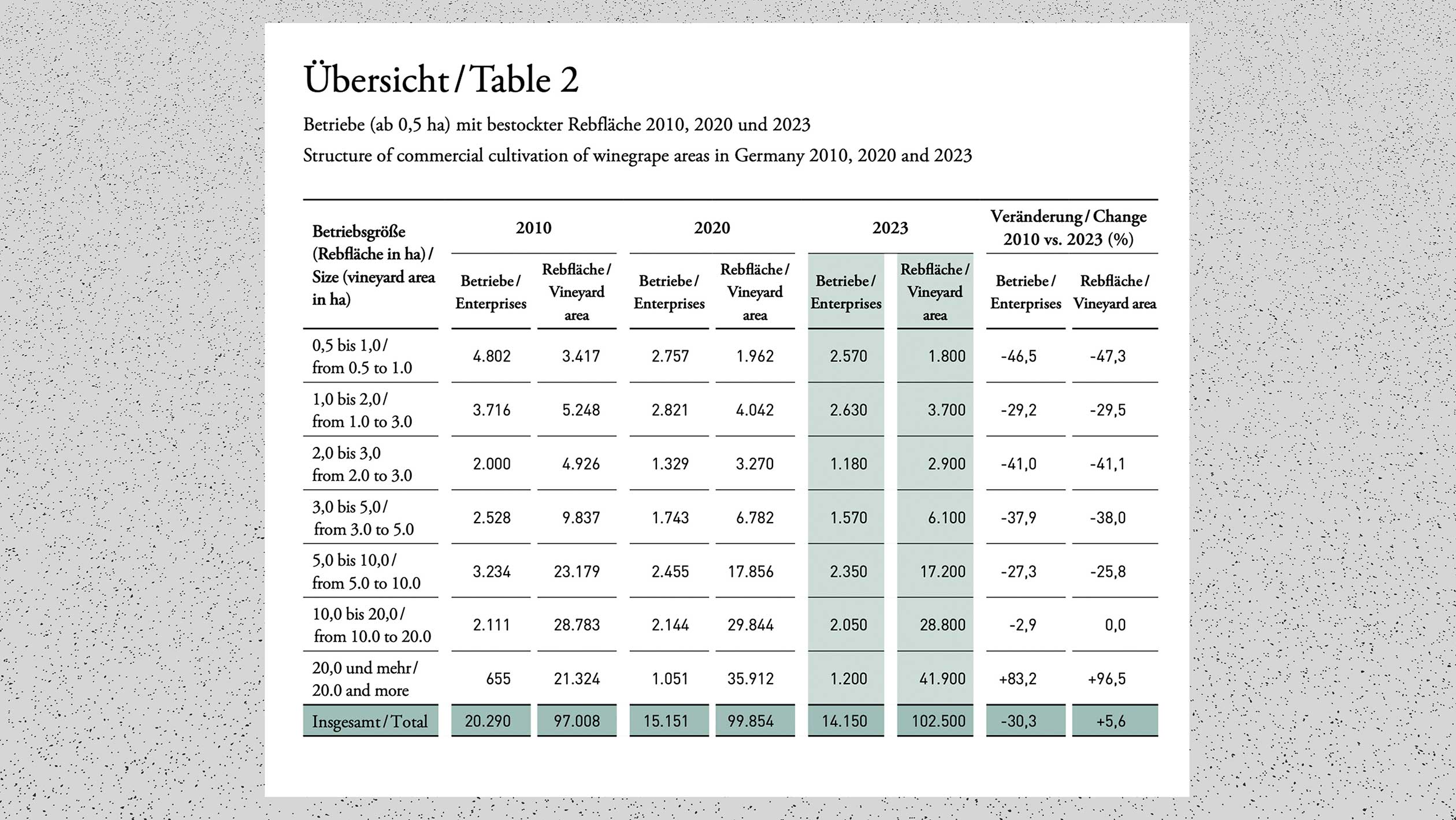
Strikingly, Loose estimates that even prior to 2020 at least two-thirds of German wine producers were unprofitable. “Before our students leave Geisenheim to go back to take over their family estate, we tell them, ‘Now is the time when you do your bachelor thesis, why don’t you look at the current situation of your estate to build up a strategy for the future?’ And how often do I see the students analyzing and for the first time realizing: ‘My parents don’t earn money.’ Then there is this thing of, ‘Oh, it’s all the generations on my shoulders. I can’t be the one giving up, so I have to work harder to make it work out.’ But there’s no way that’s working out.”
This financial strain is compounded by developing demographic shifts. Younger generations are moving away from alcohol. The German population is set to shrink due to low birth rates and insufficient immigration. As a result, Germany is forecast to consume 40 to 50 percent less wine by 2045, with a smaller population of drinkers magnified by lower per capita consumption, according to Loose.
In a global survey conducted by the Prowein trade fair and Geisenheim University, German producers registered the most pessimistic outlook for the current year.
A February 2025 Deutsches Weininstitut (DWI) report confirms the trend, showing a four percent drop in wine consumption in Germany in 2024. German wines were disproportionately affected, with a decline of five percent in sales and six percent in revenue. The downturn has knock-on effects for trade fairs, marketing, media, training and educational institutions, and investors tied to the wine sector.
How Producers Are Adapting
Some regions will be harder hit than others. For example, despite the Mosel’s success in export markets, it is expected to shed up to 10 percent of its vineyard area over the next decade, according to Ansgar Schmitz, the managing director of Moselwein e.V., a regional association. “Due to increasing production costs, especially in the steep slopes, and declining sales in Germany, we expect more producers will go out of business or reduce their vineyard land,” he says.
In Baden and Württemberg, two large regions where some 75 percent of production comes from co-ops, vineyard area reductions are likely as well. Rheinhessen and the Pfalz, with significant production in the bulk wine market, are also feeling the pinch. “That’s where we have prices of 70 cents per liter, while the production cost is at least 1.30,” notes Loose. Germany’s bulk wine market will continue to swell and prices continue to fall as growers dump more unsold wines.
Kevin Pike, the owner of Schatzi Wines, says among the German producers in his import portfolio, he’s seen two approaches to the current situation: diversification and consolidation. He offers Rheingau estate Weingut Leitz as a model for how long-term diversification can pay off. “Leitz is now basically three wineries: one focuses on non-alcoholic (NA) wines; one consists of upper Rheingau vineyards that fuel entry-level wines for Aldi, Norway, and Sweden; and one that remains a small, focused winery producing wines from steep slope sites in Rüdesheim. His business is growing for both wine sales and NA, not only in the U.S.”
Moritz Haidle heads up the midsized biodynamic Weingut Karl Haidle in Württemberg, a region that is among the hardest hit due to its high share of less-fashionable red wines, cooperatives, and what he sees as little appetite for change. “If you don’t react, the problem will overtake you,” he says. In recent years, he has adapted by streamlining his portfolio, shedding some parcels, and facing up to the reality that growth may be a thing of the past.
He credits Loose with helping to destigmatize downsizing through her focus on the structural nature of the crisis. But producers still don’t feel comfortable admitting they are shrinking, he says. (Acknowledging these taboos and other pressures, the German Winegrowers Association has begun to promote confidential mental health support services in its magazine for growers.)
At Piri Naturel, Pieroth organically and regeneratively farms from her family’s 14 hectares. “Already before the crisis in the wine market, I wanted to downsize from a small-to-medium winery to a small winery and made the first steps towards that. I don’t want to do a billion things just because the market demands it. I want to be able to focus more on nature and species conservation, which is, for me, very connected to my way of farming.” She envisions hosting workshops and teaching visitors “why it’s not possible to sell wines for three euros in the supermarket.” She also sees significant cost-savings potential in resource-sharing—machinery, tools, storage, harvest teams—among wineries.
The Pressure to Export
Exports remain a bright spot, with a slight, two percent increase in 2024. As such, more producers are pursuing this route, fueling competition for slots in import books in key markets. For decades, the U.S. has been the largest market for German wines. It remains so, at just over 12 percent of the total, albeit by a narrowing margin as Scandinavia, Benelux, the UK, Eastern Europe, and China take a larger share.
That said, most U.S. importers are optimistic that the situation for German wines in the U.S. will remain stable. (The risk of tariffs or other trade disruptions was not factored into these discussions.) “The cost to produce these wines is going up,” acknowledges Jenna Fields, the president of The German Wine Collection. “As an importer, we do everything we can to keep pricing consistent. That means warehousing on both coasts to help reduce shipping costs or picking up larger volumes less frequently so that when a grower truly needs to raise prices, we can try our best to keep them stable. For us, it’s all about maintaining value in the glass.”

This sentiment is echoed by Pike. “Prices have been steady, I think, because producers are afraid to raise them, or [if there have been] slight increases, we have absorbed them in the stronger dollar.” He believes the German wines that come into the United States “have a following and they’ll continue to do so. What we see on retail shelves and on premise is going to look pretty similar this year as last.”
Future Prospects and Structural Changes
Germany’s two largest wine-producing states, Rheinland-Pfalz and Baden-Württemberg, are developing support programs for struggling producers, according to DWI spokesperson Ernst Büscher. Initiatives under discussion include sales-promotion funds and incentives for growers to leave cleared vineyards fallow for six years instead of the current standard of three. However, there are no mandates for vineyard removals. Confoundingly, 764 acres of new vineyard area, most of it in Rheinland-Pfalz, were greenlighted in 2024.
“If there was an invisible hand that could find the ideal solution,” says Loose, “I would say, ‘Get rid of 25 percent of the acreage, reduce this surplus, make supply and demand balanced again.’” Short of that, she and her team have developed a globally unique tool to collect and evaluate the daily sales data of 600 wineries, cellars, and cooperatives that participate voluntarily. The aim is to provide the industry with reliable information, enable businesses to compare themselves with others, and empower them to make needed change.
As the industry navigates these challenges, the hope is that a leaner, more resilient German wine sector will emerge. “I hope we all go from it stronger, and at some point look back and can say, ‘It’s been a tough time, but we made it,’” says Pieroth.

Dispatch
Sign up for our award-winning newsletter
Don’t miss the latest drinks industry news and insights—delivered to your inbox every week.
Valerie Kathawala is a New York-based journalist specializing in the wines of Austria, Germany, South Tyrol, and Switzerland. She is also the co-founder and co-editor of TRINK Magazine. She holds a WSET 3 certification.