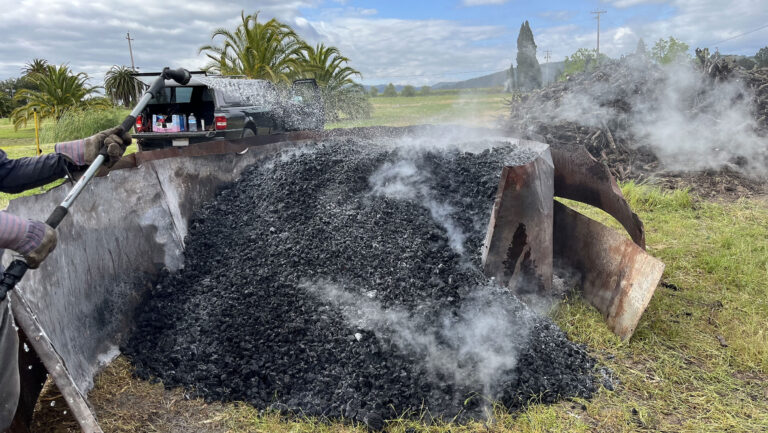
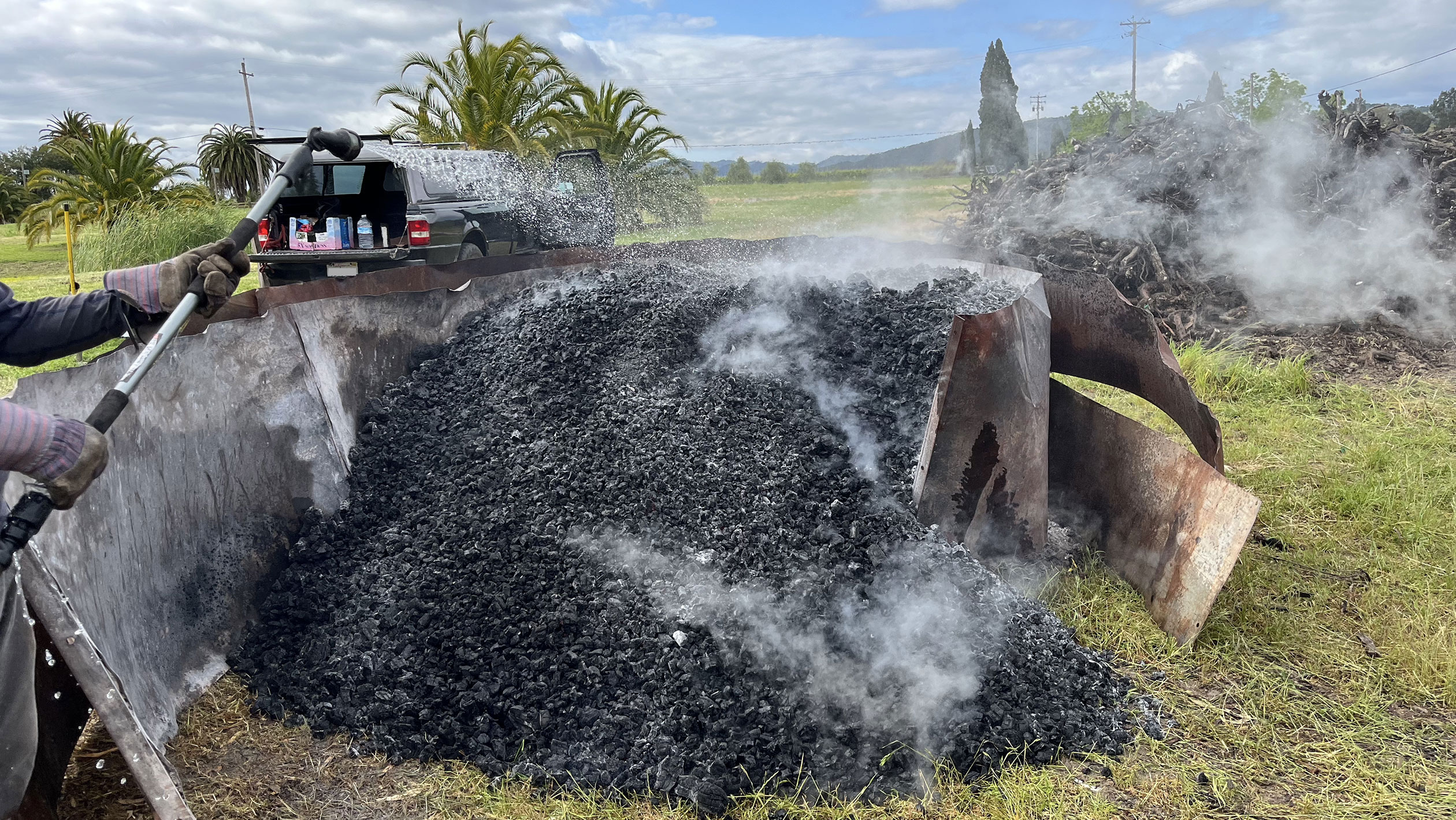
On a winter morning in Sonoma County, in a field owned by Gundlach Bundschu Winery, Eric and Katy Mayer—cofounders of the company Napachar—stood over a tangle of tree branches and vine clippings piled inside a flexible steel ring. They lit a fire, and the wood combusted into flame as the heat expelled its volatile gases, causing the wood to blacken.
The steel ring, known as a flame-cap kiln, is a low-tech tool used to produce biochar, a special kind of charcoal that is fast becoming the “it” amendment of regenerative viticulture. With its promises of carbon sequestration, while benefiting soils with water retention, aeration, microbial health, and more, biochar is still in the experimental phase in vineyards, but fans tout it for its efficacy in shoring up sustainability, depending on where, when, and how it is applied.
Capturing Carbon as Biochar
Normally, after all the volatile compounds in a wood fire dissipate, the flame dies down as oxygen reaches the remaining material, turning it into ash and allowing the carbon in the charcoal to cook off. The Mayers, however, use an anaerobic process called pyrolysis, which stops the burning at the charcoal stage. The kiln’s steel walls keep oxygen from reaching the charcoal from the sides, while the Mayers feed the burn pile. “The air can only get in from the top, where the flame will consume all the oxygen above the charcoal,” explains Eric Mayer. “So the charcoal that builds up underneath stays protected.” What results is an inert, porous material that acts like a coral reef on land, as a foundational structure for the health of the soil—one that also reduces greenhouse gas emissions.

Don’t miss the latest drinks industry news and insights. Sign up for our award-winning newsletters and get insider intel, resources, and trends delivered to your inbox every week.
A software engineer and an environmental engineer, respectively, Katy and Eric Mayer were looking to start a venture focused on carbon capture when they got into biochar. Working with vineyards, the Mayers make biochar to be placed in the soil. “Once it’s in the soil, it doesn’t degrade because by turning it into charcoal, you rearrange the carbon atoms so that they’re more stable and microbes can’t break them down,” says Eric Mayer. “That’s why biochar as carbon dioxide removal is the number one delivering technology.” Indeed, studies have singled out biochar for its efficacy in carbon sequestration, and data shows that the rapid growth in carbon dioxide removal research has been driven by the biochar industry.
Though 70 percent of the carbon still escapes from the kiln, the 30 percent that is captured as biochar is more than what would otherwise be removed from the atmosphere. “If you burn it to ash, all the carbon goes up,” adds Eric Mayer. “If you chip it and integrate it into the soil, maybe 90 percent of the carbon goes out as microbes exhale, a lot of it as methane, which is worse than carbon dioxide. So according to a sequestration analysis, this is considered a 100-percent additionality because any biochar we make is carbon that otherwise would have gone up.”
Hoping to capitalize on the many low-intensity, prescribed burns that happen in California nowadays to reduce wildfire risk, the Mayers first got their feedstock from foresters. When Silver Oak Cellars asked them to help deal with their burn piles, the couple recognized that working directly on vineyards was “way more efficient: no transportation, way less equipment,” says Katy Mayer.
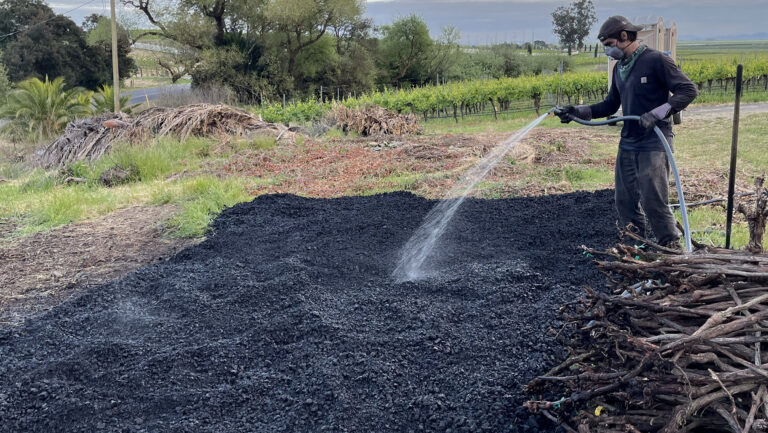
For clients like Silver Oak and Jackson Family Wines, Napachar has produced a total of 800 cubic yards, or 150 tons, of biochar in four years with its low-tech kilns, translating to 300 tons of captured carbon. They make a fraction of the biochar that the vineyards need for effective treatment, but it’s better than carbon-emitting burn piles, says Nick Filice, Silver Oak’s grape supply manager. For the majority of its soil amendments, however, Silver Oak purchases biochar.
The biggest producer in the western United States, Pacific Biochar, works with biomass power plants that burn sawmill shavings, forest thinnings, and urban green waste to generate steam that spins turbines for energy. Normally, the wood is burned to ash. Any charcoal that escapes is sent back into the furnaces. Pacific Biochar harvests that charcoal instead. CEO Josiah Hunt sells it for around $200 a ton delivered to Napa or Sonoma. His real profit, though, comes from carbon credits sold to corporations looking to offset their emissions. His material’s durability made Pacific Biochar the world’s largest supplier of durable carbon removal credits in 2023.
Buried in the soil as biochar, the carbon is tied up for 100 years, according to Rian McKenzie Lawrence, a Stanford University graduate student whose research focuses on quantifying biochar’s carbon credits. “We get caught up in the nitty-gritty of having to capture all the carbon, but something is better than nothing, especially if it helps agricultural yield, climate adaptation, and climate resilience,” says Lawrence.
The Sustainability Benefits of Biochar
For enthusiasts, there is nothing more natural than adding biochar to soil. “Physically the material is just charcoal,” says Hunt. “It’s been part of topsoil development for 350 million years, as long as plants and fire have co-existed.” Soils store up to three times as much carbon as the atmosphere, and depending on the soil, five to 50 percent of that is charcoal.
But it’s what biochar does in the soil that is of most immediate interest to viticulturists. In drought-prone Napa, Eric Mayer touts its water-holding capacity. “It’s got the structure of wood, so a gram of biochar has something like a football field of surface areas for water to stick to,” he says. In heavier soils, like clay, it helps with aeration.
“It’s an awesome habitat for microbes,” he adds. Biochar’s chemical makeup also helps microbial life to grow.
Since the science of biochar is relatively new, much of the data on vineyards comes from a Central Coast study that Pacific Biochar has provided the biochar for since 2016. The Oasis Vineyard Trial is the brainchild of soil scientist Doug Beck, who worked in Colombia with the International Center for Tropical Soil in the 1990s and learned about highly fertile, black soils created by ancient Indigenous farmers in the Amazon Basin. Along with pottery, manure, compost, and bones, terra preta soils contain steep concentrations of biochar. They are anomalous in the area. “Amazonian soils are notoriously poor, highly acidic, and weathered,” says Beck. “So biochar works wonders in that system, bringing the pH and organic matter up.”
Since 2004, when Beck started working at Monterey Pacific, which now manages 22,000 acres of vines in northern and central California, he was looking for a way to supercharge his compost. Many of the vineyards contained little soil organic matter. “It’s a very slow process to build that up,” he says. “How could I get it to go faster? Biochar came to mind.”
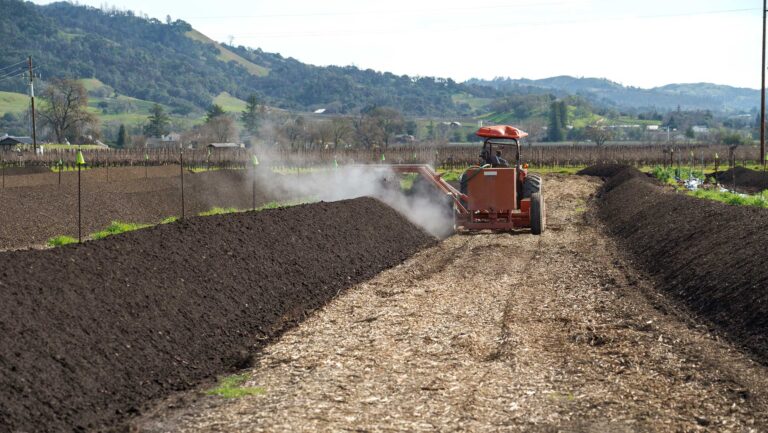
At the same time, Monterey Pacific’s director of mechanization and equipment, Jeff Lehar, was working to apply compost deeper. Lehar’s solution was to invent the Soil Amendment Injector, a patented machine that sinks compost down 12 to 36 inches, to the depth of vine roots.
The Oasis Vineyard Trial combined the new technology with biochar application on Pinot Noir vines newly planted in soil that amounted to dune sand. “We compared the application of just biochar, just compost, and compost plus biochar against no amendments,” says Beck. Over six harvests, the plot treated to compost plus biochar saw yields more than 30 percent higher than in the plot with no amendments. On low-yielding years, all of the treatments provided higher yields, with the biochar-compost combination showing a 70 percent improvement over the untreated plot—with no discernible difference in grape quality.
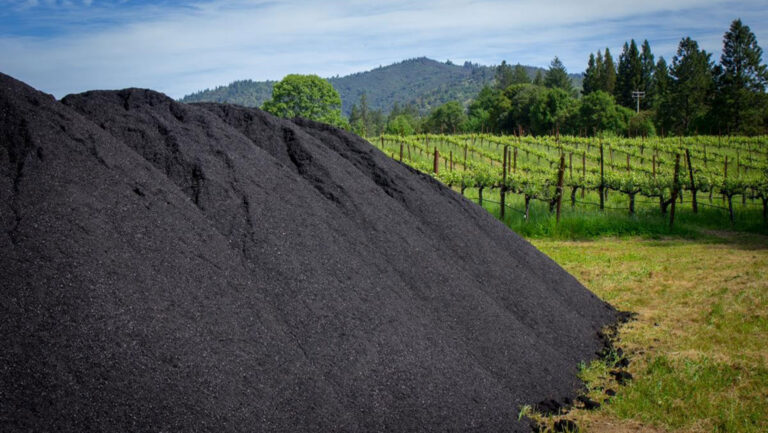
Beck chalks it up to the way the biochar inoculated with compost boosted the soil’s health. He lists a slew of indicators: improved water-holding capacity and water use efficiency; improved organic nitrogen and phosphorus; charged mycorrhizal growth with better nutrient cycling and uptake and a more functional system, where roots and the living microbiome work in concert; a better habitat for microorganisms; more efficient electron energy transfer reactions; less compaction from the tractor; and better aeration and drainage.
He translates all that into dollars. “In the first year of yield, we nearly paid for the amendments, which was 10 tons of biochar plus 15 tons of compost,” says Beck. By the second year, all the treated sites were seeing a return on investment, and after six years, in 2024, the biochar, compost, and biochar-plus-compost treatments had garnered an additional $15,689, $11,432, and $17,607 per acre in revenue, respectively.
How to Use Biochar
The Oasis Vineyard Trial saw such great success because there was so much room for improvement. The soil was dune sand, so it responded to inputs that increased its nearly non-existent organic matter. “Generally, the poorer the soil, the more likely biochar is to help,” says Lawrence. “In sandy soils where you have erosion and little organic matter, it does help.”
Jordan Lonborg, the regenerative consultant and manager of organic, biodynamic, and regenerative viticulture at Coastal Vineyard Care Associates, is judicious nowadays in his biochar use. He first embraced it as an alternative to just burning vine canes when he was the vineyard manager at Paso Robles’ Tablas Creek Vineyard. He saw no improvements with biochar alone, but his cover crop improved with a mixture of biochar and compost, and even more so with a biochar–sheep manure combo. Since then, however, he’s found biochar is so absorbent that it can deprive plants of the water and nutrients it hangs onto. Moreover, biochar is typically alkaline, so it causes even greater imbalances in soils with high pH. “I think there are places where it can be really beneficial, but I’m starting to lean more toward the idea of when and where,” says Lonborg.
Beck suggests “it’s a matter of customizing.”
“It’s not a magic powder,” adds Beck. “It has to be targeted for soils where it fills a need. You have to use 10 to 15 tons per acre and always target those low-organic soils. If you put it in good soil, you won’t see the difference in the short term.” Moreover, it needs to be primed before use. “Raw biochar acts as a magnet for nutrients and microbes and water, and it can create toxicities. We compost it, charging the biochar with nutrients, microbes, and water, and it goes into the soil fully functioning as organic matter.”
Placement is also essential. “Most people apply it at the surface level,” says Lehar. “They may run a tillage tool over it that will introduce it into a few inches of soil, but not where you want your grapevine to grow.” That might make the cover crop look amazing, but it does nothing for the vine roots. Inoculated with compost, biochar must be placed deeper in the ground, at a depth where the vines can utilize it.
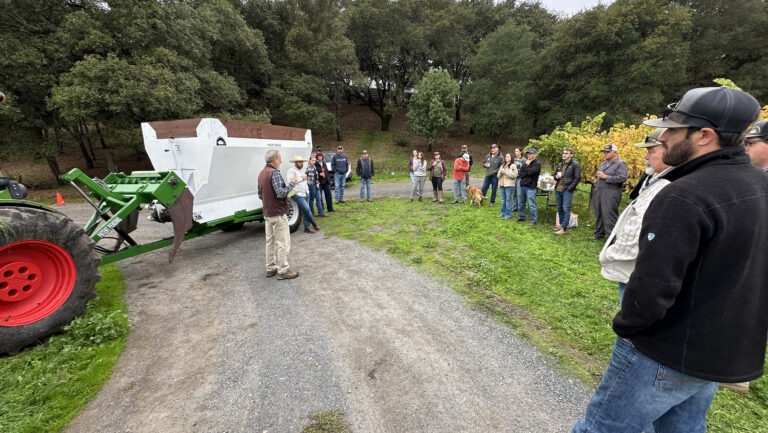
Finally, the best choice of fuelstock varies across locations. The United States Department of Agriculture developed a biochar atlas for the West Coast that helps agriculturalists figure out the right biochar for their soil. Applying what they’ve learned to the broader wine world, Beck and Lehar are partnering with the large biochar producer Sitos on a Central Coast biochar plant using almond hulls and on Soil Amendment Injector LLC, which offers custom compost-biochar applications, and will be marketing the Soil Amendment Injectors for sale by the end of the year.
Filice has used Beck and Lehar’s services on two ranches with two different soil types at Silver Oak. “We do see more resistance in the ecology,” says Filice. “Rather than going through brutal swings when it’s too cold, hot, or wet, we’re not seeing as much damage in the fruit.” But that observation is anecdotal. He’ll get real data later this year when Agrology sets up equipment to measure soil transpiration, which is an indicator of microbial activity.
In the meantime, Norm Peters, Silver Oak’s director of vineyard operations, is optimistic that the expense is worth it. “When you put biochar in your compost and stir it up for six or seven weeks, the compost populates all those little holes and surfaces just like coral,” he says. “Both compost and biochar are expensive, but my hope is that we get great, deep, rich soil that is a wonderful playground for earth worms and microbiology to do their job and repopulate the soil, and we don’t need to put compost or biochar in as much later. But that needs to be seen.”

Dispatch
Sign up for our award-winning newsletter
Don’t miss the latest drinks industry news and insights—delivered to your inbox every week.
Betsy Andrews is an award-winning journalist and poet and the co-author of Coastal: 130 Recipes from a California Road Trip. Her writing can be found at betsyandrews.contently.com.