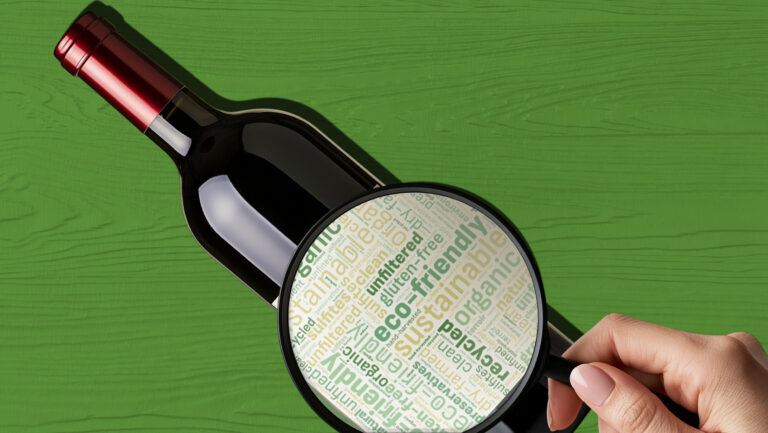
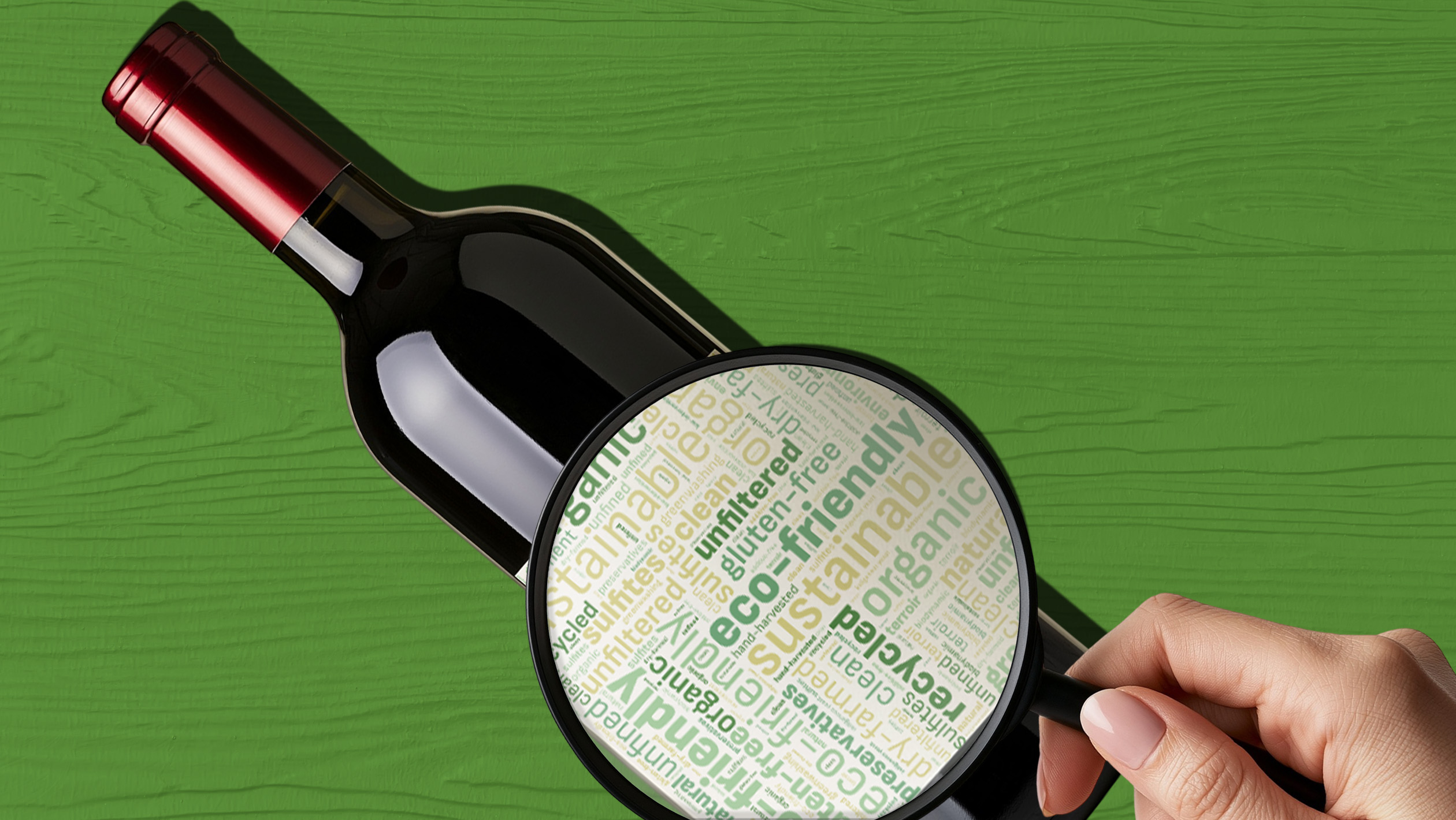
Wine producers selling in the European Union face new restrictions on how they communicate environmental claims, from sustainability labels to marketing language. Under Directive (EU) 2024/825, vague claims such as “clean,” “green,” and “eco-friendly,” among others, are subject to stricter requirements, forcing producers to reassess how they describe their products.
With the September 27 enforcement of Directive 2024/825, shoppers browsing European wine shelves should no longer have to guess or Google what terms like “sustainable” or “green” mean as they relate to their wine. The directive, also called Empowering Consumers for the Green Transition (EmpCo), was originally introduced for all consumer products in 2024 as an amendment to two existing directives, the Unfair Commercial Practices Directive and the Consumer Rights Directive.
However, many producers who could be affected by the directive may not know it exists. “My general view is that most people haven’t even really got an awareness that this regulation is there, much less what it implies for them,” says Peter Stanbury, the research director of the Sustainable Wine Roundtable (SWR), an independent sustainability advocacy organization based in London. “There’s a big knowledge gap out there at the moment.”
Don’t miss the latest drinks industry news and insights. Sign up for our award-winning newsletters and get insider intel, resources, and trends delivered to your inbox every week.
What the Directive Targets
The newly prohibited acts include irrelevant claims, such as advertising a product as gluten-free when no product of that kind contains gluten, generic terms such as “eco-friendly” without clearly indicating what that means, and sustainability badges that aren’t backed by third-party certification, among other things. A 2020 study estimated that more than 50 percent of environmental claims in the EU were vague or misleading.
Producers won’t need to overhaul production under the new directive. Instead, they can target and remove misleading information that may appear on the bottle label. “The directive is primarily focused on consumer communication,” says Ignacio Sánchez Recarte, Ph.D., the secretary general of the European Committee of Wine Companies (CEEV). “Operators will mainly need to review their marketing, labeling, and environmental claims and ensure that these are clear, specific, and properly substantiated.”
“One thorny compliance area is old stock, which is not grandfathered in,” says Michael R. Littenberg, head of environmental, social, and governance at global law firm Ropes & Gray LLP. “Impacted companies are using stickers or additional point of sale information.”
Enforcing the New Measure
How violations will be enforced is up to individual EU nations, but widespread violations across multiple EU countries could be subject to fines of up to four percent of annual turnover. “You could end up with effectively 27 member states having different frameworks, country by country,” says Stanbury. European Union directives give each member state the end goal, and each nation must then decide how to implement the law and penalties. Some countries may lean on regulators to enforce, while others, like Germany, for example, rely on civil action from business associations or environmental groups.
The greater challenge is that, along with banning vague sustainability terms on wine labels, those terms also can’t be expressed in any consumer-facing communication—whether in marketing materials or in tableside conversations with sommeliers, for example.
As the sole retail wine and liquor chain in Sweden’s government-run alcohol monopoly, Systembolaget sees nearly every type of wine pass through its inventory. “The principles behind Directive 2024/825 are consistent with the approach we have taken for several years when assessing sustainability claims and certifications,” says Emma Östansjö, a Systembolaget sustainability specialist. “We have a dedicated unit that reviews claims on products to ensure they comply with relevant legislation and are not misleading to consumers.”
In practice, this means substantiating a claim with something concrete. Third-party certifications like Demeter are one route, with verifiable practices (such as “hand-harvested” or “dry-farmed”) or quantifiable data (“25 percent less carbon footprint since 2023”) also acceptable. Producers may make specific claims if they can validate them. Certification schemes must be based on “independent third-party verification,” have requirements that are “publicly available,” and must “allow for the use of a corresponding sustainability label,” according to a questions and answers document released by the European Commission in September 2026.
But with terms like “natural,” it’s often unclear if that refers to farming, winemaking, or both. According to the Commission, if “natural” is used in a brand or product name “in a way that is likely to create an environmental association for the average consumer,” it may count as an environmental claim. The winemaker will have to spell out exactly what it means and be able to prove it if investigated; otherwise, it’s treated as a generic claim, which is banned unless a winemaker provides substantiation. As with all other cases, regulators will make a decision on a case-by-case basis.
Another concern is that EmpCo could dilute the quality of third-party audit programs, and, as the number of certifications grows, the question of which certifications are “legitimate” could soon be raised. That’s a concern of Stanbury, who has seen some vanity certifications crop up during his tenure at SWR. While he thinks the bar should be raised in some cases, in others, he sees a low barrier to entry as a way to encourage participation, while “gradually increasing the [sustainability] requirements over time.”

What the Rules Mean for Wine Marketing
Although the EmpCo directive applies to all consumer goods sold within the EU, wine is particularly vulnerable as a product that is often communicated about in terms that are hard to define or pin down. Environmental claims have also become part of how wineries communicate everything from vineyard practices and production methods to packaging and carbon footprints. But wine gets no special treatment, with “restrictions and requirements as any other product,” says Littenberg.
Terms like “natural” and “low intervention” present a particular challenge because they lack universally accepted definitions and can refer to farming practices, winemaking techniques, or both.
Systembolaget views these terms “as descriptions of a production approach,” says Östansjö. CEEV is against using the term, “natural,” with Sánchez Recarte calling it “misleading and contrary to EU legal framework. This directive could bring a positive framework as it would clean the market from terms not supported by science or that are misleading—and the term ‘natural’ would be one of these.” A handful of third-party-verified natural wine certifications do exist and would therefore theoretically make the terminology legal, including Vin Méthode Nature.
Arnold Holzer, the winemaker at Eschenhof Holzer in Austria, believes there’s no better name for his certified organic wine, Natural Orange. “In our view, [the name of the wine] accurately describes the product,” he says. “According to Austrian law, the name is compliant.” His wines passed inspection under existing Austrian law about a year and a half ago.
Holzer has no plans to change the use of the word “natural.” “We also want a certain level of assurance to protect our product,” Holzer says. “I believe that organic certification, like ours [EU Organic Certification], should be a minimum standard. Additional certifications, in combination, could be beneficial, but it’s a subjective question for each winery whether it’s economically worthwhile.”
Spanish winegrower Lorenzo Valenzuela also stands by his decision to call his line of wines, Barranco Oscuro, vinos naturales, though the wines themselves do not include those words on the label. “We defend natural wine as 100 percent pure juice fermented on its own without giving the main role to technology or controlled processes,” he says. “We don’t need labels saying natural wine—we need advised consumers, transparency, and freedom of choice.”
For Fabio Bartolomei, the winemaker at Spain’s Vinos Ambiz, wines don’t have to be labeled as “natural” in order to communicate his winemaking philosophy. “I’ve always thought the debate around ‘natural wine’ is more a linguistic, semantic debate than a wine debate,” says Bartolomei, who opted to stop using the term more than 15 years ago.
By listing fermented grape juice as the only ingredient, and juxtaposing it with a list of excluded additives, including yeast, colorants, preservatives, acids, sugar, and wood chips, Bartolomei signals that he makes natural wine without saying it outright. “I believe the wine and alcohol industry shouldn’t be exempt from labeling requirements like any other product people put into their bodies,” he says. EU wine labels are now required to carry nutrition and ingredient information, often as a QR code.
What It Means for Producers
This could be a crucial moment for winemakers to decide how to communicate the full extent of their winemaking. For Eva Parga Dans, Ph.D., a professor at the Instituto de Productos Naturales y Agrobiología on the Spanish island of Tenerife, winemakers may be able to accomplish this “through [the sharing of] transparent information about production practices, ingredients and additives, and potentially through analytical measurements.”
Sánchez Recarte argues that because more than 99 percent of wine producers in the EU are small and medium-sized enterprises, across-the-board certification isn’t the only solution. “The directive does not make third-party certification mandatory for all environmental claims,” he explains. “It specifically requires certain sustainability labels to be based on certification schemes, while other environmental claims can be supported through appropriate evidence and substantiation.” Simply put, labels, badges, and seals must be verifiable by a third party, like Demeter, and environmental claims such as “made from recycled content” can only be used with proper documentation.
“Many food and beverage companies have been preparing for EmpCo for several months or more, adjusting marketing materials and campaigns, labels, packaging, etc., in advance of the September 27 required effective date,” says Littenburg. “Many smaller companies are still playing catch-up.”

What the Future Holds for Producers Outside the EU
U.S.-based producers and exporters may already recognize a similar anti-greenwashing approach; it resembles the Federal Trade Commission’s Green Guides, a playbook for responsibly marketing environmental impact to consumers, which was last revised in 2012. It’s a guidebook for businesses, and while it isn’t enforceable by law, defying it can trigger an FTC investigation.
Both measures have the same end goal of banishing confusing greenwashing claims, but they function differently. “EmpCo is prescriptive, banning some sustainability communications and imposing requirements on others, while the Green Guides are non-binding guidance, although some states have incorporated the Guides into their consumer protection laws,” says Littenberg.
But for U.S. producers exporting wine to the EU, compliance in the United States offers no protection once their bottles cross into the market. Producers will need to provide adequate substantiation to remain compliant with EU regulations.
For some U.S.-based sustainability certifiers, regulations and guardrails are just another step in the right direction. “Napa Green supports initiatives that reduce consumer confusion regarding sustainability claims,” says Megan Scott, the operations director at Napa Green. Essentially, U.S. certifications function almost like insurance to help them trade in a variety of countries.
Littenberg isn’t convinced that the U.S. will follow the EU’s lead on stricter greenwashing rules anytime soon. “It’s still too early to tell whether and how EmpCo will work in the EU,” he says. “There are some concerns that it is overly prescriptive, too onerous, and will dramatically increase frivolous litigation. An EmpCo-type regulation is probably a bridge too far for the U.S., and EmpCo may turn out to be a regulation in search of a problem.”
For Östansjö, any producers overwhelmed with the idea of compliance when selling wines in the EU should keep the end goal in mind. “Don’t let the fear of greenwashing turn into greenhushing,” she says. “If you’ve done the work, you should be able to communicate it. The key is transparency, verification, and being clear about what exactly you are claiming.”

Dispatch
Sign up for our award-winning newsletter
Don’t miss the latest drinks industry news and insights—delivered to your inbox every week.
Lauren Johnson-Wünscher is a wine and food writer based in Berlin, Germany. She holds an MBA in International Wine Business and WSET Level 3 Certification.