At a tasting seminar during the 2025 TexSom conference, presenter Chris Tanghe, MS, the director of education for GuildSomm, sniffed a wine he had been swirling during his presentation.
“This wine smells like the grapes were sunburned,” he said. It was a familiar concept to most people in the room, but few had really explored its meaning in the context of wine tasting. An attendee asked if he could explain further.
“Sunburn presents itself as having flattened all the fruit out, totally negating any perfume and nuance,” Tanghe said. “It has aspects of oxidized and cooked fruit bitterness. It smells a bit like fruit leather but with the addition of subtle notes of rubber, freshly poured asphalt, and creosote.”

Don’t miss the latest drinks industry news and insights. Sign up for our award-winning newsletters and get insider intel, resources, and trends delivered to your inbox every week.
That vocabulary isn’t just overripeness or a hot-vintage character. It’s the sensory signature of a specific physiological event that begins in the vineyard, weeks or months before crush. And as climate change pushes heat waves into regions that have never had to think about them, grape sunburn is no longer a problem confined to the hottest places.
Understanding Grape Sunburn
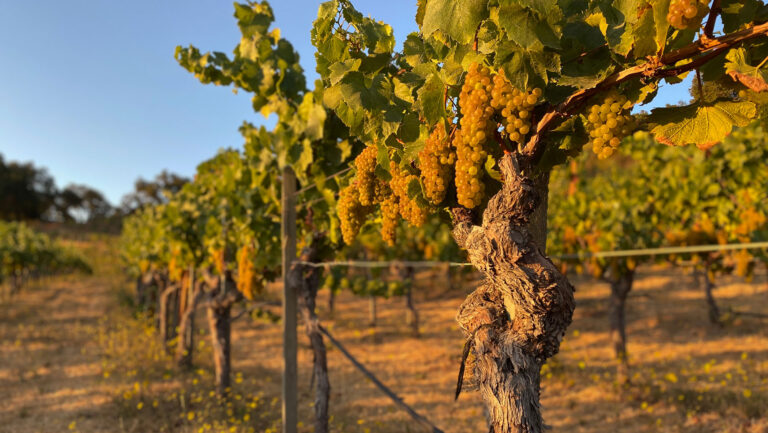
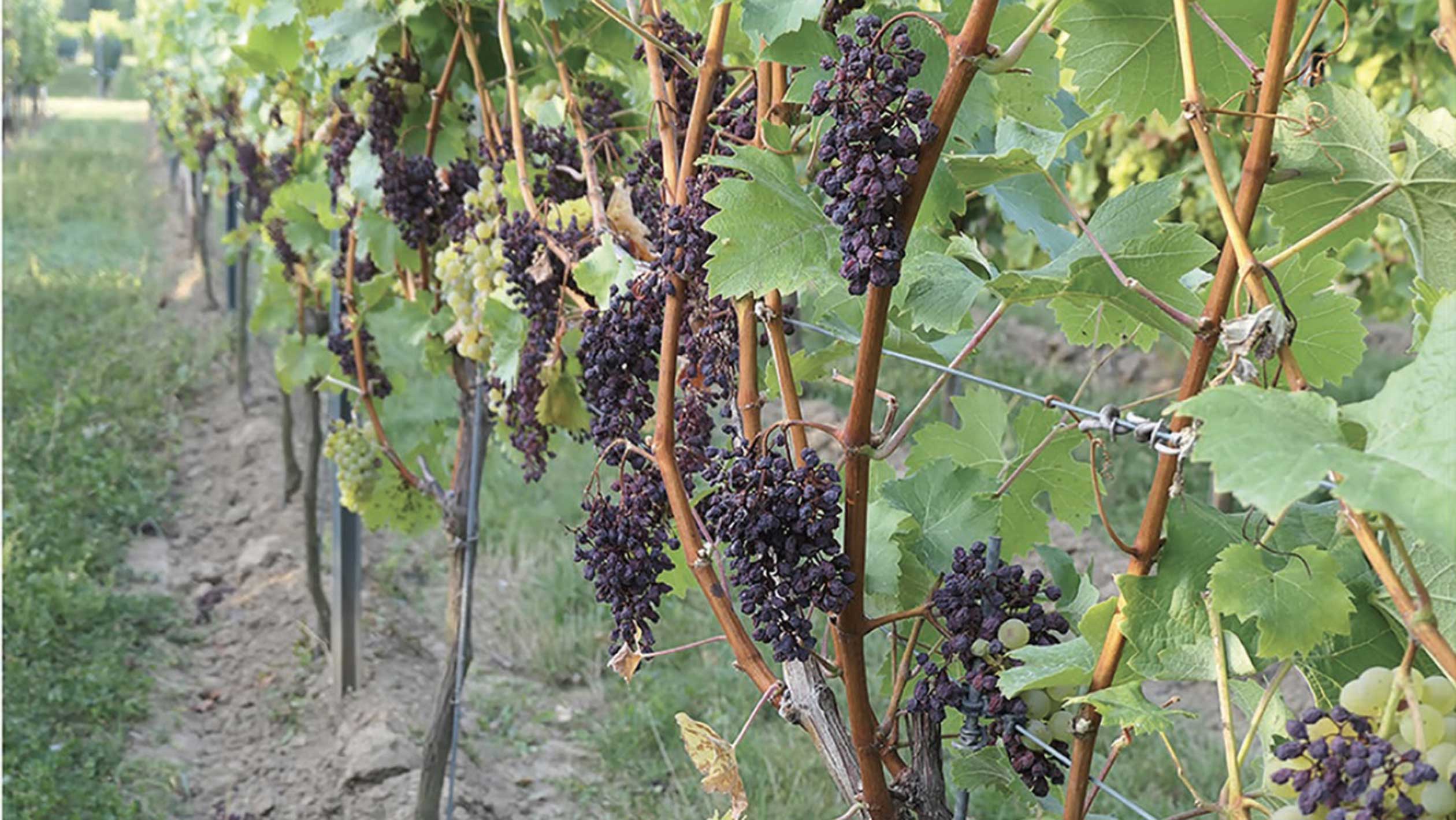
According to Joanna Gambetta, Ph.D., a wine scientist and lecturer at the University of Newcastle, Australia, whose 2021 review in Frontiers in Plant Science is among the field’s most-cited overviews, sunburn in grapes is a stress response to excess light, ultraviolet radiation, and, most critically, the temperature of the berry surface itself. Direct sun can push a berry 22 to 27 degrees Fahrenheit above the surrounding air, which means a 95-degree afternoon can make exposed fruit more than 122 degrees on the sun-facing side.
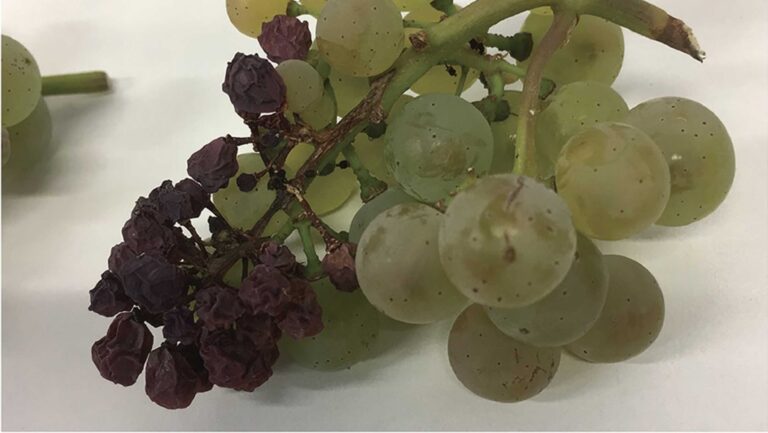
Dr. Gambetta and her co-authors distinguish two forms of the damage. Sunburn browning, the milder form, appears as yellow, bronze, or brown spots on the skin and is driven by the combination of high light and high heat. Sunburn necrosis is the lethal version in which the cells die, skins crack, and berries shrivel. It is driven primarily by extreme temperature. In apples, necrosis can occur within 10 minutes at a fruit-surface temperature of 126 degrees Fahrenheit Celsius. A similar review from Wines Australia found that fully mature Chardonnay berries can begin showing symptoms within about five minutes when berry surface temperatures reach approximately 104 to 109°F under high light conditions.
Alban Cacaret, the general manager of Commanderie de Peyrassol in Provence, offers an analogy that makes the science intuitive. “It can be compared to sunburn on a human: if the skin is gradually accustomed to exposure, there will be no problem in most cases,” Cacaret says. “But if the exposure is too intense, or sudden, or at the wrong time of day, without protection, then you get sunburned.”
The Signs of Sunburn in the Glass
When a berry’s defenses are overwhelmed, chlorophyll degrades first, then polyphenols oxidize into brown polymers. (It’s the same chemistry that browns a cut apple.) Carotenoids and the aromatic terpenes that produce floral and citrus notes break down. Tartaric acid drops. In red varieties, heat does more damage to anthocyanins than light does, according to a 2009 UC Davis report.
Steve Matthiasson, the winemaker and co-owner of Matthiasson Wines in Napa Valley, can identify sunburn in a finished wine from across the world. “I taste wine from Spain, California, France, Oregon, and pick up on sunburned grapes,” says Matthiasson. “It has both cooked green flavors and cooked fruit flavors; or astringent tannins, light color with a brown rim, and raisin characters. It will also often have high alcohol and flabby acid structure with a tartaric bite.”
Chris Tyrrell, the CEO of Tyrrell’s in Australia’s Hunter Valley, points to the aging trajectory. “These notes are only accentuated as the wine ages—excessive toastiness and earlier, premature aging is almost guaranteed,” Tyrrell says. “A smoky character becomes evident, similar to kerosene that you get in Riesling.”
How Producers Are Combating Sunburn in Grapes
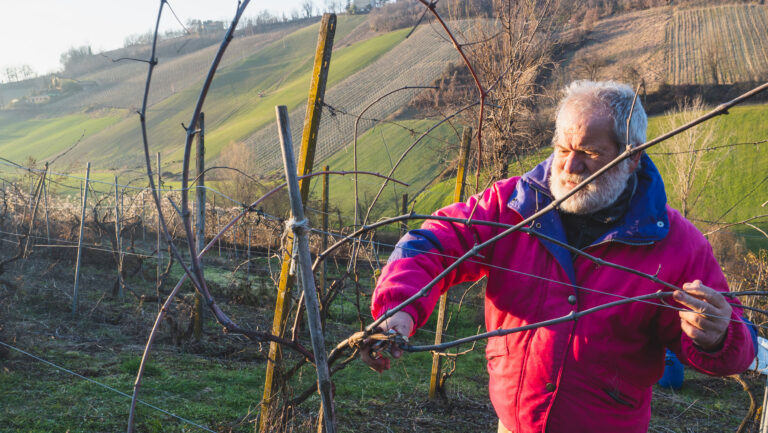
In warmer, sun-soaked climates, the orthodoxy on leaf removal has flipped in the last decade. The traditional rationale of stripping leaves to let the sun in is now widely seen as a liability, particularly in regions where leaf removal is performed for disease control and a heat wave could arrive days later. “If leaves are removed at the wrong time, such as just before a heat wave, the likelihood of sunburn increases significantly,” Gambetta says. Her research found that defoliation done at the end of flowering produced significantly less sunburn damage than defoliation done at veraison, because berries exposed earlier had time to build up photoprotective compounds.
At Chêne Bleu in the Ventoux, recent vintages have driven a categorical shift. “We have encountered issues with scorching and scalding at Chêne Bleu, particularly in 2023,” says Laura Iverson, a partner and director at the estate. A weeklong heat wave at the end of August that year, with temperatures above 40 degrees Celsius, caused significant defoliation, shriveling, and stalled maturation. “The practice of leaving grapes exposed to the sun is now a thing of the past,” Iverson says. “Leaf removal in July and August has become extremely rare, with the exception of the most vigorous Syrah vines, and is always limited to the east-facing side. White varieties are no longer subjected to leaf removal at all during the summer.”
In the Hunter Valley, Tyrrell’s has turned to kaolin clay, a reflective particle film, since 2014. “In our tests, the canopy is up to nine degrees Celsius cooler in the blocks with Surround [a brand of kaolin clay] sprayed on them,” Tyrrell says.
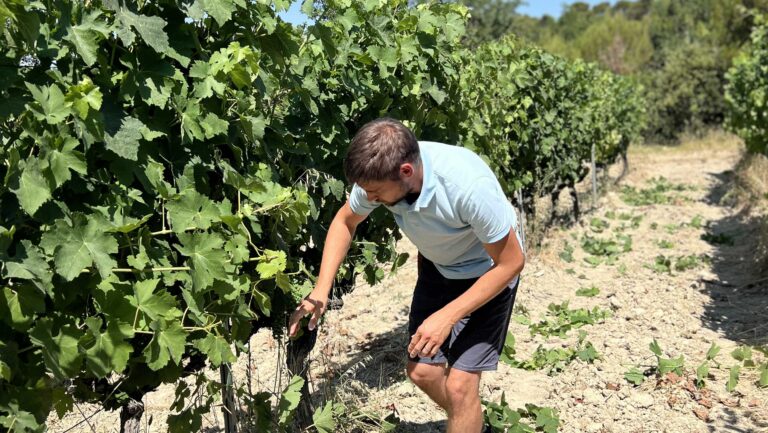
Matthiasson goes further upstream to the vineyard design itself, with regards to orientation, trellis architecture, and lateral shoots in the fruit zone. “Direct sun is a negative for color, not a positive,” he says. “And you lose so many aromas and acidity with fruit heating, even if just under the point of being sunburned.”
When prevention fails, sorting is the last defense. “We do it in the vineyard the way we harvest, others do it in the winery,” Matthiasson says. “But it is a critical step.” He quotes the late Warren Winiarski on why: “Good wine into bad wine is like white paint into black paint—the paint is still black. But bad grapes into good wine is black paint into white paint—it turns it all gray.”
Across the board, producers are recalibrating. Practices that once worked in moderate summers, such as defoliation in midsummer and exposing fruit on the east side (or sometimes both sides), are being scaled back or retimed as heat waves arrive earlier and reach further. The work of growing wine grapes in a warming climate, increasingly, is the work of keeping them in the shade.
Which means the vocabulary Tanghe used at that seminar,—fruit leather, asphalt, creosote—is likely to get more familiar, not less. The producers betting on canopy cover, kaolin, and earlier defoliation are betting that the gray, in Winiarski’s sense, can still be kept out of the glass.

Dispatch
Sign up for our award-winning newsletter
Don’t miss the latest drinks industry news and insights—delivered to your inbox every week.
Jessica Dupuy is a wine, spirits, and food writer based in Austin, Texas, whose credits include work in Texas Monthly, Imbibe magazine, Wine Enthusiast magazine, Sommelier Journal, and The Tasting Panel magazine and with the Guild of Sommeliers. A Certified Sommelier, Certified Specialist of Wine, and Certified Specialist of Spirits, she holds the Diploma in Wines through the Wine & Spirits Education Trust. Dupuy keeps her palate sharp through travel, reading, and endless tasting.