
In the vineyard, netting has long served defensive purposes: keeping out birds, blunting hail, saving crops. But as heat spikes, solar radiation, and ripening pressure intensify, that fabric is being reconsidered as a tool for something more precise: redesigning the climate immediately around the grape cluster.
The fruit zone—the narrow band where berries receive light, heat, airflow, humidity, and spray exposure—is becoming one of the vineyard’s most actively managed spaces. A well-positioned net can lower radiation load, reduce berry temperature, slow ripening, and protect acids, anthocyanins, and fruit condition during heat events. At the same time, netting can also compress canopies, limit airflow, alter spray penetration, affect phenolic development, and create new disease-pressure concerns.
As climate change pushes vineyards beyond the conditions they were designed for, growers are increasingly engineering the fruit zone rather than simply protecting it. Understanding how different netting strategies reshape the berry microclimate reveals both the promise and the tradeoffs of one of viticulture’s fastest-evolving climate adaptation tools.

Don’t miss the latest drinks industry news and insights. Sign up for our award-winning newsletters and get insider intel, resources, and trends delivered to your inbox every week.
Understanding the Science Behind Grape Shading
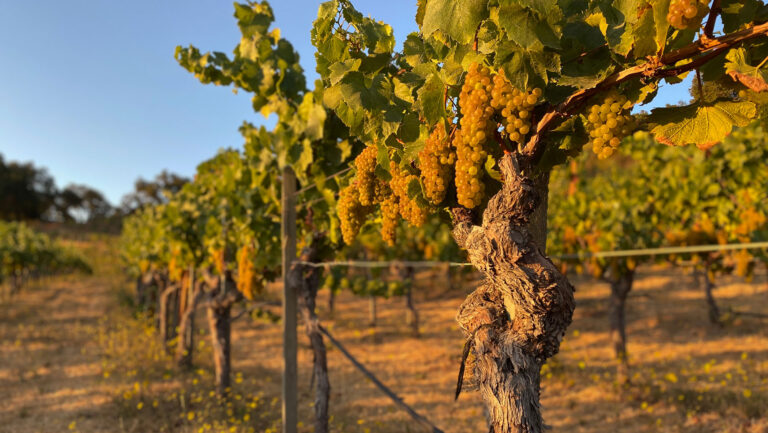
The science of shading grape clusters is deceptively complex. Grapes need light: sun exposure helps drive phenolic development and, in some regions, contributes to structure, color, and site expression in the final wines. But heat and radiation are not the same. During late-season heat spikes, sugars may continue rising even as color, acidity, aroma, and phenolic balance begin to suffer.
That distinction has shown up clearly in California research. In a 2022 UC Davis study on Cabernet Sauvignon at the Oakville Experimental Vineyard, unshaded cluster-zone temperatures reached 58 degrees Celsius during a heat event. Anthocyanins, the compounds responsible for red grape and wine color, begin to degrade when temperatures exceed about 35 degrees Celsius. In the hotter year of the trial, shaded treatments had 27 percent greater total skin anthocyanins than the uncovered control, evidence that partial shading can help mitigate anthocyanin degradation by reducing cluster-zone temperatures.
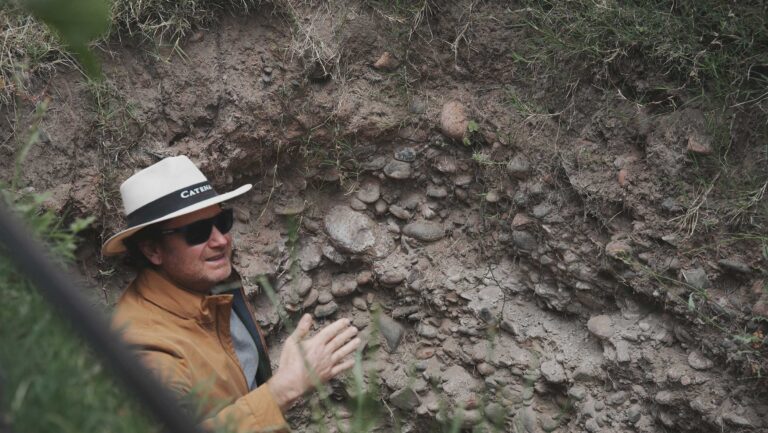
The same balance is especially important in Mendoza, where intense, high-altitude sunlight is part of the region’s identity. At the Catena Institute of Wine, research at the Adrianna Vineyard has focused on the role of UV-B exposure in grape phenolics, anthocyanins, and wine quality. The lesson from Catena’s high-altitude work is not that sunlight is inherently damaging, but that vines need filtered exposure, not prolonged direct exposure, especially during the hottest parts of the day.
“We try to make sure grapes never have direct exposure to the sun,” says Luis Reginato, the head of viticulture at Catena Zapata.
That approach shapes Catena’s canopy work. The estate does not practice leaf removal in its vineyards because the goal is not to expose clusters fully, but to let light move through the canopy in brief pulses. “What you have to do is keep the cluster zone with leaves, so light enters, but for minutes, for seconds, and then shade comes, then another flash of light,” he explains.
Hail netting is widespread in Mendoza because hail is a recurring threat, which is why roughly 90 percent of Catena’s vineyards have hail netting. But in Mendoza’s sunny, high-altitude desert climate, a standard net that intercepts about 15 percent of radiation does not necessarily deprive the vine of useful light. “In Mendoza, there is so much radiation that the plant is sort of saturated,” says Reginato.
Instead, the benefit may be more subtle. Reginato says the estate is still studying the effect over multiple seasons, but he has observed that vines under light netting can appear less stressed in very hot or dry conditions, particularly in stony soils where water stress can be an issue. The Catena Institute is now conducting an in-field study comparing nets that provide 17 percent shade, nets that provide 50 percent shade, and unnetted controls, measuring effects on vine physiology, water use, microclimate, and compounds related to berry and wine quality.
“What I notice is that the plant is a bit cooler on very hot days or in years that are very dry,” says Reginato.
Netting Used for Shade Proves Effective in Early Trials
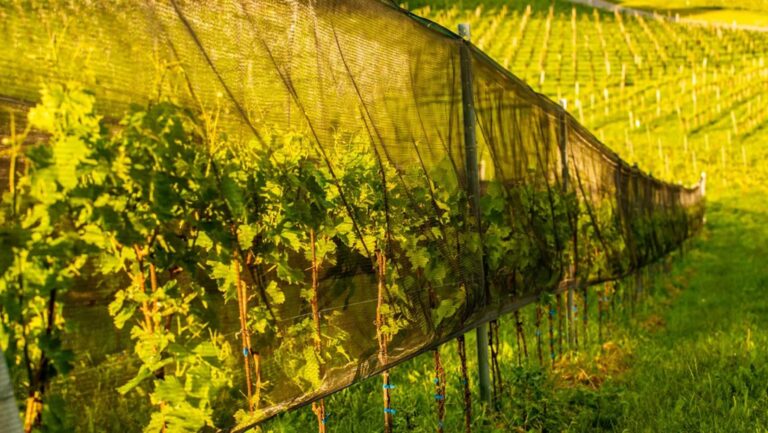
At Petra, a Tuscan Coast estate in Suvereto, Italy, the pros and cons of netting are being tested row by row. In a recent technical presentation, Marco Simonit, the vineyard-management specialist behind Simonit & Sirch, shared findings from 2025 field trials examining how vineyard techniques can adapt to climate pressure in a Mediterranean environment. The trials tested under-vine mulching, canopy adjustments, and artificial shading—the last of which produced especially striking results.
“We discovered that nets are a useful tool to protect the grapes from the sun,” says Simonit, who intends to use the 2026 growing season to collect more data.
One result from the Petra trial was particularly striking. In Merlot blocks, fruit shaded with nets on the sun-facing side of the canopy was substantially cooler than unshaded fruit, and sunburn incidence dropped sharply. Shaded Merlot clusters measured around 40 to 41 degrees Celsius, compared with roughly 50 degrees Celsius in the control. In one Merlot trial, sunburn fell from 41 percent in the control to three percent under 90 percent shade; in another, it fell from 40 percent in the control to 13 percent under 90 percent shade and five percent under 60 percent shade.
The team also tested black, green, and white shade nets, with results pointing to color as a key variable in how much heat the material absorbed.
“The black is a little bit dangerous,” says Simonit. “The white or the green seemed to be much better in terms of holding less heat.”
Shade Netting as Part of a Broader Strategy
Filtered light is only one part of a broader strategy to engineer the fruit zone. Row orientation, canopy architecture, water management, plant material, and higher-elevation site selection all matter. The goal is not simply to reduce sunlight, but to calibrate exposure so vines retain the benefits of altitude and UV light without crossing into sunburn or heat stress.
In Barolo, the question of managing beneficial UV light carries a distinct cultural and viticultural weight. Boroli, based in Castiglione Falletto, is testing hail netting in the historic Villero vineyard.
“We started [using netting] from the beginning, not for hail, but to protect the grapes from the sun, especially in the south-southwest exposition in Villero,” says second-generation owner Achille Boroli.
Working with Davide Ferrarese of VignaVeritas, an agronomist who has collaborated with the University of Turin on the subject, Boroli began evaluating different nets after seeing increasing pressure from heat and burned berries. The estate tested a more open net and a darker, more intense net, but only on the south-facing side of the row. Covering both sides, Boroli says, would risk trapping heat around the fruit, creating what he calls “a forno—an oven.”
The test revealed that the nets also have to be kept away from the clusters. If heated fabric touches the grapes, the material itself can become a source of burn.
The early, unpublished findings suggest both promise and caution. In August, the maximum temperature in Villero without netting reached 49.2 degrees Celsius. With the better-performing, more open net, the maximum dropped to about 43 degrees Celsius. But the darker, more intense net climbed above 50 degrees Celsius, showing that more shade does not necessarily mean cooler fruit.
For Boroli, the more important metric is the number of hours above a critical heat threshold. “The most important thing is how many hours we reach a temperature over 35 degrees,” says Boroli. “The grape zone without netting accumulated 210 hours above 35 degrees in the month of August. But the grape zone that had netting accumulated only 120 hours above 35 degrees.”
The effect on basic grape chemistry was less dramatic than the effect on fruit condition. Boroli says pH and acidity did not differ significantly between netted and unnetted fruit. The real difference was physical damage.
“We were concerned about the effects on pH and acidity, but the netting revealed a huge difference between burned grapes and grapes not burned,” says Boroli.
Important Tradeoffs to Consider
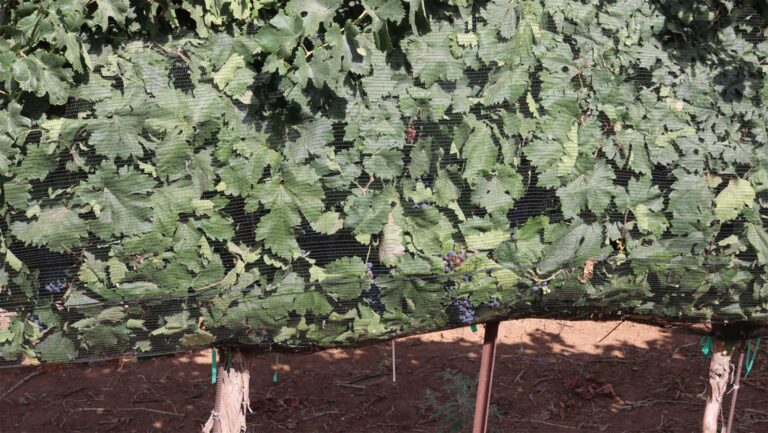
Despite these upsides, there are important tradeoffs to consider. Nets that have accumulated heat during the day can retain that warmth at night, and a sensitive grape like Nebbiolo needs cooling to preserve freshness. For this reason, Boroli removes the nets completely at the end of August to maintain freshness through the end of the growing season. The nets essentially make sure the grapes can withstand heat spikes during the hotter months such as July and August.
In the Texas High Plains, hail is a perennial threat, and black hail netting has long been a practical form of crop insurance. But a three-year Texas Tech/Texas A&M AgriLife study on Malbec and Pinot Gris showed that once nets are installed, they do more than stop hail—they change the vine’s immediate environment.
The study found that hail netting reduced canopy air temperature, leaf temperature, and vapor pressure deficit, while altering leaf gas exchange and fruit maturity. Similar to the Boroli experiment, pH and total acidity were not different at harvest, suggesting that nets can moderate the canopy environment without necessarily disrupting those basic fruit-chemistry markers. The authors also noted that netting effects remained consistent across seasons, even with different weather conditions.
For Chris Brundrett of William Chris Vineyards, who worked with Dr. Pierre Helwi on sampling black hail netting for the project, the benefits and tradeoffs are inseparable.
“The black netting showed about 11 percent UV reduction,” he says, but the net does more than filter light. It can flatten leaves, producing additional shade, and in dense canopies that can create interior leaf layers and necrotic leaves. If leaf litter collects moisture after a shower, he says, it can create “a steam box of humidity,” which his team combats by “fluffing” the net and tunneling to increase airflow in the fruit zone.
Those tradeoffs are not only physiological—they are practical. Hail netting can complicate routine fruit sampling before harvest because growers need repeated access to clusters and berries. It can also affect how sprays move through the canopy.
“When applying a plant protectant spray, canopy and fruit coverage are key,” says Dr. Justin Scheiner, an associate professor and extension viticulture specialist at Texas A&M AgriLife Extension. “Having a dense, compressed canopy may reduce spray penetration to the interior of the canopy.”
That compression can also alter airflow and light transmission. A canopy held tightly under hail netting may reduce those small but important moments of movement, meaning shoot density may need to be adjusted accordingly.
The future of vineyard netting may therefore be less about protection than calibration. Some nets may be deployed for hail and left in place through the growing season. Others may function as emergency tools ahead of heat waves. Photoselective films may allow growers to reduce the heat load from specific wavelengths while preserving enough light for photosynthesis and phenolic development. Under-vine mulches, canopy architecture, pruning strategy, irrigation, and row orientation may all become part of the same strategy.
The larger shift is conceptual. Growers are no longer managing only vines and soils. Increasingly, they are managing the atmosphere immediately around the fruit. And in a warming climate, those few inches of air surrounding a grape cluster may become one of the most consequential places in the vineyard.

Dispatch
Sign up for our award-winning newsletter
Don’t miss the latest drinks industry news and insights—delivered to your inbox every week.
Jessica Dupuy is a wine, spirits, and food writer based in Austin, Texas, whose credits include work in Texas Monthly, Imbibe magazine, Wine Enthusiast magazine, Sommelier Journal, and The Tasting Panel magazine and with the Guild of Sommeliers. A Certified Sommelier, Certified Specialist of Wine, and Certified Specialist of Spirits, she holds the Diploma in Wines through the Wine & Spirits Education Trust. Dupuy keeps her palate sharp through travel, reading, and endless tasting.