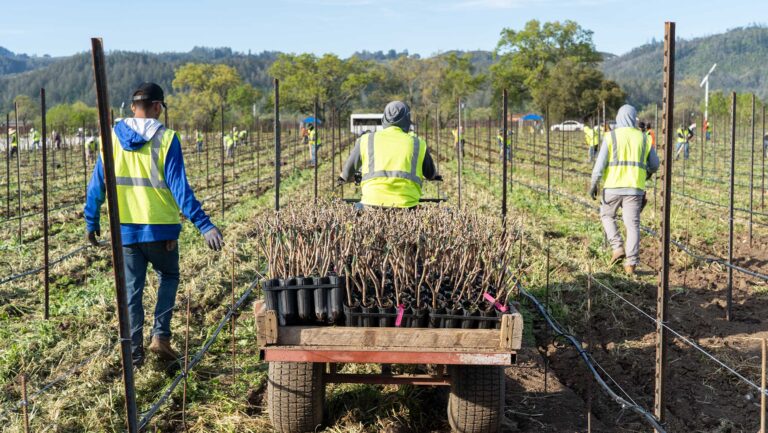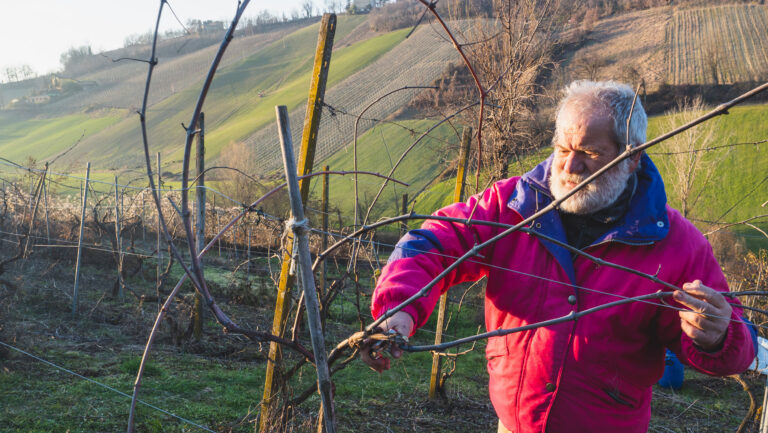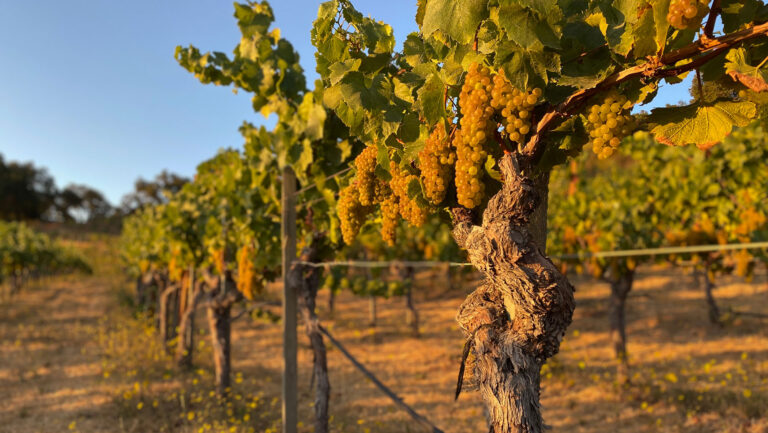
Walking the gentle slopes of Domaine du Cellier aux Moines with Philippe Pascal can feel like a masterclass in geology. But this isn’t a geological dig—it’s a vineyard in the Burgundian village of Givry. He moves through the hillside vineyard, pointing out shifts in the reddish-brown soil and picking up limestone fragments to explain the contours of the ground beneath. At the peak of the hill, his selected vineyard site, Clos Pascal, reaches just over 300 meters above sea level. Here, a steady breeze moves across the south-facing slope. On a June day when temperatures climbed well above 90 degrees, its cooling effect was a welcome refreshment.
Cistercian monks from the Abbey of La Ferté established the vineyard and cellar here in the 12th century. Pascal, an agronomist by training and former LVMH executive, acquired the property in 2004 with a goal to reposition Givry as one of Burgundy’s preeminent villages. As he observed each passing vintage, he began by studying how the different parcels of the historic site behaved differently, particularly as hotter, drier growing seasons placed new pressure on the vines. The answers, he discovered, were well below the surface.
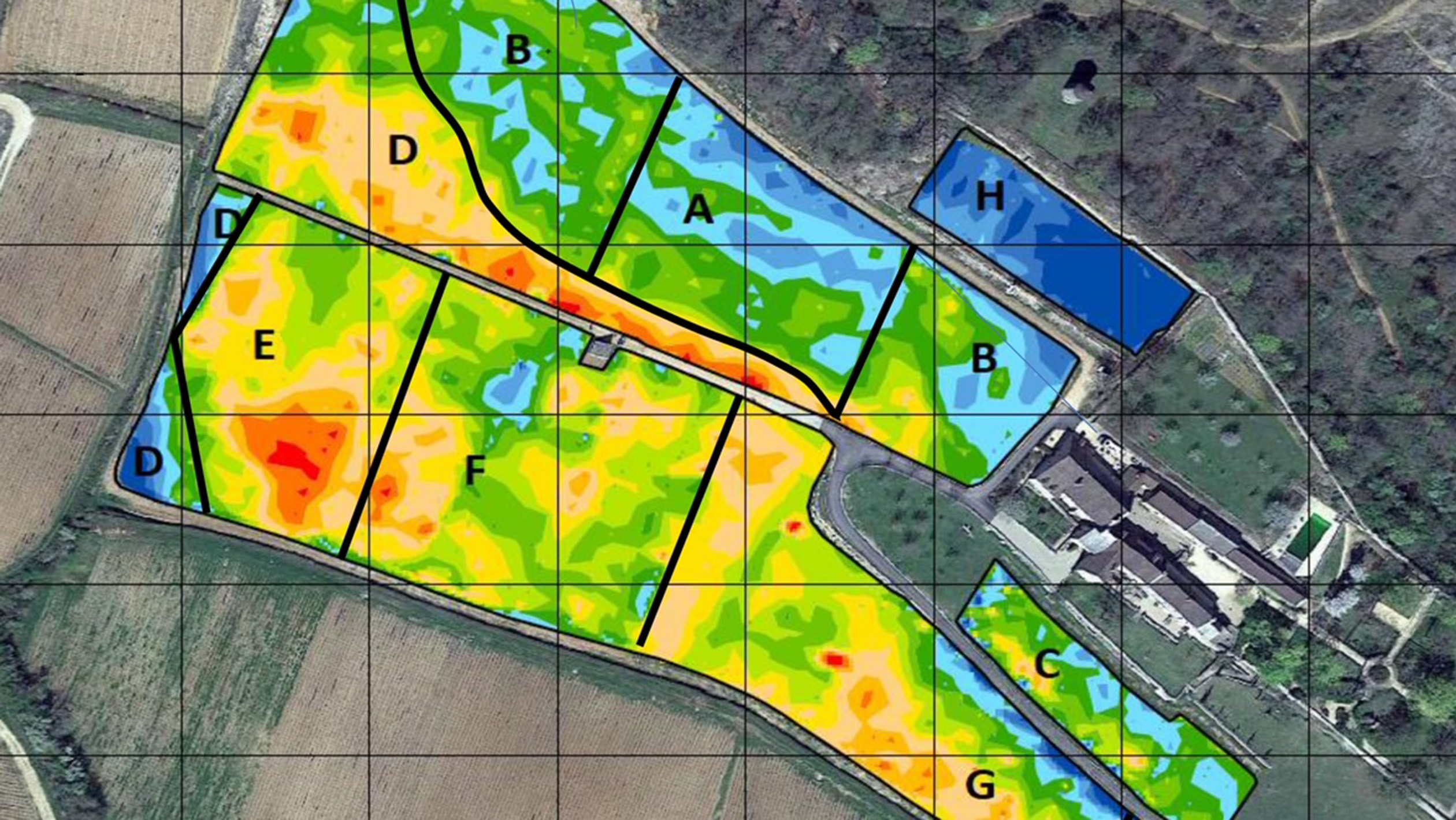
In 2021, the domain turned to electrical conductivity (EC) mapping, a process that measures how readily electrical currents move through soil to identify variations below the surface. EC data can be rendered in several ways, from two-dimensional maps at different investigation depths to vertical cross-sections and three-dimensional models. At Cellier aux Moines, the survey produced plan-view maps representing conductivity at approximately 75 centimeters and 1.5 meters. Those maps guided Pascal to dig more than 30 pits in specific parts of the vineyard, revealing significant differences in limestone density around 1.5 meters below the surface that had been far less apparent from above.

Don’t miss the latest drinks industry news and insights. Sign up for our award-winning newsletters and get insider intel, resources, and trends delivered to your inbox every week.
“As soon as you start digging, you’re reading a different book,” Pascal says. “We really wanted to understand which book we were reading from the depths at which the roots are busy.”
EC mapping can completely change the picture of a vineyard and provide vineyard managers with much better data for managing the vines. SevenFifty Daily spoke with winemakers and vineyard consultants working with EC around the world to learn exactly how the technology works and how it can be used to better understand the needs and output of a site.
Understanding Electrical Conductivity Mapping
Pascal’s approach owes much to Pedro Parra, an internationally renowned Chilean terroir consultant whose work combines geophysics, soil excavation, roots, and wine. Trained in forestry and precision agriculture, Parra later completed doctoral work on terroir in France. EC mapping is one of the key tools used in his work.
“An electrical conductivity map shows you where the vineyard is changing,” Parra says. “It does not tell you by itself what is causing that change underground. That discovery comes later.”
The test works much like an induction cooktop or wireless charging device in which energy is transferred through a changing electromagnetic field rather than through direct electrical contact. To perform the survey, a wire coil transmitter generates a magnetic field that penetrates the soil to induce small underground currents. A second receiver coil is used to measure the resulting electromagnetic response, which gives a reading on the apparent electrical conductivity of the area. With an electrical current, moisture, clay, salinity, porosity, and compaction can all influence the reading, giving Parra a guide to understanding the electrical variability of the underlying geology.
Parra uses the resulting map as his first step to target soil pits, then studies the geology and roots to determine what produced the electrical difference, often returning to vineyards across several vintages to compare those findings with vine and wine behavior.
“EC becomes my guide for digging soil pits,” he says. “It tells me where a pit will teach me the most.”
EC Maps in Practice
Parra’s work has influenced vineyards worldwide, from Europe and Australia to North and South America, with growers using EC mapping to reconsider how vineyards are planted, irrigated, divided, and harvested.
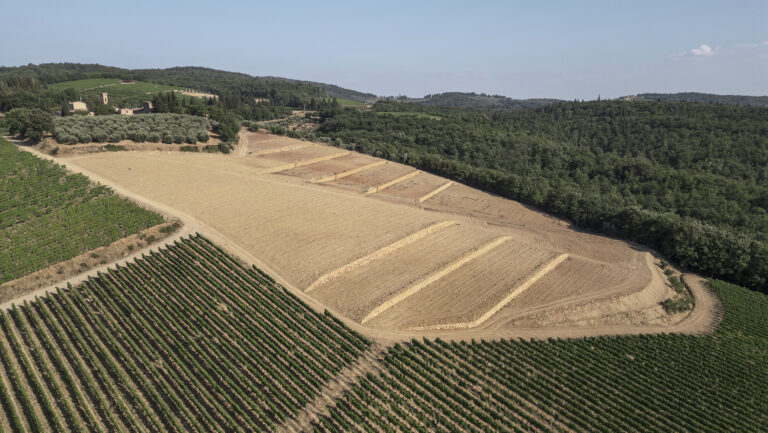
Italian winemaker Alberto Antonini, the cofounder of Mendoza’s Altos Las Hormigas, has spent more than three decades making and consulting on wines in many of the same places as Parra. In fact, they often work together. Antonini explains that an EC map gives growers a roadmap to establish polygons, or vineyard parcels that have relatively consistent soil conditions. In new vineyards, Antonini says, those divisions can inform rootstock, clone, and variety selections as well as how to design planting density, row spacing, and irrigation placement.
“You design all the polygons,” he says, “and that allows you to understand a bit more about potential differences among all of those decisions.”
With existing vineyards, the options are more limited, but Antonini argues that EC maps can still help influence how to restructure irrigation architecture, vine pruning, and canopy management strategy, all of which have a direct impact on the resulting wines. The harder question is whether these underground distinctions produce measurable differences in the vines themselves.
At Cellier aux Moines, Pascal has seen the proof, particularly in ripening. For the 2026 vintage, Pascal harvested two neighboring Pinot Noir parcels, both planted with the same massal selections. One had been conventionally trimmed, while the other was tressed, a practice in which shoots are braided or folded rather than cut. The domaine has increasingly used tressage in areas where EC-guided soil work identified denser limestone and lower water reserves. While the acidity and phenolic maturity of the resulting wines were essentially the same, the trimmed parcel reached 14.5 percent potential alcohol, while the tressed parcel reached 13.6 percent.
Research in Bordeaux suggests that electrical differences underground can correspond with measurable differences in vine behavior. In a 2025 Médoc study, geophysicist Myriam Schmutz and colleagues used two complementary methods to characterize those differences. Electromagnetic induction (EMI) allowed them to move rapidly across the vineyard and measure apparent electrical conductivity at six investigation depths, producing plan-view maps of spatial variation. Electrical resistivity tomography (ERT), by contrast, sends current through electrodes in the ground and measures resistance, producing more detailed vertical cross-sections of subsurface electrical properties. The researchers used those ERT profiles to calibrate and interpret the broader EMI data, ultimately producing conductivity maps at specific depths. Soil pits and sampling then connected the electrical patterns with sandy, transitional, and clay-rich zones. Leaf measurements and hyperspectral imaging allowed them to test whether those below-ground differences were reflected in the vines. Some of the strongest relationships appeared around 50 centimeters deep, within an important rooting zone.
Those relationships differed over two growing seasons. In 2022, leaf nitrogen showed a strong relationship with inverted electrical conductivity below roughly 50 centimeters; in 2023, leaf water content showed the stronger relationship. It’s worth noting that the study determined that the direct correlations between leaf traits and apparent conductivity alone were present but more modest, illustrating how weather, vine phenology, and soil context can alter what the electrical signal means biologically.
The Limitations of EC Mapping
Vintage-to-vintage variability is one reason producers are cautious about drawing conclusions too quickly. At Isole e Olena in Chianti Classico, technical director Emanuele Reolon sees conductivity mapping as another layer of information to test against years of vineyard observation. The estate already had a long history of soil mapping and parcelization when it adopted the technology in 2024.
“It taught us that we didn’t know enough about our soil,” Reolon says, “and now we have a starting point to work with. We are always looking to add new perspectives to our knowledge.”
The work has both confirmed expectations and produced surprises significant enough to make the estate reconsider rootstocks and planting density. But Reolon expects another three to five years of observation before drawing firm connections among soil, vintage, and vine behavior.
Still, EC mapping is not a shortcut to terroir. At Evening Land’s Seven Springs Vineyard in Oregon, winemaker John Faulkner used EC to test whether the 85-acre site contained meaningful underground units within its broadly volcanic soils. The mapping showed variation, but roughly 20 pits failed to reveal geological boundaries cleanly enough to justify the divisions he expected.
“The algorithm that visualizes the EC data made the soil boundaries seem more discernible than they were to me,” he says.
Faulkner also tested the divisions in the cellar. In 2024, before the pits had been completed, he vinified fruit according to the EC-defined zones. Parra warned him that separating the wines before understanding what the electrical signal represented underground would probably prove futile.
“In fact, it seems he was right,” says Faulkner, adding that some visible differences in the vines still appear to track with boundaries on the conductivity map, but “I’d be overstating things to say we understand why just yet.”
Parra says that this type of uncertainty is normal. Equipment choice, calibration, field technique, survey design, interpolation, and geostatistical processing can all introduce error before a map is even interpreted. But even technically sound data requires context. A conductivity reading is not specific to one soil property. The same value can result from different combinations of moisture, clay mineralogy, salts, porosity, compaction, or geological material.
“The real value of electrical conductivity comes from showing where a site changes and directing investigation toward the places most likely to explain why,” says Parra.
Or, as Pascal puts it, “EC is just a tool. It is not the Bible.” The map may show growers where to dig; what matters is what they find, and whether the vine and wine bear it out.

Dispatch
Sign up for our award-winning newsletter
Don’t miss the latest drinks industry news and insights—delivered to your inbox every week.
Jessica Dupuy is a wine, spirits, and food writer based in Austin, Texas, whose credits include work in Texas Monthly, Imbibe magazine, Wine Enthusiast magazine, Sommelier Journal, and The Tasting Panel magazine and with the Guild of Sommeliers. A Certified Sommelier, Certified Specialist of Wine, and Certified Specialist of Spirits, she holds the Diploma in Wines through the Wine & Spirits Education Trust. Dupuy keeps her palate sharp through travel, reading, and endless tasting.