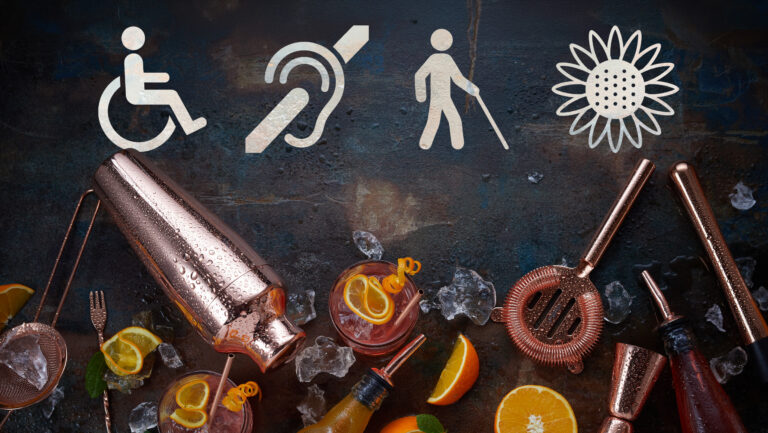
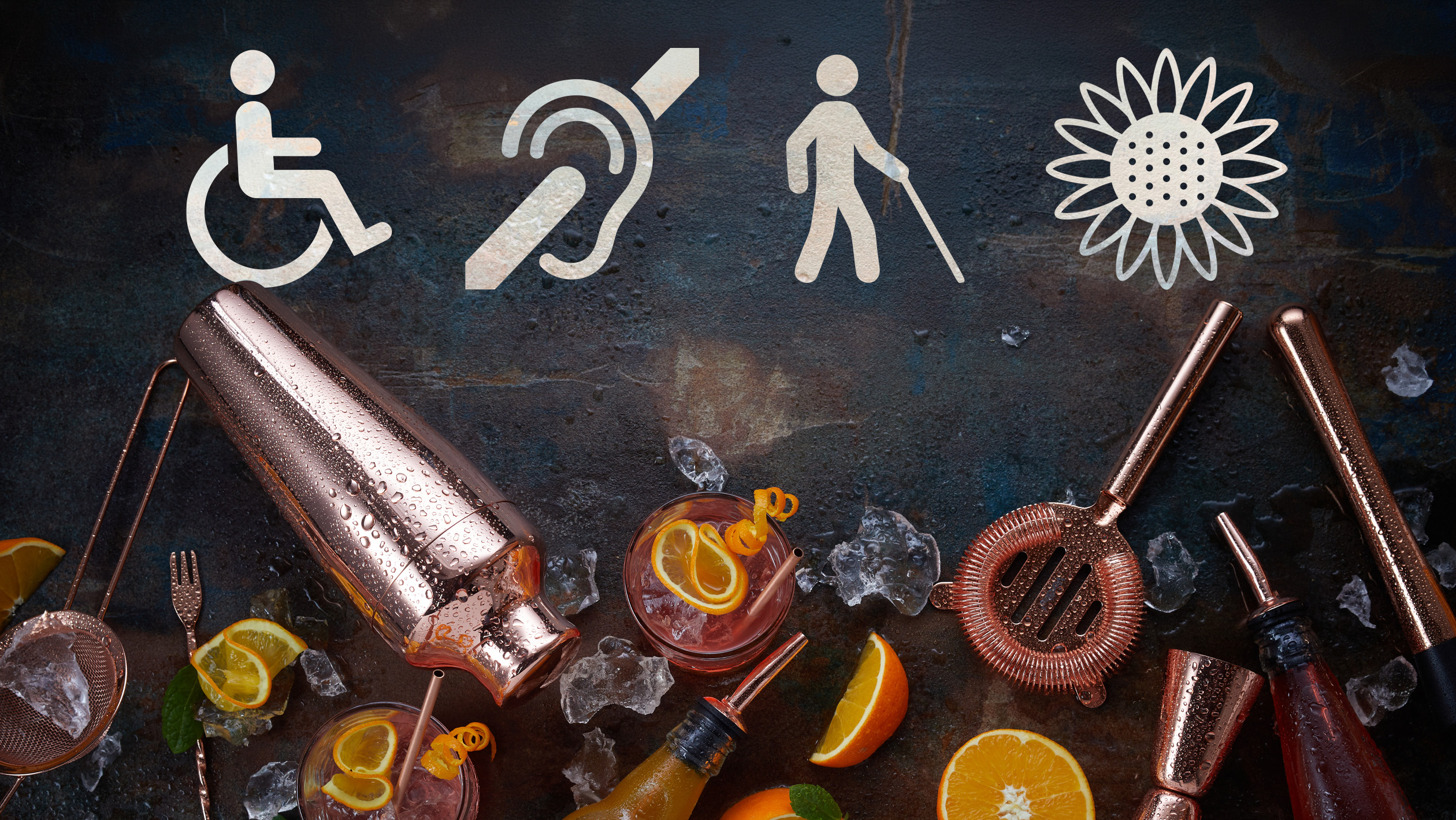
According to the U.S. Centers for Disease Control and Prevention, 28.7 percent of American adults have some sort of disability. This is a population that’s largely gone ignored by the bar and hospitality industries at large and thus excluded from gathering spaces. Venues may not even realize they’re missing this community as customers. Motivated by the need for better inclusion plus the economic potential of expanding audiences, organizations are forming to help bars address this oversight—and more bars are taking advantage.
In New York City, Slatin Group trains hospitality and tourism business staff on how to better serve members of the disabled community. Wine on Wheels, which was founded by sommelier and wine shop owner Yannick Benjamin, also prioritizes “social accessibility,” familiarizing hospitality industry members with the experiences of those with disabilities. Addressing visual and cognitive disabilities, the app RightHear enables bars and restaurants to make their spaces easily navigable using Bluetooth beacons and markers that guide app users. A disability inclusion specialist and the founder of nonprofit Inclusive Saratoga and consultancy MCH Strategy, Meghan Connolly Haupt advises venues on accessibility as both an inclusion practice and business strategy.
In Greece, drinks journalist Denny Kallikova and Dimitris Alpanezos cofounded Vision to enable visually impaired people to participate in the hospitality experience as independently as possible through audio-narrated, enlarged-text, and braille menus; staff training; and specially designed tools to help both servers and guests with the placement of drinks and food. Currently in its first pilot stage, Vision has partnered with Tales of the Cocktail and the Campari Academy to connect with bars around the world; so far, 11 bars, one restaurant, and one agritourism venue in Greece have participated in the program.
Don’t miss the latest drinks industry news and insights. Sign up for our award-winning newsletters and get insider intel, resources, and trends delivered to your inbox every week.
These organizations help bars realize the community they’re overlooking—and the customers they’re losing—by failing to accommodate the disabled population beyond the requirements of the Americans with Disabilities Act (ADA). And they’re aiding a growing number of these bars in course correction.
The Need to Think Bigger Than ADA Regulations
When the ADA was passed into law in the United States in 1990, it standardized measures like ramps, handrails, accessible restrooms, and braille on signs. But there is much more known about different kinds of disabilities now. For instance, over 90 percent of the visually impaired community today can’t read braille, notes Idan Meir, the cofounder and CEO of RightHear. There’s a world of better guest accommodation for bars to delve into, like the RightHear app that guides users from their phones instead of forcing them to rely on braille.
When a hospitality venue ignores this reality, it misses out on even more than the 28.7 percent of the population with disabilities, Connolly Haupt points out, as that statistic doesn’t include family and friends. As the mother of a child with physical and cognitive disabilities, she reasons, “Every time our family can go to a place that can accommodate my daughter, that’s a four-person bill.”
Why, then, have bars and restaurants historically not gone beyond ADA requirements to welcome disabled guests? In an industry running on razor-thin margins, an owner may assume accessibility upgrades demand capital they simply don’t have. “I think hospitality has traditionally understood accessibility primarily in physical terms,” says Kallikova. She notes that an accessible entrance and restroom are essential, but access to a space is not the same as access to an experience. “Can I independently understand what you offer?” she asks of a bar’s service accommodations for disabled guests. “Can I choose what I want and know what it costs? Can I understand what has been placed in front of me? Can I interact with the service without having to rely continuously on the person accompanying me?”
People without disabilities likely don’t realize just how unwelcoming spaces can be even if they have all the proper ramps and restroom facilities. At the heart of real accessibility lies a staff better trained for not just accommodating guests with disabilities, but respecting their independence and dignity.
“Many people with disabilities don’t feel comfortable going out,” says Peter Slatin, the founder and president of Slatin Group. “They’ll be stared at, interrupted by well-meaning or not well-meaning people. They’ll be condescended to, they’ll be grabbed—I’m frequently grabbed.” Slatin, who is blind, recalls one of the experiences that set the wheels in motion for his education work: His guide dog had always been welcome at a food hall he frequented, until one day, he was suddenly informed it wasn’t. “Their lawyers had advised them that with my dog I was a liability,” Slatin says. It became clear hospitality venues needed a far better understanding of the disabled community.
Bars Don’t Know What They Don’t Know
There’s also a simple lack of awareness. “When we reach out to bars asking, ‘Would you use [RightHear]?’, they say, ‘We haven’t had a blind person ask for this,’” Meir says. “Well, blind people aren’t coming in because they don’t feel comfortable.”
“When a group of guests is largely absent from a space, the need for change can remain largely ‘invisible’ too,” Kallikova reasons. Bars don’t feel accessible to disabled people, so they don’t patronize them. Those bars never see disabled guests in their spaces, and assume there isn’t a need for better accessibility. But that’s changing now.
“People with disabilities have been out of sight, out of mind for most of history. Now we have the ADA, so there’s a first generation born into a world where the rights of people with disabilities are rights under law, rather than being decided by individual businesses,” Slatin says. “More people are out and about, and younger people with disabilities are more likely to become activists and more willing to be in the spotlight … change is happening gradually as more attention is paid to accessibility needs.”
Visibility is growing for people with disabilities, and those who don’t have disabilities themselves are becoming ever more aware of how the former are treated. Slatin cites a yoga class at a retreat in which the instructor completely ignored him while adjusting other students throughout the session, then touched him without asking after the class to guide him out. Other people in the class told him how surprised and sorry they were to see this. If a bar mishandles service for a guest with disabilities, they risk not only permanently losing that customer, but also those who witness any mistreatment.
The Agents of Change
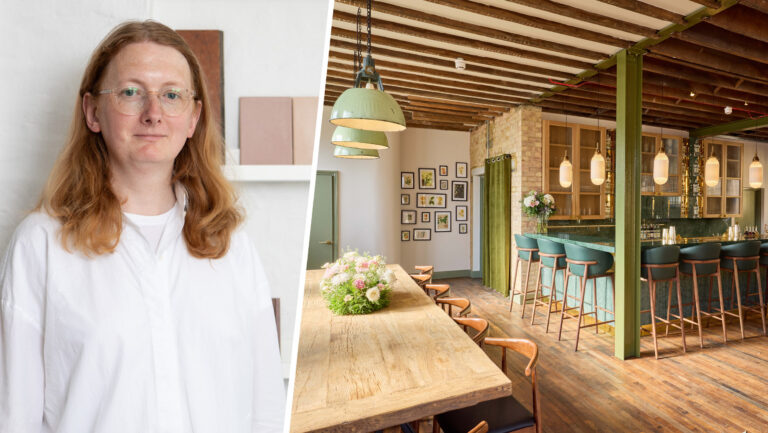
In the same way young people with disabilities sharing their experiences on social media can open up the accessibility conversation, it helps when influential bars lead the way on upping their accommodation. London architecture firm Transit Studio has worked with prestigious bars, implementing accessible design for notable names like the Fords Gin Cocktail Bar. Transit Studio founder Zoe Masterton-Smith says one of the challenges in designing these spaces is working with the client to accommodate different audiences, incorporating various kinds of seating and restrooms that are accessible but don’t feel hospital-like. It takes an elevated level of intention to create a space navigable for those with mobility issues while still in line with the bar’s aesthetic. The work Masterton-Smith has accomplished for Fords is proof this can be achieved.
Wielding similar influence, all of the Greek bars partnering with Vision are on the World’s 50 Best Bars list or extended 51 to 100 list. Dimitris Kiakos, the co-owner of To Lokali in Athens, says he already wanted to better serve visually impaired guests. “About 25 years ago, I worked at a coffee shop right next to the School for the Blind, so we had people with visual impairments coming in regularly,” he says. “What I learned from those encounters was quite simple: the starting point should always be hospitality. You welcome the person in front of you as you would welcome any other guest. You don’t want their disability to define the whole interaction.”
However, the To Lokali team didn’t have a structured accessibility system in place before Vision. The more methodical approach has helped Kiakos realize, “Good intentions are important, but they’re not always enough. There are practical barriers—access to information, being able to make an independent choice, knowing what is available or where things are—that we may simply not think about unless someone points them out.”
Konstantinos Theodorakopoulos, the co-owner of The Bar in Front of the Bar in Athens, says they’ve adapted Vision’s accessible digital menu tools, tactile table tools, and team service protocol.
“The protocol is important because accessibility isn’t only about providing information digitally,” he notes. “It also affects the way we interact with the guest and communicate practical things during service, such as where a drink or an object has been placed.”
When first presented with the Vision pilot, Theodorakopoulos realized he couldn’t remember serving a blind guest in a bar. “It made me understand that lack of visibility can also mean lack of awareness. If you don’t see visually impaired guests in bars, you may never stop to ask why they aren’t there or whether there are barriers you simply haven’t noticed,” he says. “For me, that is one reason why expanding awareness—and having more venues actually address accessibility—is so important.”
Gambit Bar in London won a 25/2026 Blue Badge Access Award, which recognizes excellence in accessibility across hospitality. Gambit and its home, The Newman, were designed with inclusion in mind. Newman head of rooms Sandia Scott says they physically walked through what an entire guest’s journey would be, identifying where any potential barriers could arise and how to remove them.
“Our teams are encouraged to understand individual requirements, communicate clearly and, importantly, never make assumptions about what a guest may or may not need,” Scott says. “The conversation should simply be: ‘How can we make your experience with us as comfortable and enjoyable as possible?’” This approach is echoed throughout initiatives like Vision and Slatin Group’s training. Service accommodating people with disabilities should be a two-way conversation—not conflating “accommodation” with doing everything for the guest and stripping them of their independence.
“We don’t believe accessibility simply means disabled access,” Scott says. “It is about giving people different ways to enjoy the same experience.”
Charting a Feasible Course to Inclusion
Not every possible measure is realistic for every bar. Some are in historic buildings and are limited in what they can modify, while some don’t have the budget. Accessibility consultants are adamant that bars should just consider what they can reasonably accomplish.
RightHear’s space-navigating technology costs $49 monthly, and bar teams can install the system themselves in about 10 minutes. It’s a meaningful change with a very low lift. For any bar, too, one of the steps with the biggest impact just requires a little extra time: training.
“One thing anyone can put in place is social accessibility,” says Wine on Wheels’s Benjamin. When he ran the now-shuttered New York City restaurant Contento, he asked Slatin to talk about the experiences of a blind guest to his staff. “Helping your staff understand this should be just as mandatory as the ADA-required grab bars in bathrooms,” he says. Benjamin recommends bars reach out to members of their own community to share how they interact with these spaces, what they struggle with, and what would make their experiences better.
“Don’t assume accessibility necessarily means redesigning your entire space,” Kallikova says. “Begin by looking at the experience from the guest’s point of view and identifying where unnecessary dependence occurs.” For service, she says, staff should ask rather than assume whether assistance is wanted, and talk directly to the guest instead of their companion. “Start with people, not equipment.”
Instead of worrying about a change that can’t be made, Connolly Haupt encourages bars to think about what they can do, and always communicate about any issues, like a step they can’t change because they’re in a historic building. “Communication is a huge piece of accessibility and inclusion. I always tell my clients it’s better to communicate what you’re doing than worry about what you can’t do,” she says.
Connolly Haupt also recommends venues add language to their menus along the lines of, “We want everyone to feel welcome in our establishment; if there’s anything we can do, please just let us know.” She recalls one brewery owner who added this language on menus. “He said, ‘it dramatically changed how we see ourselves, how our community sees us, and we see a tangible benefit financially,’” she notes.
Menu language—and staff training to back it up—is free to implement. The more bars consider diverse experiences possible within their spaces, the more free and affordable measures they can identify.
Bars that take some of these steps make their spaces accessible to that 28.7 percent of the population with disabilities, plus their friends and families. Slatin points out the word-of-mouth power in this: Members of this community share with each other which places to avoid because they’re not accessible, and they also share what places to patronize because they can count on a positive experience. Inclusion is vital, but it’s also an obvious step toward better business.

Dispatch
Sign up for our award-winning newsletter
Don’t miss the latest drinks industry news and insights—delivered to your inbox every week.
Courtney Iseman is a drinks writer and consultant based in New York City. She is level-one certified in spirits education by the Wine & Spirit Education Trust and a cicerone certified beer server. Her work has appeared in outlets including The Washington Post, Bon Appétit, Inc., Slate, Food & Wine, Wine Enthusiast, Punch, VinePair, and Craft Spirits & Distilling.