We’re in the age of the $20 cocktail, as drinkers are well aware. It’s easy to complain about the sticker shock, but for many bar owners, the final price is the result of a delicate—and difficult—dance with increasingly unpredictable elements. Labor costs are rising, as are utilities and rent. There’s breakage, shrinkage, and operating costs to consider.
Then factor in the bar industry’s current state of flux. Tariffs and inflation have escalated the price of almost every raw ingredient, from the lime juice and agave spirits for Margaritas, to the English gin and French vermouth for Martinis.
“Prices have inched up. Inflation and other external factors have come for everyone,” says Seth Watson, the owner of Distillery of Modern Art in Chamblee, Georgia. “Tariffs and inflation means we raise prices faster than we would normally, and when our guests may be less willing to come out and join us.”
Don’t miss the latest drinks industry news and insights. Sign up for our award-winning newsletters and get insider intel, resources, and trends delivered to your inbox every week.
Alex Strange, the bar director at Holiday Cocktail Lounge, agrees: “It’s 100 percent believable that your Margarita may creep up to $25 in the next ten months.”
Profitability is a tightrope act. Proprietors have to offer a drink that appeases the guest’s wallet and palate. But the price also has to satisfy those who are signing payroll, paying purveyors, and handling all the other elements of keeping the lights on.
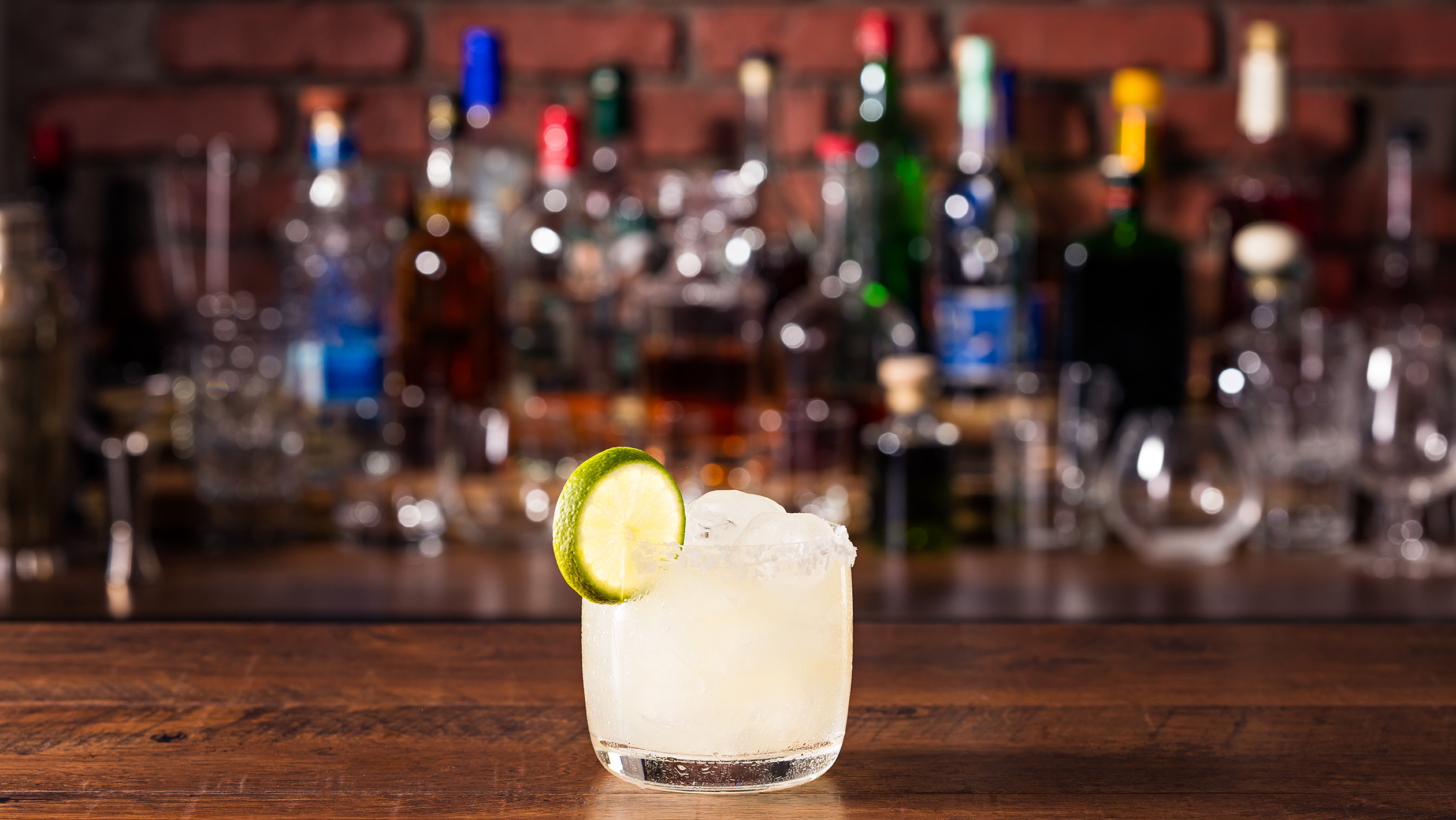
Using the nation’s most popular cocktail as an example, SevenFifty Daily talked to venues across the country to understand how they build myriad costs into the prices of their Margaritas.
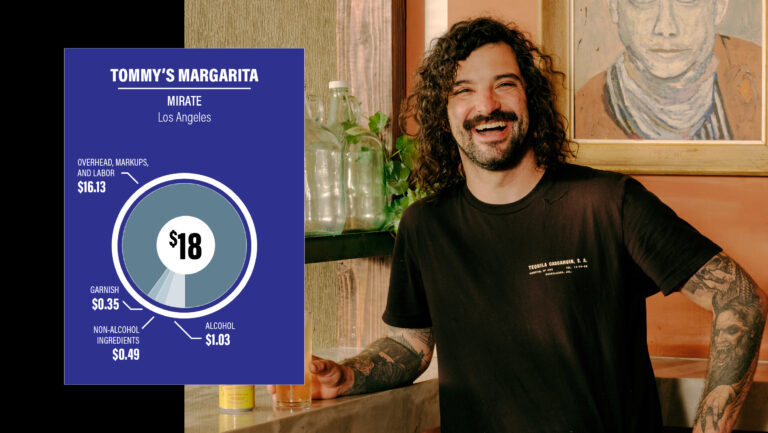
*Mirate includes their overhead, markup, and labor costs together.
The Bars and the Drinks
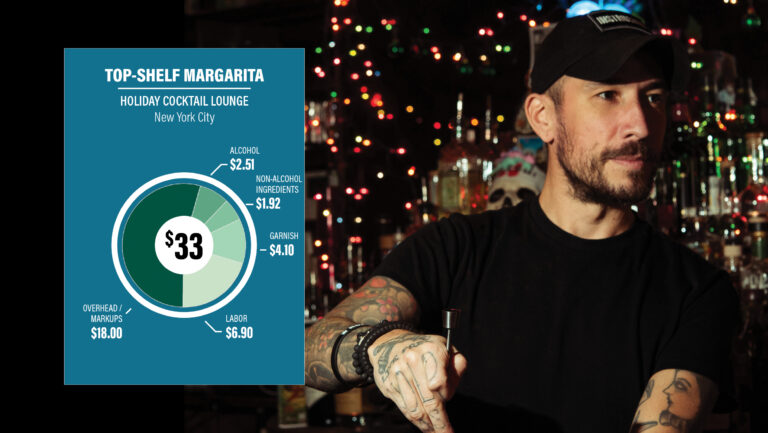
Top-Shelf Margarita, $33, at Holiday Cocktail Lounge, New York City
A classic Margarita at Holiday Cocktail Lounge, one of the East Village’s most iconic and industry-heavy dive bars, is $18, made with the usual tequila, Cointreau, and lime. But to contextualize what a higher-end pour looks like, Strange broke down what a two-ounce Casamigos Margarita costs in New York City.
Tommy’s Margarita, $18, at Mirate, Los Angeles
This Tommy’s Margarita variation—made with tequila, lime, and a homemade substitute for agave nectar—is served at Mirate, a 180-seat, multi-story Mexican restaurant and bar in the Los Feliz neighborhood.
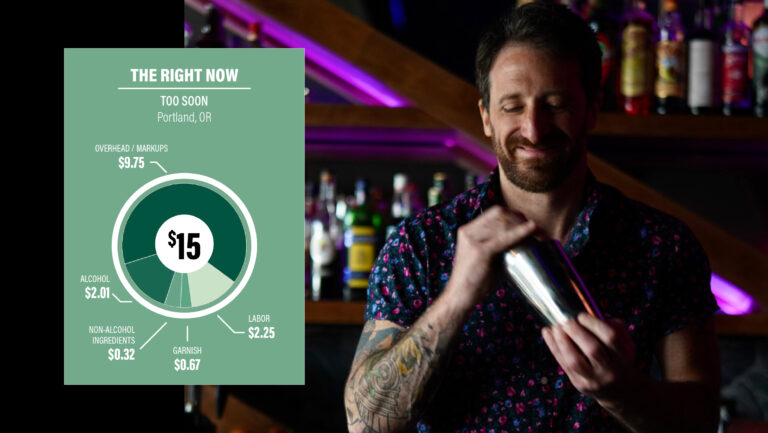
The Right Now, $15, at Too Soon, Portland, Oregon
Too Soon, a neighborhood bar with a cocktail lean in Portland, Oregon, serves a Margarita-ish drink called The Right Now, made with tequila, Cynar, lemon, and simple syrup. “It’s like a sour and Margarita had a baby,” says co-owner Nick Flower. The drink is a nod to the Too Soon, a classic cocktail invented by Sam Ross.
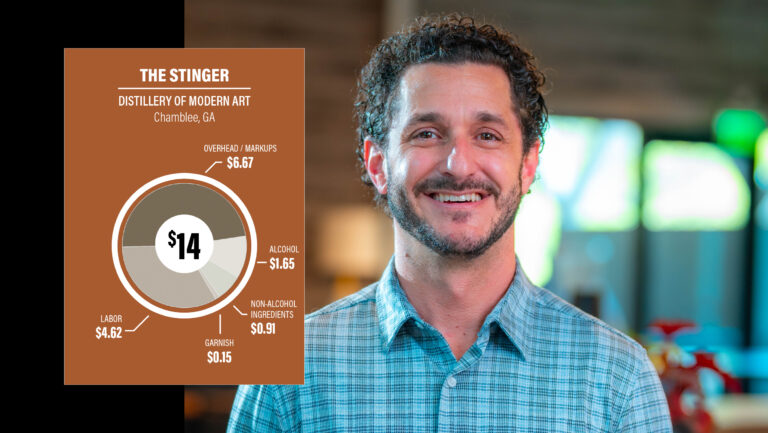
The Stinger, $14, at Distillery of Modern Art, Chamblee, Georgia
The Stinger is a spicy Margarita riff from Distillery of Modern Art, a 3,000-square-foot distillery, events space, and cocktail lounge. It’s made with jalapeño-infused vodka, bell pepper syrup, lime juice, and house-made tepache. It’s topped with sparkling water, rimmed with habanero salt, and garnished with a dehydrated lime.
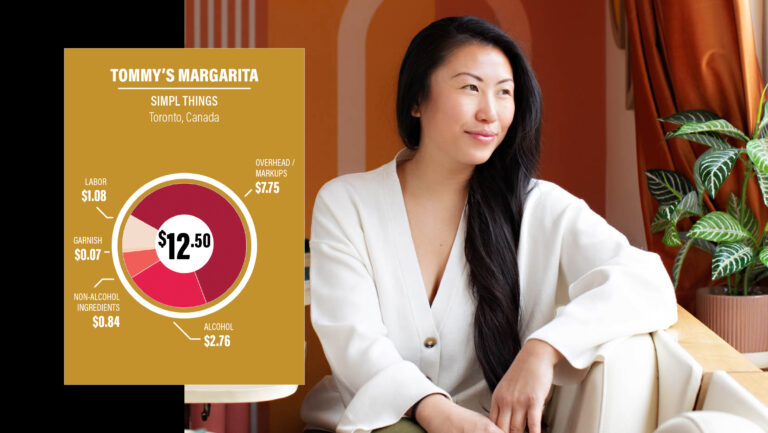
Tommy’s Margarita, $12.50 ($17 CAD), at Simpl Things, Toronto, Canada
Simpl Things, an all-day snack and cocktail bar in Parkdale, an up-and-coming area in Toronto, also serves a Tommy’s Margarita.
Breaking Down the Cocktail Costs
Alcohol
While the Margarita may call for just two alcoholic ingredients (triple sec and tequila), picking a brand or bottle goes beyond taste; it’s about balancing the cost with the quality. “The key is picking a brand that is high quality and affordable,” says Flower. “Real Del Valle Blanco is delicious and comes in a liter-sized bottle, so it amounts to $0.71 cents an ounce.”
Evelyn Chick, the owner of Simpl Things, opts for Los Altos Tequila, which costs her $35, or $1.38 ($1.89 CAD) an ounce. She serves two ounces in her Margarita, and forgoes triple sec, following the classic Tommy’s Margarita specs.
Holiday Cocktail Lounge uses Gran Centenario Plata in their house Margarita, but they’re also amenable to guests’ preferences. Two ounces of a premium pour like Casamigos would run Strange $2.07. Triple sec is $0.44, bringing the alcohol cost to $2.51.
Mirate considers that many customers may prefer mezcal, so they allow them to choose, and the cost of both is factored into the menu price: $0.75 for blanco tequila or $1.03 for mezcal.
With tariffs, shortages, and other distribution hiccups, alcohol pricing can be volatile. That has been felt at Too Soon, where bartenders buy alcohol through liquor stores rather than distributors, due to Oregon’s control state system, so Flower must be in constant conversation with retailers about availability. “We have a cocktail on the menu right now that uses navy-strength rum. Three weeks after launching it, we tried to order more rum from our local liquor store and they were sold out,” he says. “If a drink is a high seller, then we need ingredients we can access easily.”
Non-Alcoholic Ingredients
Accounting for the cost of non-alcoholic ingredients tends to be a moving target. Lime prices have risen immensely over the last few years. Currently, for Holiday Cocktail Lounge they’re sitting around $0.75, which works out at $1.17 cost per volume, but “there are instances like the ‘limepocalypse’ of 2013, where limes went from $95 a case to $320 in one summer,” says Strange.
Too Soon’s Flower uses lemons in his Margarita riff, which also fluctuate in cost. “Lemon pricing varies, but right now we can get a case of 75 to 100 lemons for about $35 to $40. There is around one to 1.5 ounces of juice per lemon, so we can get anywhere between 150 to 300 ounces of lemon juice per case.”
Repurposing waste is one way to reduce ingredient cost while also lowering the carbon footprint of a bar; Distillery of Modern Art uses its pineapple discards and sugar to make a tepache.
To add sweetness to balance out a Margarita’s signature tart flavors, bartenders add an agave or simple syrup, which require prep work to produce. At Simpl Things, they sweeten the drink with 2:1 agave syrup, which costs around $26 ($36 CAD) to make three liters, or $0.27 ($0.37 CAD) per drink. Mirate reckons that it costs $0.17 a serving for their “nogave,” an agave alternative made in-house from demerara sugar and orange blossom honey.
Garnish
Strange points out that garnish, straw, and the Kold-Draft ice he uses will add a few dollars to the menu cost of a cocktail. It’s not just the price of creating ice cubes, but what it may cost to maintain and repair appliances. “Getting someone to fix a Kold-Draft machine, which happens almost monthly, is an immediate $250,” says Strange.
Even the sprinkle of salt that rounds a rim needs to be factored into costing. These numbers are minute—$0.05 for a salted rim at Mirate; $0.15 for the habanero salt at Distillery of Modern Art—but if you’re serving thousands of drinks a year, they add up.
To save costs, Flower makes an artichoke salt (a shelf-stable blend of dehydrated artichokes and salt) and salts half the rim with it. “It’s very affordable to make,” says Flower. “The cost of everything is going up, so it’s important to consider ingredients that are affordable and sustainable. And only half-salting the rim goes a long way.”
Labor
Labor includes not just making the drinks, but unloading cases, juicing limes, weighing sugar, changing C02 tanks, prepping the bar, and many other tasks outside of shaking and stirring.
“Thirty-three percent of the costs go towards labor,” says Watson. “It takes about 30 minutes to two hours of actual labor to make most of our non-alcoholic ingredients, sometimes spread out over a few days if things need to rest or macerate.”
In states like California, labor costs start at $16.50 per hour. Mirate has a large space, which requires a lot of bodies to operate, and a prep-heavy cocktail program significantly bumps up those costs. Their labor numbers also include menu building—the research and development time needed to build and finesse each cocktail.
To balance the books, Flower tries to keep labor at 15 percent of the cost of a cocktail, though he admits that’s slightly higher than he’d like it to be. “Ten percent labor is our dream, but with a kitchen it makes it tough,” says Flower. “You can’t plan on what sales you’ll do on any given night, so it’s best to be well staffed to give the best service possible. As expensive as it is, we don’t mind taking a hit on labor while we build our following and business.” To balance labor costs, he works service at Too Soon himself three to four nights a week.
Chick has three bartenders working a shift at Simpl Things. Each staff member gets paid $13 ($18 CAD) an hour, plus vacation and sick pay. “Minimum wage has jumped from $10.30 to $12.43 ($14.25 to $17.20 CAD) in the last three years in Ontario, and we go above it to make sure our team is supported,” she says. “On top of that, we run monthly paid staff training sessions to ensure everyone is equipped not just to serve guests—but to build a long-term career in hospitality. We pay staff for the full time they’re in training.”
Overhead and Markups
Business owners have to factor in operating costs, rent, marketing, and other overheads, which often means predicting and managing intangibles—factors that keep the lights on. Utilities, insurance, breakage, and glassware are amongst the considerations.
Rent in Toronto is more affordable than in New York, but, divided by the 3,000 cocktails Simpl Things serve on average in a month, it still amounts to an add of $1.18 ($1.63 CAD) per drink. “Rent and overhead have also crept up—we’ve seen a consistent five percent annual increase, plus rising insurance, maintenance, and supply costs,” says Chick. She also allocates $0.36 ($0.50 CAD) per drink to cover glassware, ice, and incidentals.
At Holiday Cocktail Lounge, Strange prices drinks with a 16 percent pour cost—that is, the cost of goods per pour—so the cocktail price to account for a premium tequila like Casamigos, for example, would become $15.69, rather than $2.07. All costs and markups are integrated into every ingredient, so they can accurately land on the profitable menu cost of a drink. “There’s maintenance costs—compressors, autotaps, and soda guns,” explains Strange. And it gets expensive. Holiday Cocktail Lounge pays $27,000 a month for liquor liability, general liability, and worker’s compensation insurance plus unemployment benefits to retain staff, “the latter of which is very difficult to do in the post-COVID world,” says Strange. “When all those factors come together, it’s very understandable that your Margarita is over $20.”
Is It Possible to Cut Cocktail Costs?
Each bar looks for ways to reduce costs where they can. At Holiday Cocktail Lounge, that additional 16 percent pour cost also provides a financial buffer for unexpected expenses and other expensive elements like food programs—a legal requirement for New York City bars. The Distillery of Modern Art also uses a working equation to factor in their extra expenses. “We keep ingredient costs, including garnishes, at 18 percent or less of the price of the drink,” says Watson. “To price, we take the cost of the drink, multiply by five and round up. This gives me room to price in labor and overhead, which I am always thinking about.”
Switching out or balancing more and less expensive ingredients also offers some flexibility in pricing. “We use our lower cost items on our menu to balance out pricier-to-produce items that we don’t want to make more expensive,” says Max Reis, the bar director of Mirate. At Too Soon, certain ingredients just can’t feature on the menu any longer. “Liquor prices have gone up: the amaros, Cynar, certain tequilas we’ve used in the past,” says Flower. “We can’t use those ingredients anymore because I don’t want to raise prices. So we adjust our flavor profiles. That flexibility is the cost of staying open.”
To a degree, there is only so much wiggle room, not just due to the true cost of goods and services, but to consumer endurance for rising prices. Given “the nature of our neighborhood, we also cannot charge more for a beverage, because the average price of what people are willing to pay isn’t that of another neighbourhood, like Downtown,” says Chick. She is also committed to fostering a healthy work environment, which adds to costs, but, she says, she always finds that tight attention to detail helps make the cost sheets balance out in the end.

Dispatch
Sign up for our award-winning newsletter
Don’t miss the latest drinks industry news and insights—delivered to your inbox every week.
By day, Kate Dingwall is a writer, editor, and photographer covering the intersection between spirits, business, culture, and travel. By night, she’s a WSET-trained working sommelier at one of the top restaurants in Canada. She writes about strong drinks and nice wines for Forbes.com, Wine Enthusiast, Vogue, Maxim, InsideHook, People Magazine, Southern Living, Liquor.com, and The Toronto Star.