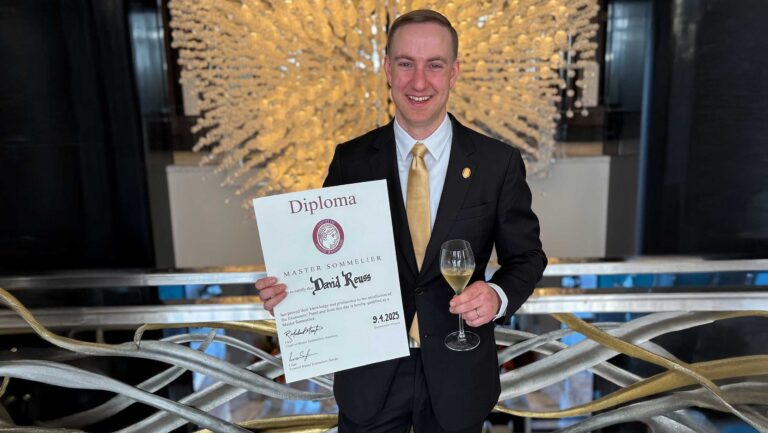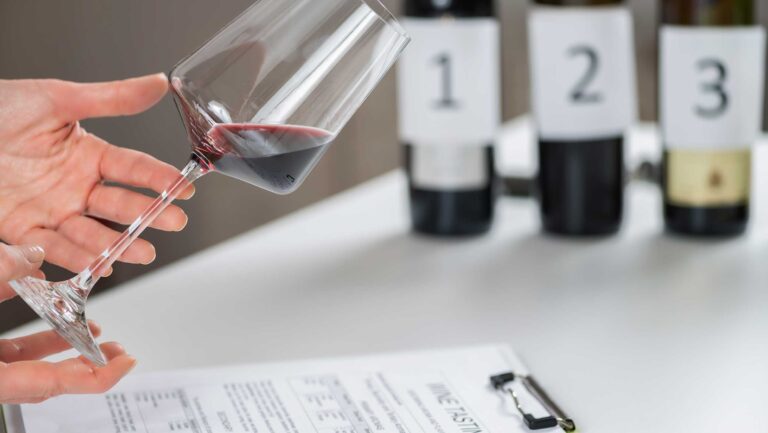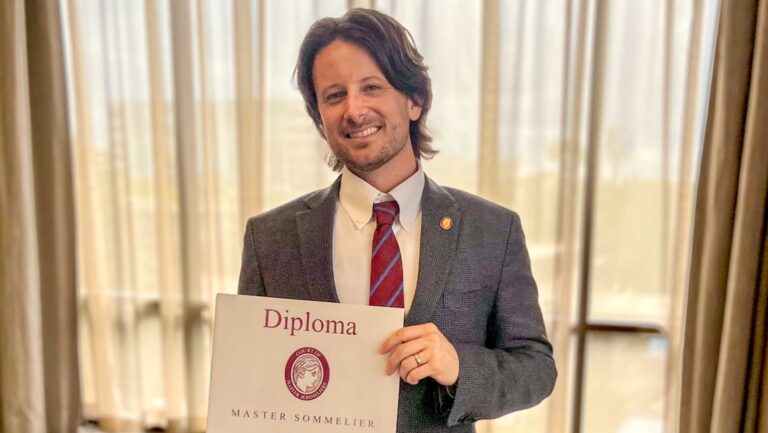
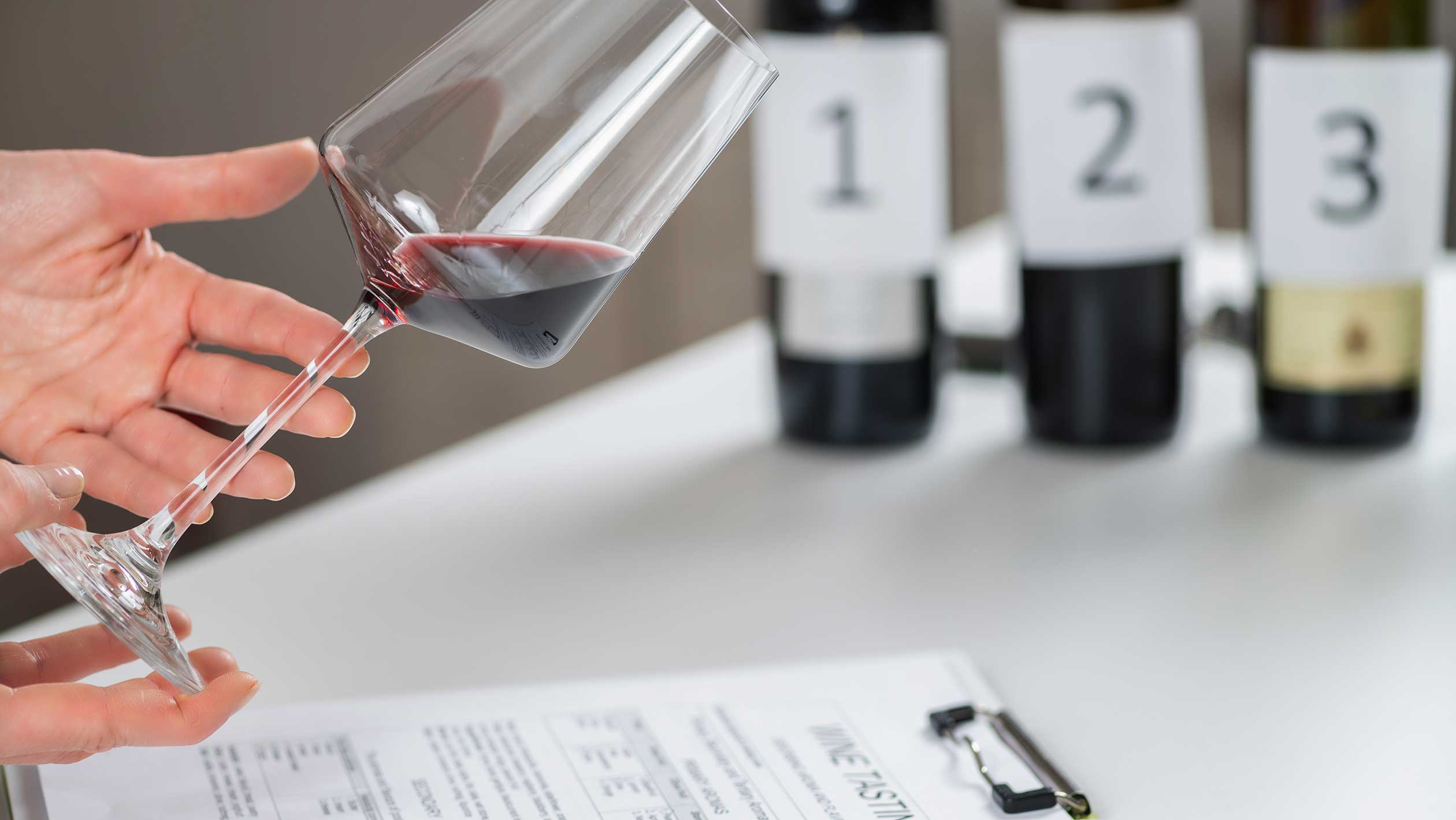
While it’s easy to romanticize blind wine tasting, it isn’t an art form or a party trick, and it’s definitely not a guessing game. “I used to be a super feelings- and emotion-driven taster, but after two failed attempts at the Master Sommelier exam, I shifted to a more data-driven approach,” says Jonathan Eichholz, MS, an educator at GuildSomm.
“It’s not very creative what we have people do in a tasting exam,” confirms Tim Gaiser, MS, the author of Message in the Bottle: A Guide to Tasting Wine and an instructor at the Napa Valley Wine Academy (NVWA). “But what it is is a skill in which we’re requiring people to use a framework and neurologically do the same things over again and assess what’s different and how they’re representing that internally.”
Learning how to do that successfully can be a physically and mentally demanding pursuit that’s both incredibly rewarding and extremely humbling. The reasons for attempting to master this skill are myriad, but whatever the end goal, the journey is a long one.
Don’t miss the latest drinks industry news and insights. Sign up for our award-winning newsletters and get insider intel, resources, and trends delivered to your inbox every week.
“It’s just one of those things that you cannot rush,” says Peter Marks, MW, the vice president of the NVWA and the current panel chair of The Institute of Masters of Wine tasting exam. He points to Malcolm Gladwell’s book Outliers: The Story of Success, which argues that you need 10,000 hours of practice to become an expert at a complex skill. Looking back, Marks calculated that he did indeed spend 10,000 hours studying for the MW exam before he passed.
At every stage in such a long journey, it’s worth taking stock of your progress to assess what’s working and what needs improvement. The best advice for improving blind tasting skills often comes from the community of like-minded wine professionals that have gone through this unique endeavour. “In wine, everything is better achieved through community,” says Claudia Chamberlain, a regional sales manager for Jackson Family Wines and an instructor at Capital Wine School, who is currently studying for both the MW and MS exams. “It takes a village to be able to get across the line to that master-level tasting.”
In that spirit, expert tasters from across the industry share their best advice for becoming a better blind taster.
Stop Blind Tasting—At First
“One doesn’t train for a marathon by running lots of marathons,” says Eichholz. A vast amount of learning is required before you attempt to blind taste a wine.
At its core, blind tasting is a practical application of theory, so you need to start with a strong knowledge base. Before you approach a wine, “You have to have at your fingertips the knowledge about grapes and regions and quality levels and styles and acidity levels and all of those sorts of things so that you can look at your notes and go, ‘If we have ABCD … it’s most likely going to fit this,’” says Christopher Martin, MW, the director of education at the Wine Scholar Guild (WSG).
Marks recommends another step before blind tasting, particularly for students working toward the MW exam: practice writing good tasting notes. “That can often be done [by writing] dry tasting notes, so you don’t have to go out and buy all the wines,” he says. “You should know what a Pinot Noir from Carneros tastes like versus one from Vosne-Romanée and be able to differentiate those.”
Along with dry tasting, Marks says that “doing open [non-blind] tasting is often a really good thing so you can find your clues.” Amber Rill, previously the assistant food and beverage manager at the recently closed Corkbuzz Union Square and a current MW student, does just that. “We do a lot of open-label tasting, where we’re assessing [the wines] and seeing if we can pinpoint how we would reference these in an exam or in a blind tasting setting,” she says.
Lead with (Structural) Data
“Blind tasting is two things: data collection and theory process, no more, no less,” says Eichholz. Once you have the theory knowledge, you need to collect and record accurate tasting data to connect the dots.
To do this successfully, there’s no getting around the fact that you need to be a good taster. “Meaning, can you taste acid levels, sugar levels, alcohol levels, tannin levels, and be able to match those tasting skills with what the actual wine in the glass is presenting,” says Marks. “At home, you can take measured amounts of sugar, tartaric acid, you can buy powder tannin, and do those [calibration tastings] at home.”
Many advanced tasters strongly believe that the structural elements of a wine are key to correctly identifying a wine blind. “Structure will set you free,” says Eichholz. “You can’t make high-acid Vigonier or low-tannin Cabernet Sauvignon.”
Martin echoes this sentiment. “There is an overreliance on and slight obsession with aromas … but I would say that for the vast majority of wines, aroma is not the main thing that takes me to a [conclusion]. Texture is the way to get there.” Martin also points to the book Beyond Flavour: Wine Tasting by Structure by Nick Jackson, MW, which argues that a wine’s structure is a more reliable indicator of its identity than flavor.

Make It Personal
It’s important to personalize your approach to tasting, but that doesn’t mean it’s an exercise in creativity. Instead, it’s about understanding how you taste or think to ensure you get to the right answer. “You need to know not just how to taste, but how you taste personally,” confirms Martin.
“You need to let people find out for themselves where they detect acid or alcohol so that they can make accurate assessments,” says Marks. “I’ve struggled with confusing acidity and tannin. They’re both somewhat sharp or acerbic, so finding where on your palate you taste them [can help you differentiate]. I judge acidity by how mouthwatering it is … whereas tannin, I actually swirl the wine around and [feel it] on the side of my gums. Just separating those two locations was something I was able to do to become more accurate.”
“I struggle with Chablis,” says Rill. “It’s a wine I really like to drink, but for some reason when you get it in front of me in a glass blind, I really struggle. But I never miss Muscadet. It’s just so weird the things that you’re attuned to in blind tasting.”
Everyone has unique strengths and weaknesses, and identifying your personal skills will help focus your studies. “The thing that helped me a lot is learning laterals,” adds Rill. “If I think something could potentially be Chablis, what would be the other possible grapes it could be or regions in the world that it could come from?”
… But Also Make It Social
There’s plenty you can—and should—learn on your own, but “tasting, talking, and sharing with others is insanely crucial to improving your skills,” says Eichholz.
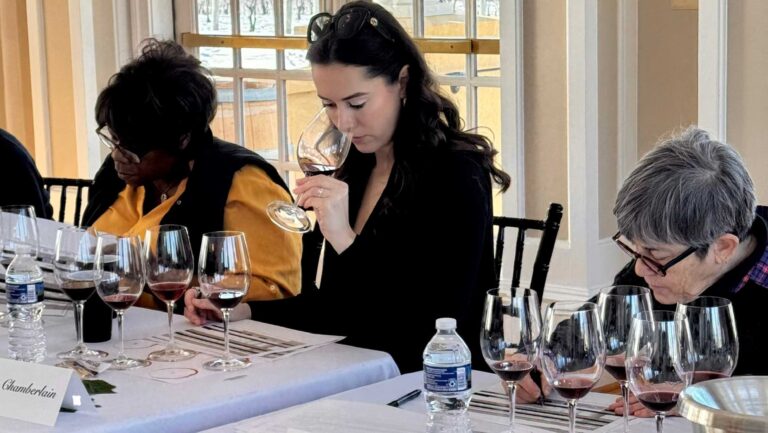
One of the best ways that Chamberlain has found for improving her tasting skills is listening to other people taste. “When you hear other people give a tasting note and then you find out what the wine is, it’s almost like something clicks in your brain,” she says. Even if you don’t have a local tasting group, Chamberlain suggests listening to people blind taste on YouTube or on the GuildSomm podcast.
Tasting groups, however, are crucial. “Any kind of intentional group that you can put together around wine is the first place to start,” says Chamberlain, who says she welcomes out-of-town guests to their Washington, D.C.-based tasting groups, so those people take what they learn back to their local communities.
At Chamberlain’s tasting group, “We meet two to three days a week and we do six-wine blinds,” she explains. “We cap it at usually 12 to 13 people. Everyone pays $25, so the host has about a $300 budget to go get six wines and then everyone Venmos or pays cash at the end. That way it’s blind for everybody except the host. I’ll usually have [tasting] grids printed out for people and we practice verbal tasting.”
Study Across the Aisle
Two of the primary wine education and assessment programs—Wine & Spirit Education Trust (WSET) and Court of Master Sommeliers (CMS)—have distinct differences, but a lot of similarities as well. While WSET takes a written, classroom-based approach to tasting, CMS is verbal, just as a sommelier would describe a wine to a guest at a restaurant. But both programs focus on a systematic tasting grid.
Verbal tasting might sound unnecessary, not to mention intimidating, to anyone outside of the CMS program, but Chamberlain feels strongly that mixing up your style of blind tasting has huge benefits.
“I always encourage WSET students … if you have access to one of those verbal tasting groups, go,” she says. “Feel free to just grid it out loud in WSET format, but I find that it helps everybody. That kind of cross function—between WSET, which is more of a classroom setting, definitely more foundational, versus CMS, which is more like choose your own adventure—really does help build out a tasting lexicon pretty quickly.”
On the flip side, “Writing is such a strong memory trigger and we don’t have that,” says Gaiser, referring to the CMS program. So even if the exam is verbal, practicing written tasting notes can help students with memorization.
Martin agrees that exploring a different method of tasting can be very complimentary. “Any MW student goes through that process of going, ‘Okay, I understand all of this stuff, but how do I take my communication to that next level?’” Martin hopes that the new WSG Tasting Diploma will help students expand on the foundation they’ve built, and help them explore new ways of effectively communicating about a wine.
Evolve with the Times
“The world of wine is changing rapidly,” says Eichholz. “So our approach to tasting needs to change. Old tasting lessons, conventions, and paradigms are no longer relevant. The world of wine is also more wonderfully diverse than ever, and we should be continuously expanding our tasting vocabulary to welcome other flavors, aromas, and cultures.”
These major changes are influencing exams, too. “There’s a hell of a lot more wines that are available,” says Marks. “How do you taste them all? In that regard, the Master of Wine exam has evolved significantly over the years. It has become less of a pure identification exam. We are putting more emphasis on other aspects, like quality, commercial potential, maturity, and style.”
One thing everyone emphasizes? “Don’t be afraid of being completely wrong,” says Martin. “In blind tasting you really have to put your ego aside. Some days you’re tasting really well and some days you’re not. And you just sort of go, okay, I’ll just enjoy the wine, or if not, maybe just have a beer.”

Dispatch
Sign up for our award-winning newsletter
Don’t miss the latest drinks industry news and insights—delivered to your inbox every week.
Caitlin A. Miller is a New York-based wine writer and a senior editor for SevenFifty Daily. Her work has appeared in Food & Wine, Vinous, and Christie’s International Real Estate Magazine. She holds the WSET Diploma in Wines, the WSET Level 2 Award in Spirits, and was the recipient of the 2020 Vinous Young Wine Writer Fellowship.