You could credit the Internal Revenue Service (IRS) for the recent revival of the three-chamber still in the American distilling community. In the early 20th century, the government agency employed chemists to help enforce the Bottled in Bond Act, the 1897 legislation that set standards for whiskey production. A.B. Adams, one of those chemists, wrote, “In the United States nearly every distiller uses one of two kinds of stills for the first distillation. The three-chambered beer still, either wooden or copper, is used in Maryland and Pennsylvania; in Tennessee and Kentucky the small 10- or 12-chambered continuous beer still is used.”
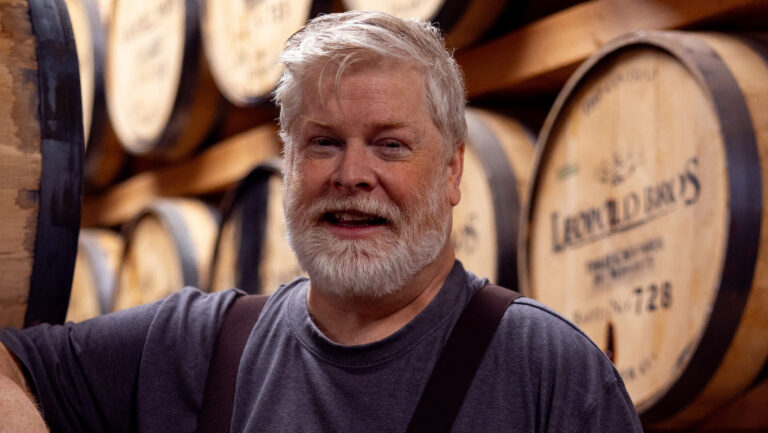
That document was the key that turned Todd Leopold’s whimsical obsession with antique distilling equipment into a real-life pursuit. Leopold, the head distiller at Leopold Bros in Denver, Colorado, which he founded with his brother in 2001, was perplexed as to why the three-chamber stills were ubiquitous throughout Pennsylvania through the early 1900s, despite the increasing availability of less labor-intensive, less expensive pot and column stills.
“Those chemists looked at how everyone was making rye and bourbon in an attempt to write up what rye and bourbon actually was,” says Leopold. “They looked at samples of new-make every year for eight years at 31 different distilleries. Fourteen were making rye and all except one was using a three-chamber still. Because every rye producer was using [the three-chamber still], it got my attention.”

Don’t miss the latest drinks industry news and insights. Sign up for our award-winning newsletters and get insider intel, resources, and trends delivered to your inbox every week.
He also learned that Canadian giant Hiram Walker had a three-chamber among its many column stills, indicating to Leopold that the juggernaut was using the spirit for blending. Since it wasn’t a matter of making whiskey production easier or more cost-effective, it had to be a matter of flavor. So Leopold became the first to set out on a chase to find the early-20th-century whiskey-drinking experience.
Three-chamber stills were also used to produce the original bourbons that made Pappy Van Winkle a known entity before he opened Stitzel-Weller Distillery in 1935. It’s believed that the last one to operate into the 1950s was at Pennco, the giant contract distiller that later became Michter’s. But the widespread introduction of column and pot stills, which are far less labor-intensive, drove three-chamber stills into extinction. Until, that is, Leopold called up Vendome Copper & Brass Works in Louisville, Kentucky, in 2010 and asked if they’d build one for him.
Since then, other distillers have joined Leopold in the pursuit of vintage character, and it’s not just boutique indie operations. The allure of unearthing long-lost character is tempting enough that the giant Monster Beverage acquired one in 2024 and fired it up last year.
The Challenge of Recreating a Three-Chamber Still
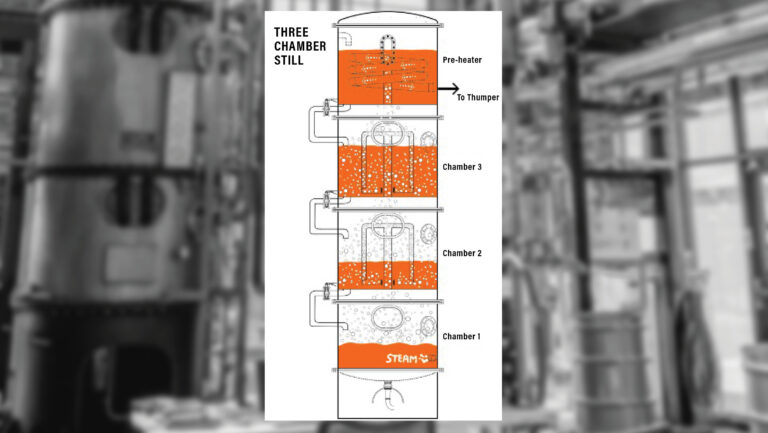
Commissioning Vendome to build a three-chamber still was, by all accounts, a big ask. Unlike column or pot stills, where the entire system operates with a fixed amount of mash going in, a fixed alcohol volume being produced, and a fixed amount of steam powering it all, the three-chamber still is a batching system. It’s akin to a trio of pot stills stacked on top of each other. Vapors move upwards through the chambers as the liquid boils, and gravity pulls the mash downwards, from one pot to the next. The temperature in each chamber changes regularly. And to make matters more complicated, it operates on a constant injection of steam, which means it runs under pressure that can get so high that the whole metal contraption shakes. As such, every chamber needs to have built-in pressure protection.
Vendome has a century-plus-old legacy of mechanical engineering and copper expertise. What they don’t have are blueprints or technical manuals for how to fabricate three-chamber stills. But the one thing they knew for sure, explains Kyle Grant, the project manager and craft distillation systems designer at Vendome, is that every part of a three-chamber still is exclusive to a three-chamber still.
“We didn’t have any parts on the shelf we could use,” says Grant, noting that it set off a host of challenges. “Everything built for the three-chamber still is very custom. We had to design interior pieces to be replaceable for when they wear out. Each chamber holds so much liquid and weight that the still design itself is very robust. The shell and chambers will outlast interior pieces, so we had to make sure whenever things go bad, we had what we’d need to make sure we could replace parts of the system.”
In what turned out to be a first for the fabricators, an unfamiliarity with the mechanics of this antique contraption prompted Leopold and the Vendome team to enlist a metallurgist to determine how thick the copper should be.
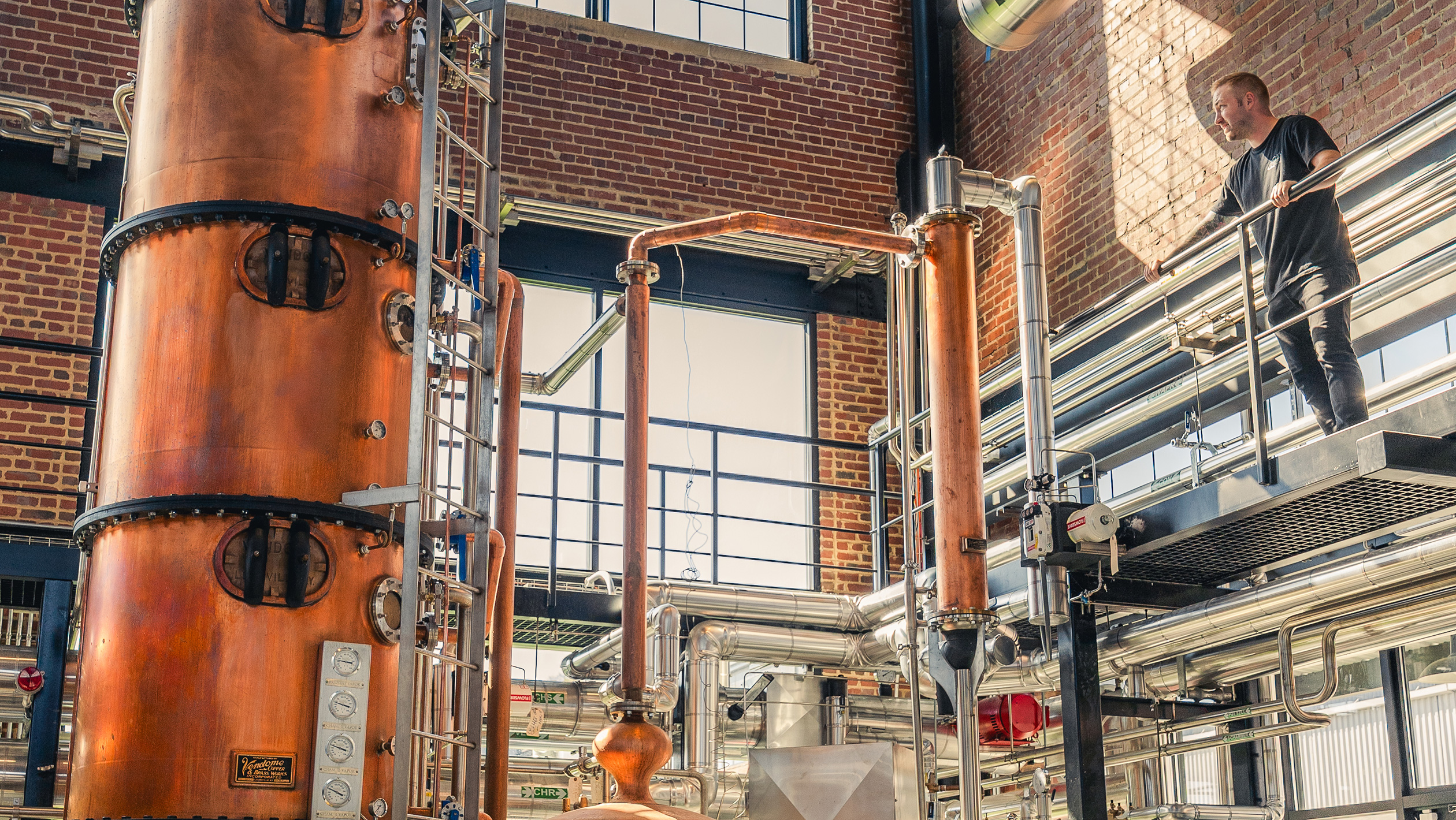
The resulting still was 18 feet tall and five feet in diameter. According to Leopold, if that amount of copper was used to make a standard still, it could produce about 200 barrels in a day. The three-chamber? Just two barrels.
The inefficiency, the high cost of commissioning a customized machine, and the human labor required to operate it, make the pursuit of the three-chamber still a high-risk endeavor. So why bother?
Flavor—Not Efficiency—Keeps Three-Chamber Stills Alive
Talk to anyone committed to using them and the answer is simple: flavor and character. You simply can’t achieve the flavor and body captured in the three-chamber new-make with any other mechanism or method. Since they operate under extremely high pressure—greater than atmospheric pressure—the boiling point in the chamber is higher than normal. More heat is needed to distill, which results in oilier elements that typically wouldn’t evaporate until later in the process vaporizing sooner. That means compounds typically found in the tails—rich, funky chocolate notes and deeply floral elements—are pulled into the hearts.
“My three-chamber still transcends distillation,” said Royce Neeley, the founder and head distiller at Neeley Family Distillery in Sparta, Kentucky. “By the time the liquid gets to chamber three, it’s distilled three separate times, which is how it draws everything out flavor-wise. It can make the heaviest spirit there is.” He’s using it to make bourbon and rye. “It makes a terrible clear spirit, but you give it five years in a barrel and it makes something no other still in the world can. Those rich notes are so interesting to me. I want to use it for blending—I love the thought of a pot-three-chamber-still blend. It can be such a significant tool in the toolkit.”
Matt Strickland’s interest in the three-chamber still has an archaeological tinge to it. As the master distiller for Iron City Distilling, in Pittsburgh, Strickland wanted to revive Monongahela rye—a distinct style of rye made with three-chamber stills in Pennsylvania before Prohibition—and recreate the signature spirit in its native place. He learned about the recreated still Leopold commissioned, but it was discussions with Pennsylvania historians Laura Fields and Sam Komlenic that led him to explore why distillers in centuries past bothered with the labor-intensive equipment. Like Leopold, he concluded it had to be a specific flavor—one so compelling that he was driven to chase it.
“You get this funky, malty, chocolaty, deeply floral spirit,” Strickland says. “It needs to be in a barrel for the compounds to mature and round themselves out, but we’re definitely getting the notes that we’re after—notes from pre-1900 Pennsylvania ryes.”
While some distillers are recreating three-chamber stills in the name of capturing an old-world flavor, there’s at least one distiller who hasn’t had to recreate anything to reach that end. At a beachfront distillery in Barbados that dates to 1893, Alexandre Gabriel, the blender and owner of Stade’s West Indies Rum Distillery, makes Planery Rum on a three-chamber still that was installed in the 1930s. It makes an artisanal rum that Gabriel sees as a portal to the island’s past.
“It makes a rustic rum,” Gabriel says. “You get these tastes—raw chocolate, raw ginger. This is a rum that’s not saying, ‘I’m sorry.’ This rum—as the guys in the distillery say—is rumming.”

Dispatch
Sign up for our award-winning newsletter
Don’t miss the latest drinks industry news and insights—delivered to your inbox every week.
Liza Weisstuch is a New York City-based journalist whose work has appeared in The New York Times, The Washington Post, The Daily Beast, Bon Appetit, Robb Report, and The Wall Street Journal, among others. She is the U.S. contributing editor to Whisky Magazine. You can reach her on Instagram (@livingtheproof) and X (@livingtheproof)