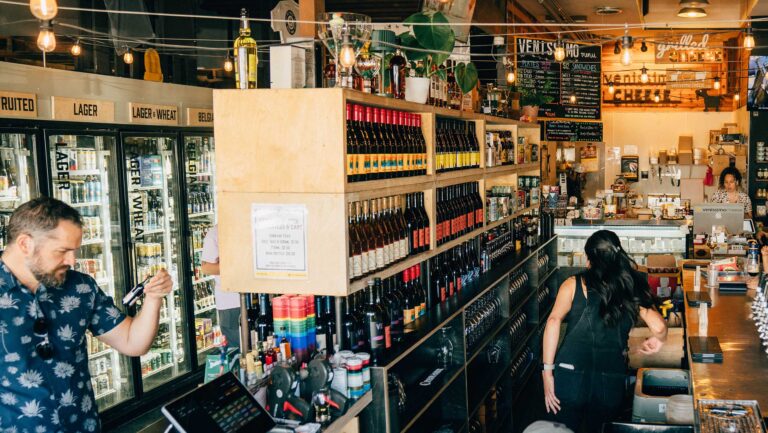
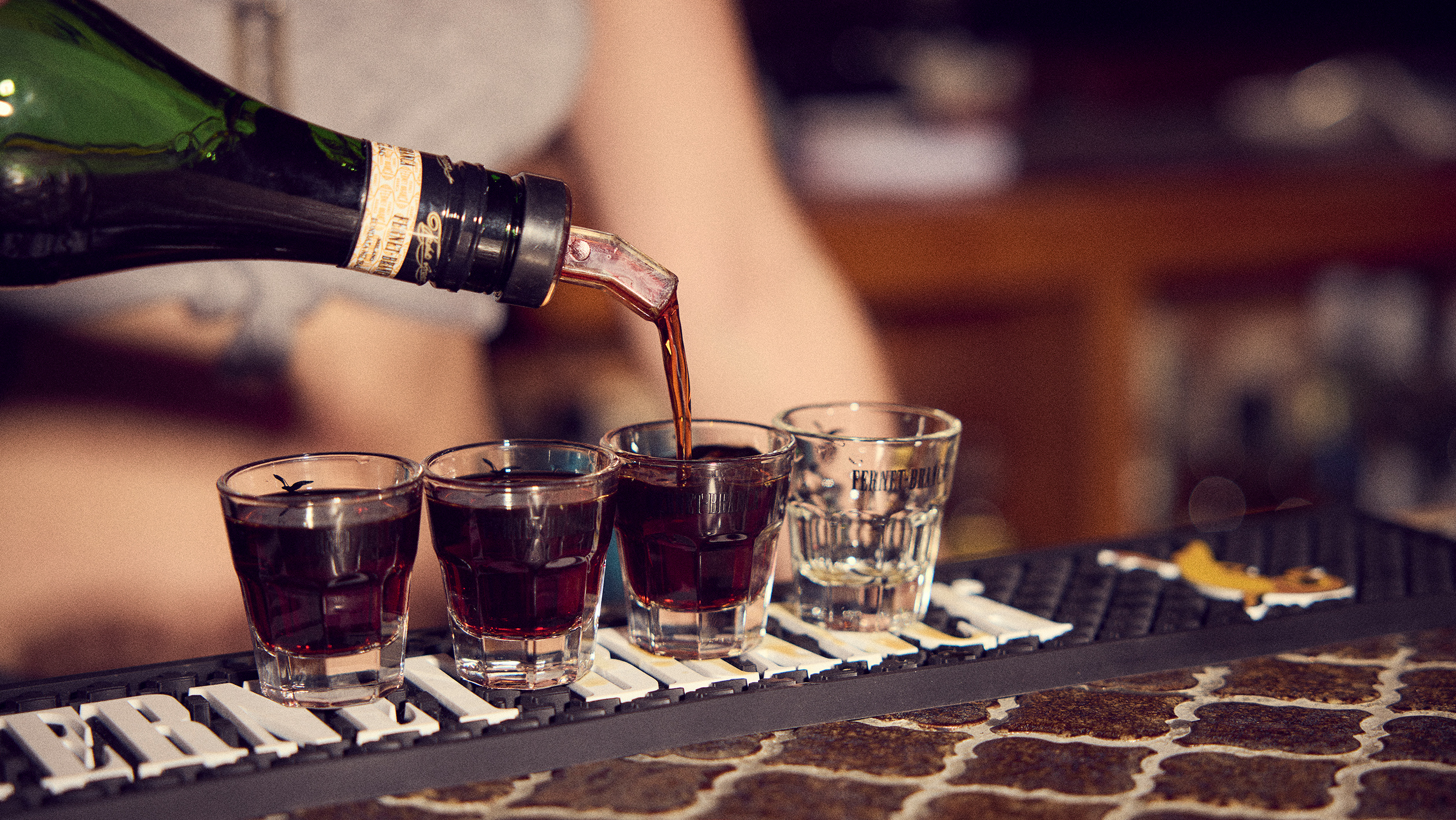
After long hours and stressful shifts, it’s not uncommon to find hospitality workers finding relief by gathering around the bar with colleagues, venting about the night’s challenges, and celebrating the triumphs. For many of them, Fernet-Branca is the drink of choice to toast the end of a night. “You don’t order fernet to relax; you order it to close the loop on a night,” says Nick Kosevich, the chief executive officer of Earl Giles Drinks Emporium in Minneapolis, Minnesota.
Known for its intensely complex and medicinal flavor profile, fernet is a bitter Italian herbal liqueur often consumed as a digestif, though it can be taken as a shot, or mixed into cocktails. In the hospitality world, it’s gained the reputation as the unofficial industry drink and is referred to as the “bartender’s handshake,” signaling its appreciation and mass consumption among hospitality workers.
“[Fernet is] functional, grounding, and communal in a quiet way,” says Kosevich. “You don’t debate it, you just pour it, and move on together.”

Don’t miss the latest drinks industry news and insights. Sign up for our award-winning newsletters and get insider intel, resources, and trends delivered to your inbox every week.
Although there are a number of fernets lining bar backs and retail shelves across the country, no brand has earned the status as the ultimate insider drink among hospitality professionals quite like Fernet-Branca.
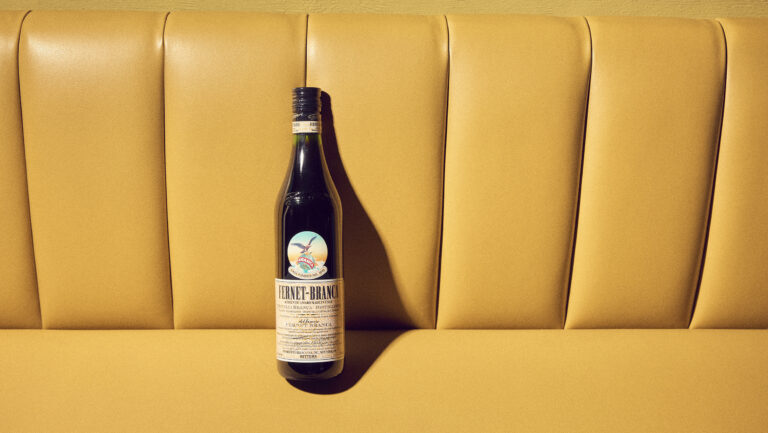
The Origins of a Bitter Category
Fernet is, by nature, a challenging spirit to categorize. The Oxford Companion to Spirits & Cocktails calls fernet “an ill-defined style of Italian bitter digestive.” A subcategory of amaro, this grape-based liqueur, which contains herbs and aromatics like cardamom, chamomile, rhubarb, and aloe, began its life as a medicinal cure-all tonic developed in response to a wave of cholera that hit Milan, Italy, in the mid 1800s. The herbalist who first created this elixir, Bernardino Branca, also founded Fernet-Branca, the brand that would become synonymous with the dark, herbaceous, and aggressively bitter style of amaro.
Fernet-Branca first arrived in the United States along with a major wave of Italian immigration in the late 1800s, according to Edoardo Branca, the managing director of Branca USA and a sixth-generation member of the brand’s founding family. At the same time, it landed in Argentina, where it gained a huge cult following and where Fernet-Branca opened its only distillery outside of Italy in 1935.
While Fernet-Branca’s original U.S. footprint was small and limited to a few Italian communities in major cities like San Francisco and New York, it gained broader awareness in the 1920s when, despite the ongoing Prohibition, Fernet-Branca was sold as a medicinal spirit made with a secret blend of 27 herbs, says Branca. “It was [marketed for] being good for the stomach and for digestion,” he notes. Since medicinal liquors were exempt from Prohibition laws, consumers were allowed to purchase Fernet-Branca at pharmacies, and Branca says that the spirit became an “old grandma remedy” for fever when served warm.
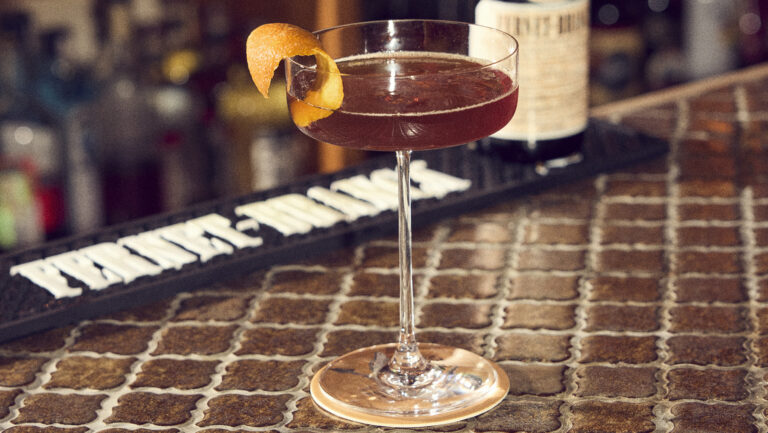
Fernet Finds Its Place Behind The Bar
It was nearly a half-century later when Fernet-Branca began to take hold as a bartender favorite. “In the late ’90s and early 2000s, bartenders started to adopt it in San Francisco,” says Branca.
Matt Ross, the general manager of The Roosevelt Room in Austin, Texas, worked in San Francisco from 2004 to 2011 and recalls the early embrace of Fernet-Branca among hospitality workers. “I can attest first hand that this is where Fernet-Branca got its start as an industry tell among all service staff, not just bartenders,” says Ross. In the early 2000s, San Francisco alone was responsible for reportedly 35 percent of Fernet-Branca’s U.S. consumption.
Both Ross and Branca attribute Fernet-Branca’s success in San Francisco to Antoinette Cattani, a portfolio manager for Branca USA who pushed the spirit all over the city, specifically aiming at the service industry instead of general customers.
Cattani believed that framing Fernet-Branca as a drink for bartenders would both help the bartenders develop a genuine fondness for the spirit and, according to Branca, would also amplify its “cool factor” among guests who want to feel like they’re in the loop.
Fernet-Branca’s reputation as an industry drink soon spread to other major urban markets like New York City and Chicago, and it can now be found at bars and retail shops across the country. According to Chris Watt, the chief executive officer of Branca USA, over three million bottles of Fernet-Branca sell in the U.S. every year.
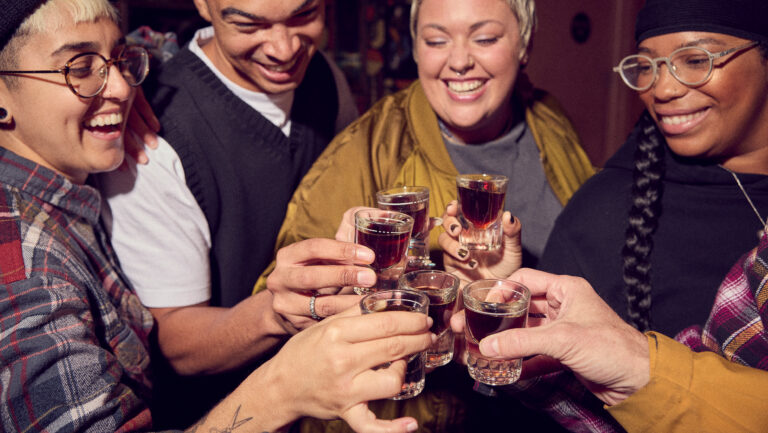
The Hospitality Industry’s Love Affair With Fernet-Branca
There are a few theories why Fernet-Branca appeals so strongly to hospitality workers, beginning with the spirit’s unique bitterness. “After a long shift surrounded by sugar, citrus, syrups, and noise, fernet is a palate cleanser and a reset,” says Alberto Battaglini, the co-owner and founder of Pony Cocktails + Kitchen in Santa Ynez, California. “It’s bitter, herbal, and very medicinal. It cuts straight through the palate and snaps you back to baseline.”
Amber Garcia, the beverage director of Carmella’s Dessert Bar in Charleston, South Carolina, takes it a step farther, explaining that “Fernet is not trying to be nice. It’s mentholated, herbal, medicinal, and unapologetic. Enjoying such a beverage signals ‘I’ve been in the weeds; I’ve seen things’.”
Fernet-Branca’s early marketing as a medicinal tonic may also help explain its later appeal among bartenders.“It does wonders on your stomach, whether you just worked a shift on a diet of 5-Hour Energy [drink] and a handful of fries eaten as quickly as possible, or you just came from a huge meal, fernet will make your stomach feel better,” says Kyle Davidson, the beverage director of Bar Tutto in Chicago.
Famous for its strong and bold flavors, it may be Fernet-Branca’s “punishment factor” that drives industry professionals to it, says Arum Krause, the chief mixologist of Space Bar in Pittsburgh, Pennsylvania. “Bartenders sometimes like challenging flavors, and fernet fits that mold.”
The nasal punch of eucalyptus and saffron, the woody taste of myrrh, and the bitterness of gentian can all be polarizing on their own, but when they’re blended together into a single sip, they can overwhelm the palate of less-experienced drinkers. But that’s exactly what allows hospitality workers to bond over this peculiar blackish elixir. “You don’t have to love it the first time,” says Battaglini. “Most of us didn’t. Fernet is a learned affection. It grows on you the way bitter flavors, long nights, and hospitality itself does.”
Fernet-Branca’s insider quality doesn’t just apply to industry employees drinking after a shift; it can also tip bartenders off to guests with a hospitality background. “There’s something to be said for when a guest orders one,” says Ellie Cormican, a bartender at Refinery Rooftop in New York City. “You instinctively pause and think, ‘Industry?’ “Your guard comes down a bit, and it usually sparks a conversation.”
While the category has expanded over the years with the introduction of fernet brands like Letherbee Fernet, Fernet Francisco, and Fernet-Vallet arriving to the market, Fernet-Branca still dominates as the end-of-shift ritual bonding servers, bartenders, hosts, managers, and bar regulars with adventurous palates.
“Trends will come and go, but Fernet’s role feels permanent,” says CJ Lapid, the head bartender at Pinky Swear in New York City. “Other spirits may have their moment, but Fernet-Branca has helped shape how people drink, not just what they drink.”

Dispatch
Sign up for our award-winning newsletter
Don’t miss the latest drinks industry news and insights—delivered to your inbox every week.