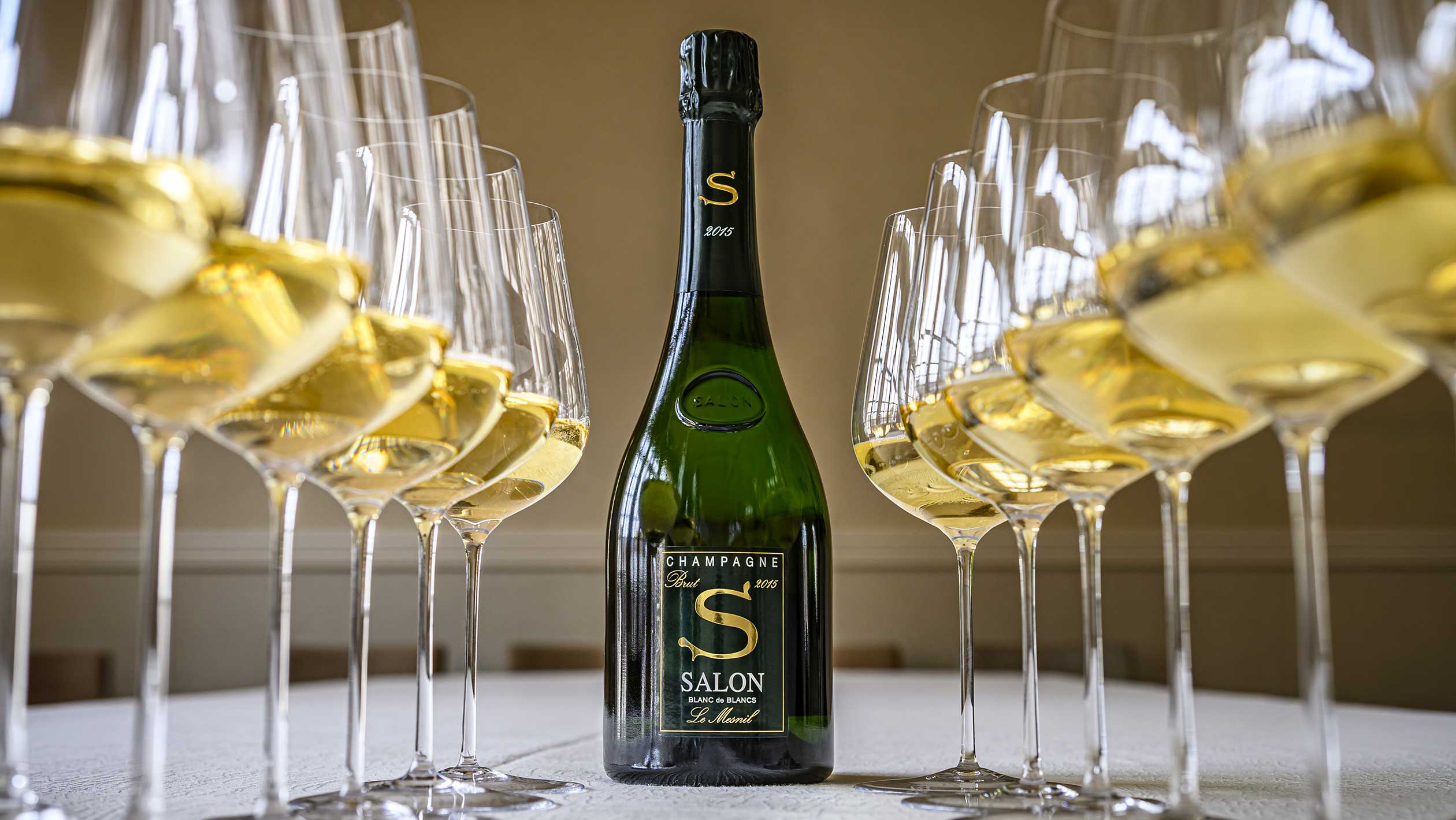
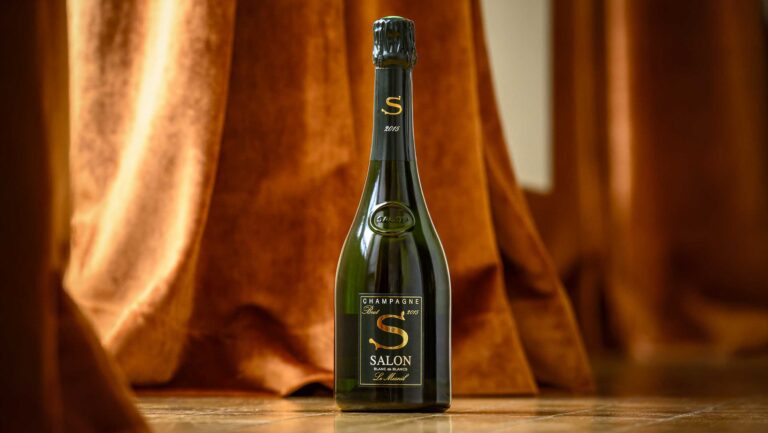
A Champagne house’s top wine—the prestige cuvée—is designed to signal rarity. Produced in limited quantities and positioned as a flagship wine, prestige cuvées turn scarcity into an aspiration. While many Champagne houses produce exclusive bottles coveted by collectors and connoisseurs, few have attained the near-mythic status of Champagne Salon, a wine that has become a benchmark for rarity, longevity, and terroir expression.
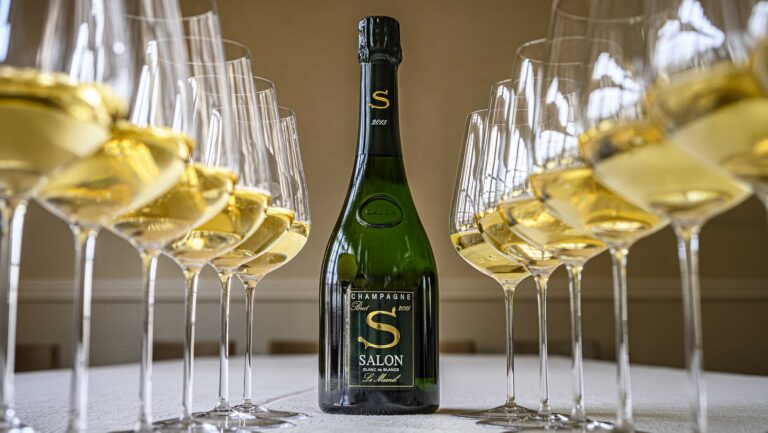
A series of production choices have led Salon to become one of Champagne’s most sought-after bottles. A vintage Blanc de Blancs, the wine is made with Chardonnay from Le Mesnil-sur-Oger vineyards that requires an average of 10 years of aging. The winemaking philosophy has always been based on a simple premise: one vintage, one grape, one terroir.
“Just how micro-focused they are on what they do excludes even comparable wines from being held in the same conversation [about prestige],” says Dean Fuerth, the beverage director at Sushi Nakazawa, which has locations in New York City, Washington, D.C., and Los Angeles. Each location carries about 150 Champagne selections on its 1,100-bottle wine list, and after sake, it is the most in-demand category.
Don’t miss the latest drinks industry news and insights. Sign up for our award-winning newsletters and get insider intel, resources, and trends delivered to your inbox every week.
Unlike other prestige cuvées, Salon has done little to no marketing; this is a Champagne for those who know. So what makes Salon such an icon in an already rarified category?
One Village, One Grape, One Vision
Eugène-Aimé Salon, a Champenois, lived and worked in Paris in the fur trade, but always wanted to create Champagne for personal consumption. With the help of family member Marcel Guillaume, the first bottles of Salon were produced in 1905. “It was the exact opposite of the classical Champagne recipe,” says Audrey Campos, who leads communications for Salon and Delamotte. Where Champagne relies largely on blending vintages, grapes, and sites, Salon’s ethos is “selecting the right grape variety that will be exactly adapted to its terroir, and a wine with long aging capacity,” she says. “And there was no need to produce Champagne every year because there was no commercial ambition.”
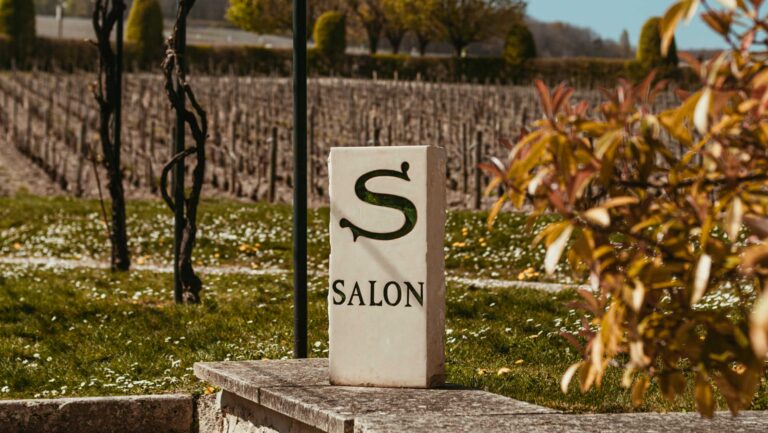
Under Guillaume’s guidance, the relatives identified parcels in Le Mesnil-sur-Oger where the grape would grow best. Les Mesnil’s chalky soil contributes to the wine’s distinct salinity and acidity, a defining feature that has become central to Salon’s identity. “Marcel Guillaume was the man who defined the philosophy of Salon from the beginning,” says Campos. “He was totally aware of the very importance of the place, not only the terroir itself, but also the exact location of the vines.” To highlight the importance of the place, Salon prominently featured Le Mesnil on the label, marking one of the earliest appearances of the village name on a Champagne bottle.
Salon has sourced from the same 20 plots, a total of 14.7 acres, since the beginning. A “collective of growers” supply the fruit, says Campos. In Salon’s history, only one plot has ever changed hands, Clos de Mesnil, which was sold to Krug Champagne in 1971.
Of all the sites Salon sources from, the most precious is Le Jardin, a 2.12-acre plot located behind the Salon house and cellars, and the vineyard first purchased by Eugène-Aimé Salon. It was replanted in 2002 after nematodes damaged the vines. To balance vigor, vines are trained in a single cordon and are planted with Chardonnay clone 40B, which the house deems the best for the site.
Salon is always 100 percent Chardonnay. Crucially, the appellation accepted the idea of a Blanc de Blancs wine from the beginning, legitimizing the style and positioning Salon as pioneers.
Rarity by Design
Scarcity drives much of Salon’s reputation. The wine is only produced in what is considered the absolute best years. In its 120-year history, only 45 vintages have been released, with an average of 40,000 to 60,000 bottles each vintage. “As Champagne goes, even for prestige these days, it’s a statement that they only release it a handful of times per decade,” says Fuerth. “When it eventually does get released, it’s such an event in the wine world. It’s really just an obsessive focus on quality.”
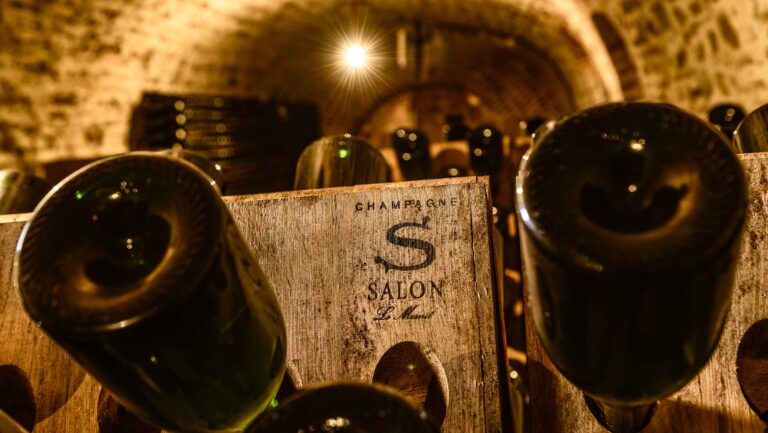
It also takes a long time for a vintage to hit the market. Salon requires an average of 10 years of aging on the lees before it’s released, but there’s no hard and fast minimum for bottle aging. “We adapt to the evolution and the profile of every vintage, and we decide at the end of the process,” says Cristian Rimoldi, the export manager for Salon and Delamotte. For example, the 2015 vintage will be released before the 2014 vintage, which requires more time in the cellar.
An Insider’s Secret
Eugène-Aimé died without any heirs, and the house changed hands. For a while, it was owned by Pernod Ricard, where, by many accounts, it languished until 1988 when it was purchased by Laurent-Perrier. Despite the transitions, “Over the years, nobody touched this original recipe, and that, for me, is part of the mystery of Salon and why it’s iconic,” says Rimoldi.
Salon’s mystique is also largely due to its lack of marketing. Although Salon relies on Laurent-Perrier’s facilities and resources, “being part of a family-owned business, it’s so important to preserve the DNA of each house,” says Rimoldi.
A closer connection exists between Salon and Delamotte, a neighboring property to Salon. Delamotte was already owned by the Laurent-Perrier family when they acquired Salon. When Salon chooses not to make a vintage, the fruit goes into a Delamotte wine.
Although Champagne has seen a rise in tourism since the region was declared a UNESCO World Heritage site in 2015, Salon’s cellars are not open to the public, and Rimoldi counts on sommeliers to serve as the de facto ambassadors to the label. It’s a wine that basically relies on word of mouth.
Despite all its firsts, it’s the quality that makes Salon an icon. “One of my coolest moments with Salon was when one of our regulars came in and got a bottle,” says Adele Corrigan, the general manager of 13 Celsius Wine Bar in Houston, Texas, which was named one of the top 10 U.S. spots for Champagne in 2023 and 2025 by the Comité Champagne. The wine was poured into a decanter, and the customer eventually left, leaving about half a bottle’s worth of wine for the staff. “We put it on the back bar because we were busy, with plans to try it later,” says Corrigan.
By the time they got around to it, “the wine had warmed up, and almost all the bubbles had left,” says Corrigan. “You could actually taste the wine underneath all the carbonation and that truly changed my perspective. To be able to taste the wine underneath all the bubbles and really appreciate the craftsmanship that goes into that level [of Champagne] is really special.”

Dispatch
Sign up for our award-winning newsletter
Don’t miss the latest drinks industry news and insights—delivered to your inbox every week.
Shana Clarke is a wine, sake, and travel writer, and the author of 150 Vineyards You Need To Visit Before You Die. Her work has appeared in Saveur, Fortune, NPR, Wine Enthusiast, and Hemispheres. She was shortlisted for the Louis Roederer 2020 International Wine Writers’ Awards and ranked one of the “Top 20 U.S. Wine Writers That Wineries Can Work With” by Beverage Trade Network in 2021. She holds a Level 3 Advanced Certificate from Wine & Spirit Education Trust and is a Certified Sake Sommelier. She will always say yes to a glass of Champagne. Learn more at www.shanaspeakswine.com and follow her @shanaspeakswine.