One of the preeminent bars of the cocktail renaissance is now at the heart of what could be one of the most foundation-shaking moments for the industry it helped to foster. The 21 employees of famed institution Attaboy voted 13-to-8 in favor of unionization, officially forming Attaboy Local 134 in May. How this plays out will affect not only this bar and its employees, but the bar world at large.
Support for labor unions in the U.S. is the strongest it’s been since the mid-1960s. An August 2025 Gallup poll showed that 68 percent of U.S. adults approve of labor unions, up from 48 percent in 2009. Even the House of Representatives recently showed rare bipartisan support for a piece of pro-union legislation.
Broadly speaking, average Americans are likely to be in favor of unions. However, most people envision unions as large-scale labor organizations, such as United Auto Workers, or pinned to national chains, like Starbucks Workers United. A single cocktail bar owned by two partners, with fewer than two dozen employees, is a different subject altogether.
Don’t miss the latest drinks industry news and insights. Sign up for our award-winning newsletters and get insider intel, resources, and trends delivered to your inbox every week.
What Workers Want at Attaboy
For the organizers of Attaboy Local 134, the broader principle of supporting labor outweighs concerns about the size of the workplace. “I have heard dozens of variations of this basic theme: I’m pro-union, just not this one; I’m pro-labor but the shop is too small; I’m pro-worker, but small businesses shouldn’t have unions; I’m pro-labor, but not in this legacy institution,” says Zachary Gelnaw-Rubin, a member of the union’s organizing committee, who notes he speaks for himself and does not hold an elected position within the union.
Regardless of its size, Attaboy Local 134 is backed by a majority of employees who supported its union drive. Goals include a stronger voice in workplace policies, improved channels for feedback and input, more transparent and accessible benefits for all employees, better job protections, and enhanced workplace safety. “Our demands are not radical, but the response to them has been,” Gelnaw-Rubin says.
Owners Sam Ross and Michael McIlroy say they were caught off guard by the union drive and unclear about the goals and any previously unmet expectations. “We respect our employees’ right to organize,” Ross says. “We simply continue to seek clarity regarding what specific changes they believe are necessary and how those changes would improve the workplace for everyone involved.”
Ross maintains that his primary focus is keeping the business afloat. “For us, the concern has never been about winning or losing a public relations battle,” he says. “It is about ensuring that whatever comes out of this process preserves the thing that everyone involved claims to care about: the continued success and survival of the bar.” In an Instagram post from June 26, Ross expressed his fear of losing Attaboy in starker terms: “If I become the person responsible for that legacy disappearing, I honestly don’t know how I would live with that.”
Many consumers are torn between supporting improved conditions for the bartenders and other employees and supporting a small business they love. “I think most consumers looking at this situation are trying to reconcile two values that they both care deeply about,” Ross says.
Understanding Attaboy’s Union Drive
Attaboy’s organizers announced plans to form a union on April 4, 2026, with a deadline for their efforts to be recognized by ownership on April 13, 2026. After Ross and McIlroy declined to do so, the vote went forward and the union drive succeeded via the aforementioned 13-to-8 margin on May 5, 2026.
This is largely uncharted territory in the hospitality industry, with only a handful of examples in recent years, such as Achilles Heel and Barboncino in New York, both of which have since closed. The SunTrapp in Salt Lake City, Utah, temporarily closed after employees voted to unionize, but has since reopened.
The most notable comparison, though, is Death & Co., less than a mile away from Attaboy, where employees ultimately voted 10-to-8 against forming a union in November 2023. “We learned a lot from the 2023 union drive at Death & Co., a bar of similar stature,” Gelnaw-Rubin says.
The owners of both bars expressed surprise at the push to unionize as well, believing compensation and benefits at their establishments already exceeded industry norms.
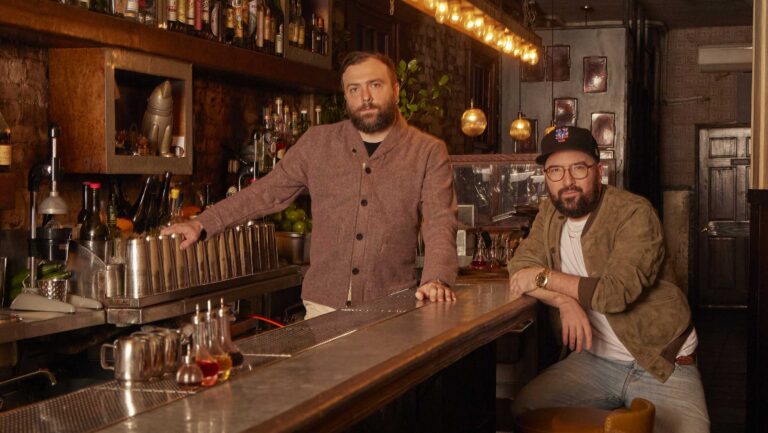
“That’s part of why this has been confusing for us, as prior to the organizing effort, we believed the team was generally happy and engaged,” Ross says. “The bar offers highly competitive earnings, healthcare benefits, significant scheduling flexibility, and opportunities to participate in Attaboy events, takeovers, and guest shifts around the world. The long tenure of many of the employees involved reinforced our belief that they found value in working here.”
Dave Kaplan, the CEO of Gin & Luck and a cofounder of Death & Co., sees the parallels. “It feels similar in that it didn’t seem like it was about pay or benefits,” he says. “All of our full- and part-time employees receive healthcare and have for many years. We’ve always tried to be on the leading edge of pay.”
For employees who voted against Attaboy’s union drive, meanwhile, the current workplace has not been a happy one. “The team’s dynamic has shifted, and while nothing has actually changed, there’s an air of uncertainty,” says Spikes Colby, who worked with Ross at Temple Bar for almost five years before joining Attaboy’s team at the end of 2025. “I personally feel uneasy and have noticed the relationship between coworkers—employees to management and ownership—is strained.”
Another anti-union employee who spoke on the condition of anonymity to avoid workplace strife said that while there were some tweaks that could be made, employees were treated fairly and compensated well, and they didn’t see the need to unionize. This employee now feels unheard and unrepresented while dealing with the consequences. “No one has asked for our thoughts,” they say. “No one has mentioned the fact that we are now part of this whether we like it or not. That’s a tough position to be in.”
Gelnaw-Rubin acknowledges that while the vote was not unanimous, delivering positive outcomes to everyone is the goal. “We are all still friends and coworkers, and now we are all union siblings,” he says. “What is important now is that we are building the organizational structure of the union to be as fair as possible and to represent the interests of all the members in a democratic way. A majority of workers voted for the union, and a majority want the union to succeed.”
Along the way, much of the nitty-gritty has played out in sometimes ugly fashion across social media, and it seems that people on each side have only dug in their heels further. “The division line for the bar unionization debate doesn’t appear to be cultural or political as much as it seems generational,” says Jeff White, the head bartender of the forthcoming Tender’s Club in Brooklyn. White, one of the many vocal commenters on social media, has been a bartender in the city since 2017. This issue in particular strikes a nerve for him, as he feels the anti-union crowd includes many of the same people who helped change perceptions of bartending from a backup job to a legitimate career.
“I haven’t heard much of anything from our high-profile bar legends who pioneered bartending as a real job,” says White. “Was it only supposed to be a real job when they were working, or is it just different now that many of them are bar owners? What is the point of an industry that prides itself so much on mentorship if they instead choose to become barriers to progress?”
As of publication, negotiations have not yet begun between Attaboy ownership and Attaboy Local 134. The union has been recognized by the National Labor Relations Board, but it still needs to adopt a constitution and elect its executive board.
Are There Alternative Pathways?
While some hotel bartenders are among the 40,000 members covered by the Hotel and Gaming Trades Council, the vast majority of bars operate as independent businesses. Many in the industry believe that alternative solutions, like industry-wide efforts, would be more viable and offer a greater chance of long-term success.
“I believe unions have played an important and positive role across many industries, but that said, I struggle to understand how unionization functions effectively at the scale of a single bar or small bar group,” says Chad Spangler, a partner in Washington, D.C.’s Service Bar and Causa/Amazonia. “I see more potential value in a broader model that brings together workers across different bars, restaurants, and hospitality businesses.”
Spangler is no stranger to hot-button industry upheaval, operating in the D.C. market which underwent multiple rounds of wages versus tips debates and legislation. “Ultimately, I believe the most productive outcomes come when employees can understand the challenges and realities owners face, and owners can meaningfully understand the perspective and concerns of employees,” he says. “Finding that balance and mutual understanding is important.”
That is the essence of negotiation, of course, and the old adage that a good compromise means that both sides leave a little bit unhappy applies. “Unions are a force for good, but a tiny owner-run bar like Attaboy is not a good test case for this,” says Philip Duff, the director of Liquid Solutions, Ltd. and longtime bar industry consultant. “It makes sense for places of a certain scale, and the key is bargaining in good faith. A business still has to make a profit so workers may not get everything they want, and owners have to accept more power sharing and less profit in service of happier, healthier, and more motivated workers who stay in their posts longer.”
For Libby Lingua, the owner-operator of Highball in Phoenix, who previously worked for larger hospitality groups and the Marriott Autograph Collection brand, this is a nuanced issue. “Having been on both sides of the industry, I can appreciate how challenging it is to operate a small independent business and keep it financially healthy,” Lingua says. “At the same time, I’ve experienced poor management and unhealthy workplace cultures firsthand, and those experiences have certainly shaped how I approach leadership today.”
Lingua’s perspective reflects her multifaceted background in different positions and settings across the industry. “Building a profitable business while also creating an environment where employees feel valued, supported, and fairly compensated is a constant balancing act,” Lingua says. “That said, I’ve always believed that people are the foundation of any hospitality business. Without a strong team, there is no business.”
Can Individual Bar Unions Work?
As industry insiders and the public at large watch Attaboy’s unionization effort unfold, the central question is whether unions at this scale can work for both employees and owners.
Certainly, Attaboy Local 134 believes so. Gelnaw-Rubin stresses that this hasn’t been a fun diversion, and steps to unionize were only taken because the staff supports the bar and wants to make it stronger. “We don’t want different jobs, we want to work at Attaboy because we love the bar, and we feel invested in its legacy,” Gelnaw-Rubin says. “And we want to exercise our agency and our rights as workers to improve it as a workplace so that working there can be sustainable.”
Ross also doesn’t feel like supporting improvements for employees and running a successful business have to be in opposition. “Those are both reasonable goals, and I don’t think they are inherently in conflict,” he says.
Beyond that, as an owner of Attaboy, Ross says his main goal is to maintain its legacy. “Our mentor, former business partner, and beloved friend, Sasha Petraske, gave us more than a business,” he says. “He gave us a responsibility. The space at 134 Eldridge Street is not just four walls and a bar. It is the cradle of a movement that changed cocktail culture around the world. Sasha created something extraordinary and trusted us to carry it forward. Not for a few years. Not until it became difficult. For generations.”
Union organizers argue that the employees furthering that mission deserve treatment that aligns with the bar’s reputation.
Another question is whether Attaboy’s vote will encourage more workers of independent bars to pursue union drives. “At this point, I do not necessarily foresee a widespread wave of unionization among bars,” Spangler says. “My view is that unionization is likely to have greater impact when approached more broadly across the industry rather than on an isolated business-by-business basis.”
Ross, though, believes the singularity of this union effort will cause ripple effects across the industry. “I suspect what happens here will have implications well beyond our own bar,” he says. “Owners are watching. Employees are watching. Hospitality professionals across the country are watching.”
Gelnaw-Rubin sees Attaboy Local 134 as one link in a much larger chain, one that he hopes will continue to expand and strengthen. “The labor movement is ever present,” he says. “Yes, it will continue, and I hope more bars and restaurants get in on it.”
He has been galvanized by support from customers and positive messages received from others in the bar world, though he also acknowledges the criticism and skepticism he has received. The mix of reactions reflects the broader reality that while there are strong opinions and outspoken individuals representing every belief, most people want small businesses and their employees to succeed together.
“Ultimately, this isn’t a story about good people versus bad people,” Ross says. “It’s a conversation about how a small independent business evolves while continuing to support the people who helped build it. We care deeply about our employees. We care deeply about the bar. Our hope is that when this process is over, both are stronger than they were before.”

Dispatch
Sign up for our award-winning newsletter
Don’t miss the latest drinks industry news and insights—delivered to your inbox every week.