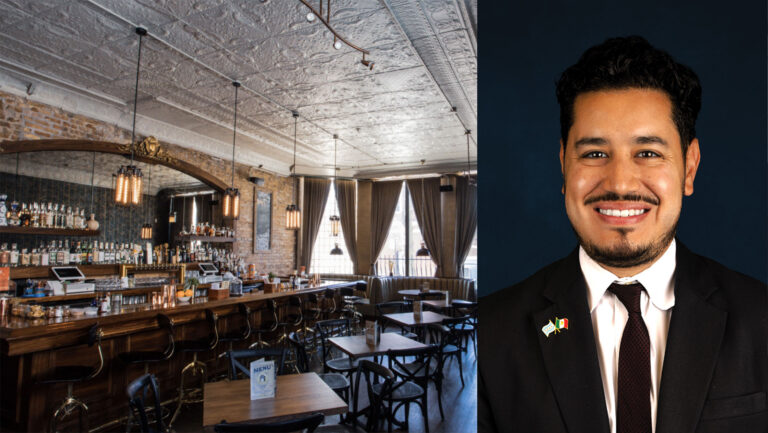
In his 18 years in the bar industry, Mike Hidalgo has been a dishwasher, barback, bartender, beverage director, and manager. He’s risen to prominence, and through his nonprofit Behind the Bar, he’s used his mixology skills to give back to his community. A permanent legal resident of the United States, he currently holds positions at two sister restaurants. He’s never been afraid to hustle.
But, lately, Hidalgo has been working fewer shifts. And, otherwise, he says, “I’m not going out, even just to get a little sunlight with my dog.” It’s not because he doesn’t want to. “Everybody is just going from work to home, home to work. I have legal residency. But I’m still targeted because of my accent and the color of my skin, so it doesn’t mean I’m safe.”
Hidalgo lives in Minneapolis, and for nearly two months, his city has been under siege as part of the anti-immigrant crackdown under President Donald Trump. More than 3,000 agents from Immigration and Customs Enforcement (ICE) and Customs and Border Patrol (CBP) have descended upon this city of just over 400,000, its neighbor St. Paul, and, in an expansion, the entire state—ostensibly, as per a Department of Homeland Security (DHS) press release, to “remove the worst of the worst.”

Don’t miss the latest drinks industry news and insights. Sign up for our award-winning newsletters and get insider intel, resources, and trends delivered to your inbox every week.
In reality, the targets of Operation Metro Surge have not been “criminal illegal aliens who were killing Americans, hurting children, and reigning terror,” as DHS claims, but everyday residents like Hidalgo and tens of thousands of Minnesotans who are protesting the federal assault daily. Over 3,000 people have been detained, including children, and an entire city is being terrorized. ICE has killed at least two people in Minneapolis, both white U.S. citizens seeking to protect their brown neighbors on the streets. This is in addition to at least six others nationwide who have died in ICE facilities or in confrontations with ICE officers this year.
“It’s like—como se dice—the militia,” says Hidalgo. “I moved from Mexico, and I saw violence in the past. This is what it looks like. There are hundreds of cases of people being abducted and beat up. I don’t think this is the American dream anymore.”
Minnesota businesses and their workers are suffering, and the toll is especially high in the hospitality sector, where approximately a third of workers nationwide are immigrants. (The Trump administration acknowledged as much on June 14 of last year when it halted raids against hotels and restaurants, only to resume them three days later.) Minneapolis is seeing the most brutal mobilization thus far, but workers and owners at bars and restaurants in other cities have also been targeted—and new targets are likely still to come. There is fear and true hardship. But there is also community action and courage, as the industry comes together to take care of its own.
“The Economic Impact Has Been Brutal”
“We have created networks of people that are driving, observing, and guarding our spaces in shifts morning and night,” says a prominent Minneapolis restaurateur, who asked to remain anonymous out of fear for their team’s safety. “We moved team members from riskier areas and secured rent-free places for them to live in safer neighborhoods. We’ve filled out DOPAs [Delegation of Parental Authority documents], so we have guardianship for our team’s children in the event that they are taken. One of our employees’ partners was deported, so our babysitters are watching their baby too. It’s worse than what you’re seeing on the news.”
“They’re just taking whoever they want,” confirms Robb Jones, the owner of the bar Meteor. “I work with another restaurant group, and we lost all the cooks in our kitchen, who were just waiting at a bus stop on their way to work.”
SevenFifty Daily spoke with Jones and three members of his leadership team. “Less-targeted white workers are smuggling brown coworkers to and from work in their back seats with blankets thrown over them,” says Tyler Kleinow, Meteor’s general manager. The danger is not just on city streets. Liam Lavandowska, one of Meteor’s head bartenders, reported his parents’ shock when six workers were abducted from three restaurants in the Minnesota suburbs.
In the meantime, Meteor’s staff is at the center of a rapid response network of locals who have organized against ICE, says Lavandowska’s fellow head bartender, Berit Johnson. “All of us are on Signal chats and on patrol when we are not working,” she says. “The thing that’s been keeping my heart up is watching our community rise up together.”
“The more people witnessing and impeding ICE is the safest situation,” says Gabriel Campaña-Blatti, the bar director of Wrecktangle Pizza. He strives to fill locations with staff and guests for safety in numbers. “Friends and neighbors are coming out to show that, while people are afraid, they’re not too afraid to make sure there are protections for local businesses.”
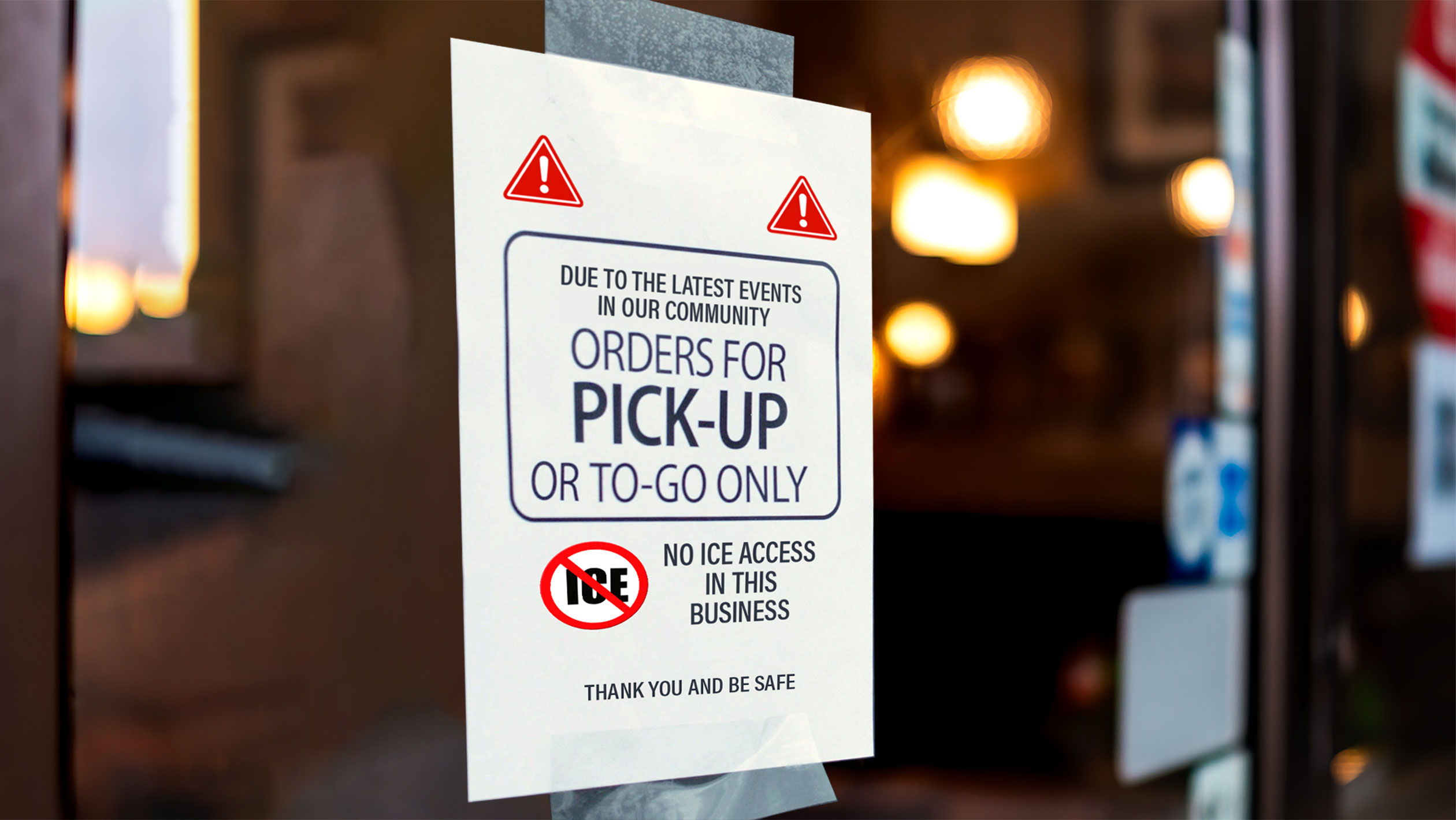
Still, reports Hidalgo, “Businesses have shut down temporarily. Many are only takeout. The ones that still operate in a regular way are locking the doors, and you have to make a reservation.” He’s been working less because, like many owners, his boss cut open times for safety and because no one is going out. “The economic impact has been brutal,” adds Hidalgo.
In Willmar, two hours west of Minneapolis, ICE agents ate at a Mexican restaurant and later returned to arrest the very people who had served them. “That’s an inhumane thing to do, cynical and provocative,” says Hidalgo. It’s why he chose to speak with SevenFifty Daily. “I’m trying to tell my experience as it is because you have the power of projecting voices, so tell the world out there what’s happening up here.”
The economics of the occupation has put owners in a double bind. As part of the resistance, Minneapolis unions and faith leaders led a statewide strike on January 23. Days before, Owamni owner Sean Sherman, a member of the Oglala Lakota Sioux Tribe and the nation’s most prominent Native American leader in hospitality, said, “We are standing down on Friday, but I had mixed feelings because businesses, especially BIPOC businesses, are already being hurt immensely, and just asking people not to work or spend money isn’t helping that. We should be having a BIPOC Friday instead of a stand-down Friday.”
The need to demonstrate leadership at work and, at the same time, in the community has left many owners reeling. “There is no right thing to say or do,” says the anonymous restaurateur. “We don’t want to draw attention to our people, but then the public response is, ‘You’re not speaking up?’ Emotions are so high.”
Campaña-Blatti adds, “Staff looks to management and relies on us, asking, ‘Do you think it’s safe?’ It’s so unclear and chaotic.” At Wrecktangle locations, signage delineates public spaces, where ICE is allowed with an administrative warrant, and private spaces where they are not. Protocols include filming interactions and having only a manager speak with agents, ideally outside the restaurant’s locked doors. “But the agency isn’t caring about its own rules, so it’s a fearful situation.”
In the meantime, U.S. immigration policies have left workers in a dangerous catch-22. Despite Trump administration rhetoric about “illegals,” there is no current path to legal residency, let alone citizenship. “People say, ‘Do it the right way.’ What’s the right way? I know people who’ve been trying to do it the right way for 20-plus years,” says Christian de Leon, the owner of El Sazon and its three offshoots. de Leon has temporarily closed two of his restaurants after ICE was sighted at one and a sous chef, who is a documented legal resident, was stopped by ICE at another. The restaurant group has since started a GoFundMe for staff. “I have families out of work, and I have bills to pay. During the holidays, restaurants hope to make a bit of money, but it didn’t happen because of ICE. People weren’t buying and didn’t go out. Small restaurants and Latino-owned businesses—they’re killing us. If this continues for another month, I don’t know if I’m going to survive.”
“In All Honesty, I Feel Radicalized”
Elsewhere in America, ICE has stormed through cities or is planning to. In Washington, D.C., where ICE was deployed this past summer, one restaurateur, who asked to remain anonymous, reports that several employees were detained. “Most have been deported,” they say. “We have tried writing letters through their attorneys proving their work track record with us, and we’re trying to get final paychecks to people. But it’s tough getting concrete information, and there’s not much we can do. These things are happening at a level that, even as a restaurant group with close to 300 employees, we can’t solve.”
During December’s brief Operation Catahoula Crunch in New Orleans, Ruby, a bartender in the Central Business District who asked to use her first name only, reports that hospitality pros utilized networks developed in the wake of Hurricane Katrina to help with sheltering workers with groceries and transportation. “I never hoped in a million years I would have to mobilize my Mutual aid skills for something other than a natural disaster, but here we are,” she says.
In Chicago, where ICE’s Operation Midway Blitz this past fall was augmented by a National Guard deployment, Mike Moreno, the owner of Osito’s Tap, reports having “daily run-ins” with ICE: Black Hawk helicopters hovering, armored vehicles parading, and agents aiming guns and threatening people. “It was two months of terrorization, and it negatively impacted our bottom line,” he says. “We lost 50 percent of sales.”
The experience left Jason Vincent, the owner of Chicago’s Giant, Pizza Matta, and Chef’s Special Cocktail Bar with “mainlined anger,” he says. “We have several DACA [Deferred Action for Childhood Arrivals] and naturalized people. I cannot begin to put myself in those shoes. In all honesty, I feel radicalized. I feel different.”
Both Moreno and Vincent participated in Todos Ponen, a recent fundraiser that gathered 11 Chicagoland bars and 40 restaurants raising $100,000 for grocery gift cards for 125 families suffering deportations. Co-organizer Marcos Carbajal is the owner of Carnitas Uruapan in Chicago’s Little Village, “a primary point of entry and a center of tourism for people of Mexican heritage in the Midwest,” as he describes it. “So the threat of raids was a double whammy for business owners because we rely on a community that had reduced hours and income.” It is also a locus of resistance. “If ICE goes a couple blocks in, within five minutes they are met with people surrounding them, making it difficult to do their jobs,” adds Carbajal. “We all need to be communicating more than ever as local business owners because we keep each other safe.”
Chicago’s resistance, he says, is based on models developed in Los Angeles, where the National Guard was also federalized to quell protests against DHS’s boasted 10,000 arrests in the second half of 2025. Restaurants and bars there routinely have a button on their POS systems that fires a ticket to the back of house alerting staff that ICE is present.
Industry activists continue to support the community around ongoing detentions. Julio “Jules” Gutierrez has been using his cocktail pop-up, Chuntikis, to support nonprofits like Long Beach’s ÓRALE (Organization Rooted in Abolition, Liberation, and Empowerment). Bar community leader Robert Martinez has been organizing fundraisers for groups like CHIRLA (Coalition for Humane Immigrant Rights) and Unión del Barrio. “Hospitality’s superpower is to funnel money into causes,” he says. Martinez and Gutierrez are collaborating on a panel for this year’s Tales of the Cocktail. “We’re thinking about calling it ‘The Economics of Terror,’” says Martinez. “The rich will push any button to get us to fight with each other to distract us from the fact that they are robbing us blind.”
In the meantime, Los Angeles’s hospitality industry is suffering an “ICE recession,” says Javier Cabral, the editor-in-chief of L.A. Taco, which covers food, drink, and street-level news. “If you’re not directly affected because of your legal status, your morality and your soul and your general excitement to go out and try a new place is affected. It’s hard to compartmentalize and still have a glass of wine or beer. I’m seeing bars here just gasping for air.”
“I’m Sorry, My Tank Is So Empty”
The latest city to suffer the ICE onslaught is Portland, Maine, where Operation Catch of the Day launched on January 22, 2026. At the tapas and cocktail bar Sur Lie, naturalized U.S. citizen workers have missed a week of work, too fearful to leave their homes, says owner Krista Cole. Her beverage director is Puerto Rican, and Cole has told her to carry ID. “It doesn’t make us be our best, and we need to be our best in a city full of creative restaurants and bars,” says Sur Lie chef Sam Helmke. “It’s hard to put on that hat and smile every day when you’re waking up scared.”
Neighbors have turned out to support bars and restaurants, says Ilma Lopez, the owner of Portland’s Ugly Duckling and Chaval. “People have been checking on us,” she says. “‘Are you okay? Do you want me to go grocery shopping for the team? Do you want me to walk you to your car?’” Still, the occupation is taking its mental toll. “You feel like you’re doing something wrong, even though you’re not. This isn’t the America that I moved to 22 years ago. I’m from Venezuela, where there was no freedom of speech, where you couldn’t go out in the streets if you were against the government. I followed the rules to become a U.S. citizen, and you’re telling me that now Americans don’t follow the rules against their own communities?”
Another local restaurateur who asked for anonymity broke down when speaking with SevenFifty Daily. “I’m sorry,” they said. “My tank is so empty.”
As local bar and restaurant owners mobilize to support their communities, some wonder: where is the support from the larger hospitality industry?
“These mobilizations are having a real and destabilizing impact on the well-being of the hospitality industry and the people who make it what it is,” says Charlotte Voisey, the executive director of Tales of the Cocktail Foundation. “In periods of heightened uncertainty, it is critical to underscore the importance of standing together with empathy, care, and shared responsibility.”
Though the United States Bartenders Guild (USBG) has historically been apolitical to accommodate members’ varying perspectives, president Ingrid Shawn Rodriguez issued a statement in late 2025 expressing USBG’s concern about the impact of immigration enforcement activity on the hospitality industry. Last year, USBG started working with the American Business Immigration Council to lobby for legislation to protect immigrant workers and provide a clear path for immigration reform.
“USBG membership is diverse,” says executive director Bo Shuff. “But what we have in common is hospitality and caring for others. I think the vast majority would agree that due process and humane treatment need to occur, regardless of which side of the aisle people align on. The industry has been built on the work of immigrants, and we recognize that as an important component of who our people are and what this industry is.” Bartenders displaced from work can apply for financial support through the USBG’s Bartender Emergency Assistance Program, while Another Round Another Rally offers a grant called Mental Health for Latino Restaurant Workers in Español.
Grassroots initiatives to help immigrant workers also need support from drinks businesses to maintain their momentum. Hidalgo provided a list of Minneapolis groups that are taking donations to support immigrant rights in the city. Former taproom manager Jessica Salas has launched Hasta La Raiz, in which breweries nationwide create specialty beers, donating profits to Freedom for Immigrants. Denver bartender Tiffany Hernandez runs Escuelitas, partnering with immigration lawyers on Know Your Rights and ICE resistance workshops at bars and drinks conferences around the country. Hernandez relies on support from spirits brands. Getting it consistently hasn’t been easy. “I’ve had issues with brands following acquisitions,” she says.
Volans Tequila is one of the sponsors for Escuelitas. “Morally, everybody should be supporting her, and Tiffany has done a great job of cultivating a crowd, so there’s a lot of eyes on her and us,” says Volans ambassador Travis Gale. Volans, however, is independently produced in Mexico. “Most brands are owned by larger companies that can’t position themselves to speak,” adds Gale. “It would break their business and their shareholders.”
That is immaterial to Minneapolis bar owners like Robb Jones. He has a message for brands and suppliers of Central American and Mexican spirits: “If you’re not being vocal about this, if you’re making money off these people, celebrating their heritage, and not actually doing anything to support these people when they are here, then we’re not buying from you.”
Since SevenFifty Daily spoke to Jones, outrage over the killing of Veterans Administration nurse Alex Pretti has pressured the Trump administration to remove acting ICE director Gregory Bovino, but Operations Metro Surge and Catch of the Day continue. For Sean Sherman, such government-perpetrated terror is not new. “If you’re Black or Indigenous in America, this is the police state that we’ve been living in since America’s formation,” he says. Minneapolis’s ICE prison, where at least four members of the Oglala Sioux Tribe have been detained, is at Fort Snelling, a concentration camp for Native Americans during the 1862 U.S.-Dakota War.
And, yet, “things are definitely worse now,” says Sherman, who drafted an open letter to congress for industry members to sign that demands changes to federal immigration enforcement. “This has massive implications of what’s to come everywhere if it isn’t checked. We cannot let this be our new normal, no matter what we do. Everybody has to speak out against it in whatever capacity that they have.”

Dispatch
Sign up for our award-winning newsletter
Don’t miss the latest drinks industry news and insights—delivered to your inbox every week.
Betsy Andrews is an award-winning journalist and poet and the co-author of Coastal: 130 Recipes from a California Road Trip. Her writing can be found at betsyandrews.contently.com.